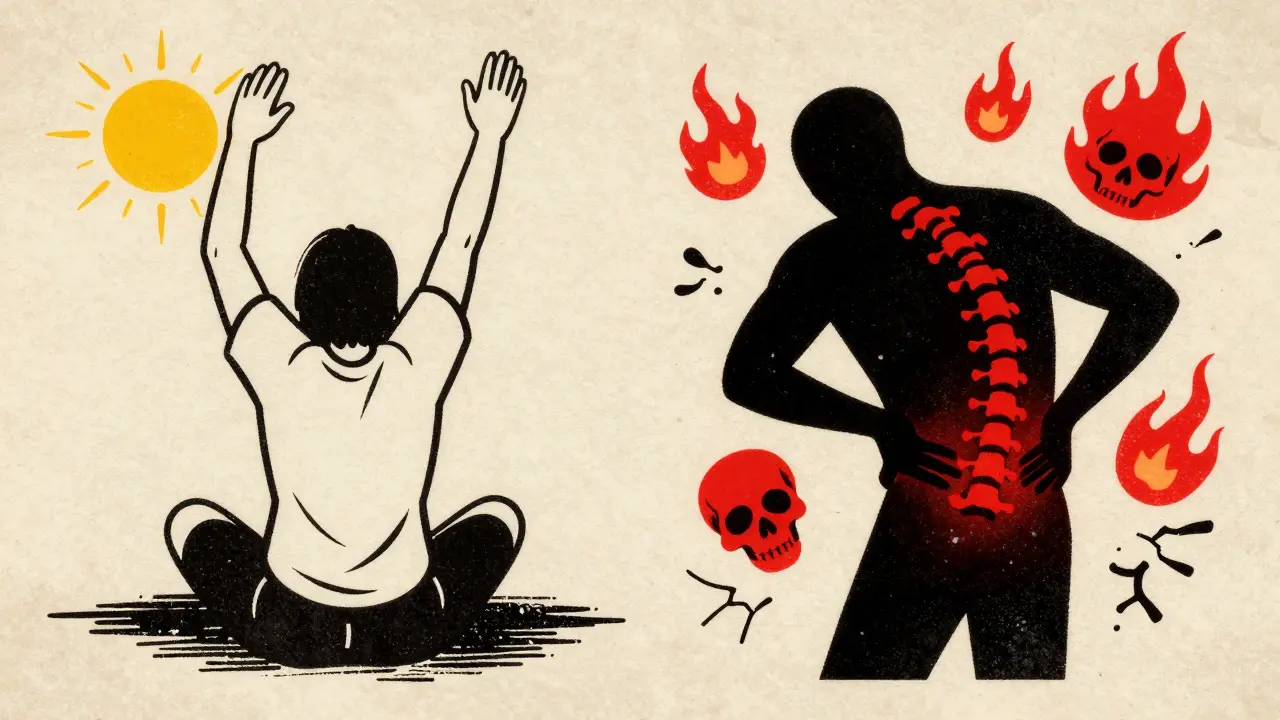
Most people will experience back pain at some point in their lives. For many, it comes and goes like a bad weather pattern-annoying, uncomfortable, but gone in a few days. But sometimes, back pain isn’t just a muscle strain. It can be a warning sign of something serious. Knowing the back pain red flags can mean the difference between a simple rest and a life-changing diagnosis.
What Are Back Pain Red Flags?
Red flags aren’t just vague symptoms. They’re specific clinical cues that point to potentially dangerous conditions like spinal infections, tumors, fractures, or nerve damage. The American College of Physicians, the American College of Emergency Physicians, and other major medical groups agree: if you have one or more of these signs, you need more than ibuprofen and a heating pad.Here’s the hard truth: 90% of back pain cases are harmless. They’re caused by lifted boxes, bad posture, or sleeping wrong. But the other 10%? That’s where things get dangerous. Missing a spinal infection or a fracture can lead to permanent nerve damage, paralysis, or even death. That’s why doctors don’t just order scans for every ache-they look for the red flags first.
Red Flags That Can’t Be Ignored
- History of cancer - If you’ve had cancer before, especially breast, lung, or prostate, any new back pain needs evaluation. Cancer can spread to the spine, and early detection matters. Studies show patients with a prior cancer diagnosis who develop back pain have a 6.4 to 15.3 times higher chance of spinal metastasis.
- Unexplained weight loss - Losing weight without trying, especially if you’re not dieting or exercising more, can signal cancer or chronic infection. When paired with back pain, it’s a major red flag.
- Fever or chills - Back pain with a fever isn’t just a flu. It’s a classic sign of spinal infection (osteomyelitis or discitis). One study found 67% of spinal infection cases included fever, compared to only 5% of mechanical back pain cases.
- Recent trauma or fall - A car crash, a bad slip, or even a simple fall from standing height can fracture a vertebra, especially in older adults or people on steroids. After age 50, the risk of fracture jumps sharply. CT scans detect fractures in 98% of cases, while X-rays miss nearly a third.
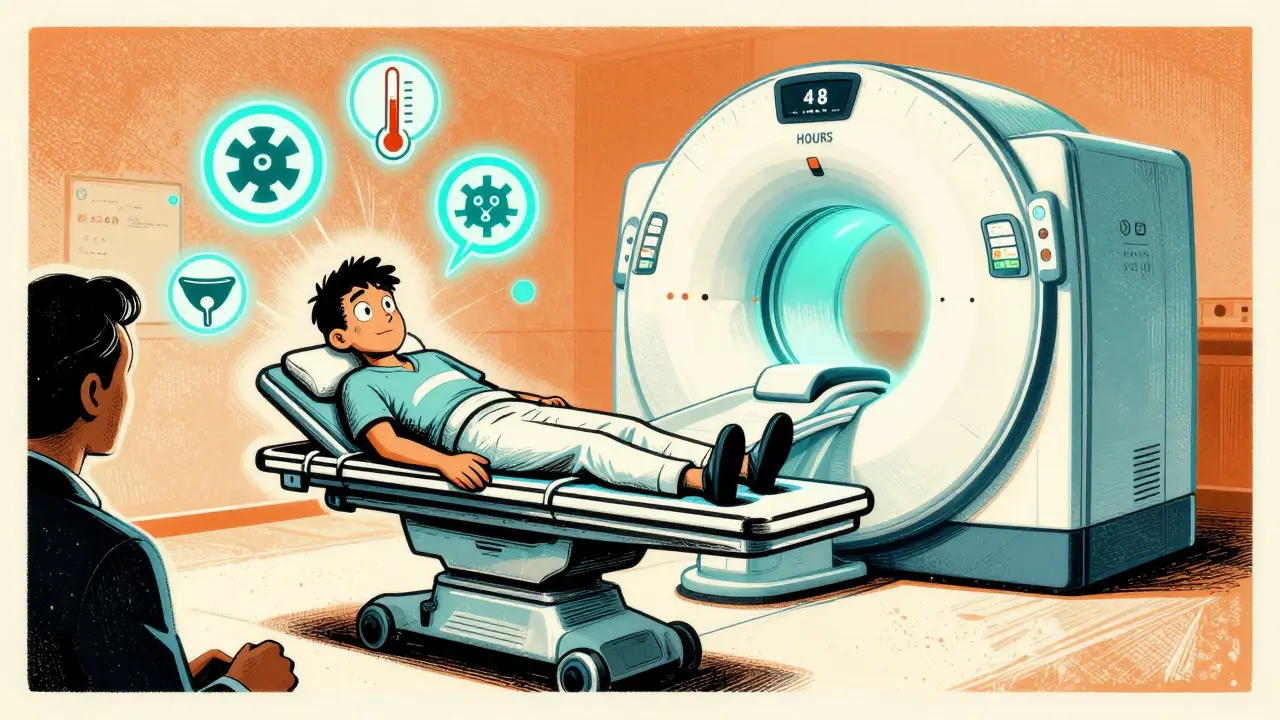
- Loss of bowel or bladder control - This is the most urgent red flag. If you can’t hold your pee or poop, or feel numbness around your genitals, you may have cauda equina syndrome. This is a surgical emergency. Delaying treatment beyond 48 hours can cause permanent incontinence or paralysis.
- Progressive weakness or numbness - If your leg is getting weaker, or your foot keeps dropping when you walk, nerves in your spine are being compressed. This isn’t sciatica that will resolve on its own. It could be a herniated disc pressing on the spinal cord or a tumor.
- Pain that doesn’t improve with rest - Most muscle-related back pain gets better with rest, ice, or over-the-counter meds. If your pain stays sharp, constant, or wakes you up at night, it’s not just soreness. A 2019 study showed 78% of patients with spinal infection had pain that didn’t respond to painkillers.
- Age under 18 or over 50 - Back pain in kids is rare and often signals something serious. In older adults, even minor pain can mean a fracture. People over 70 with back pain have a 36.5% chance of having a vertebral compression fracture, compared to just 9.1% in those under 50.
- Long-term steroid use or osteoporosis - Steroids weaken bones. Osteoporosis makes them brittle. If you’re on prednisone or have been diagnosed with bone loss, any new back pain needs an X-ray or CT scan to rule out a fracture.
When Should You Get Imaging?
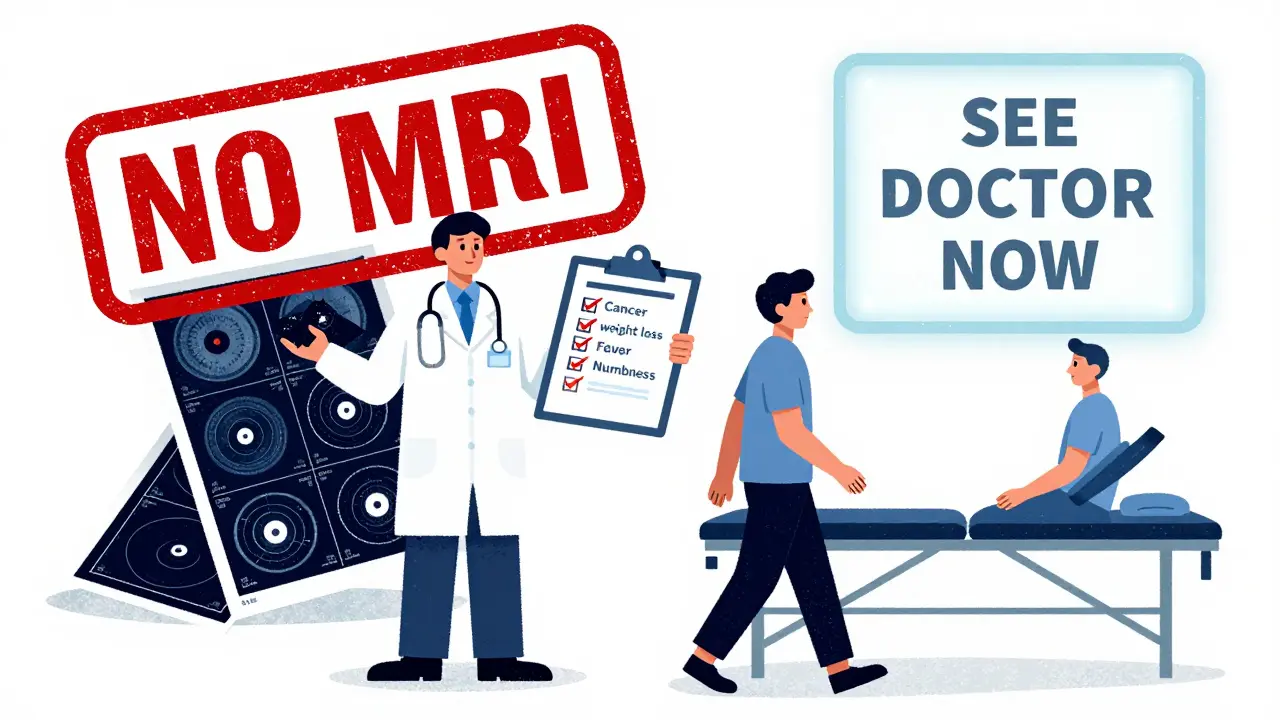
Imaging isn’t a cure. It’s a tool. And using it too early does more harm than good. A 2020 review of over a million patients found that 34% of back pain scans were unnecessary-meaning they were done without red flags, and didn’t change the outcome.So when is imaging actually needed?
- For suspected infection or tumor - MRI is the gold standard. It shows soft tissue, bone marrow, and nerves better than anything else. CT scans are good for bones, but miss early infections.
- For suspected fracture - X-rays are a first step, but if you’re over 50 or on steroids, go straight to CT. X-rays miss up to 36% of fractures in older adults.
- For cauda equina syndrome - MRI must be done within hours. Delaying it increases the risk of permanent nerve damage.
- For persistent pain beyond 4-6 weeks - If conservative care (rest, physical therapy, meds) hasn’t helped, imaging may be warranted. A 2018 study found patients with no improvement after four weeks were nearly 20 times more likely to need surgery.
Plain X-rays? They’re rarely useful for routine back pain. They can’t show discs, nerves, or early infections. They’re only helpful for checking bone alignment or known fractures.
When to Refer-Not Just to a Doctor, But to the Right Specialist
Not all back pain needs a specialist. But red flags demand one.- Emergency room - Go immediately if you have loss of bowel/bladder control, sudden leg weakness, or severe pain with fever. These aren’t “wait-and-see” situations.
- Neurologist or spine surgeon - If you have numbness, tingling, or weakness that’s getting worse, you need a specialist who understands nerve compression. They’ll decide if you need surgery or targeted treatment.
- Primary care or rheumatologist - For unexplained weight loss, night pain, or a history of cancer, your doctor may order blood tests (like ESR or CRP) and refer you to oncology or infectious disease.
- Physical therapist - If you have no red flags, physical therapy is often more effective than imaging. But if you have red flags, PT is not the first step-it’s a distraction.
Here’s the scary part: 12% of malpractice cases involving back pain are due to missed diagnoses. That’s not because doctors are careless. It’s because red flags are easy to overlook-especially if the patient says, “It’s just a pulled muscle.”
Why So Many People Get Scanned for Nothing
It’s not just doctors. Patients ask for scans. Insurance sometimes pays for them. And in a hurry, it’s easier to order an MRI than explain why it’s not needed.But here’s what happens when you scan without reason:
- You find “abnormalities” that aren’t causing pain-like disc degeneration in a 65-year-old with no symptoms. In fact, 79% of asymptomatic 80-year-olds have degenerated discs on MRI.
- You get stuck in a cycle of more tests, more visits, more anxiety.
- You pay more. A single unnecessary MRI can cost $1,200-$3,000. In the U.S., over $3 billion is spent yearly on useless back pain imaging.
- You risk unnecessary surgery. One study showed that patients who had early imaging were 3 times more likely to have surgery-even when their pain was mild and non-specific.
That’s why guidelines say: don’t image unless there’s a red flag. The Choosing Wisely campaign, backed by over 100 medical groups, lists “avoid imaging for low back pain without red flags” as one of its top recommendations.
What’s Changing in 2026?
The old red flag system is being updated. Instead of just checking boxes, doctors are starting to use risk scores like the STarT Back Tool, which combines symptoms, mental health, and physical findings to predict who’s at risk for serious problems. Early results show it’s 83% accurate at spotting trouble.Another breakthrough? Point-of-care ultrasound. Emergency rooms are now using handheld ultrasound to check for bladder distension-something that can hint at cauda equina syndrome without waiting hours for an MRI. One 2022 study found it was 92% accurate.
And soon, blood tests might help. The INTEGRATE trial is testing whether high levels of CRP and ESR (markers of inflammation) can help identify spinal infections faster. Right now, it takes an average of 18.7 days to diagnose spinal infection. That’s too long.
What Should You Do If You Have Back Pain?
- Don’t panic. Most back pain is not serious.
- Do track your symptoms. Note when it started, what makes it better or worse, and if you have any other symptoms like fever, numbness, or weakness.
- If you have any red flags listed above, don’t wait. See a doctor within 24-48 hours.
- If you have no red flags, try rest, gentle movement, and OTC pain relief for 4-6 weeks. Physical therapy often helps more than scans.
- Don’t pressure your doctor for an MRI. Ask: “Could this be something serious? Do I have any red flags?”
Back pain is common. But ignoring warning signs isn’t bravery-it’s risk. The goal isn’t to scare you. It’s to help you act at the right time-before it’s too late.
What are the most dangerous back pain red flags?
The most urgent red flags are loss of bowel or bladder control, sudden leg weakness, and back pain with fever. These can signal cauda equina syndrome or spinal infection-both require emergency treatment within 48 hours to prevent permanent damage.
Should I get an MRI for my back pain?
Only if you have red flags like cancer history, unexplained weight loss, fever, or neurological symptoms. For most people with simple back pain, MRI won’t help and can lead to unnecessary treatments. Guidelines recommend waiting 4-6 weeks of conservative care before imaging.
Can back pain be a sign of cancer?
Yes, especially if you have a history of cancer, unexplained weight loss, or pain that worsens at night. Cancer can spread to the spine, and early detection improves outcomes. If you’re over 50 and have new back pain with these signs, ask your doctor about imaging.
Is it normal for back pain to last more than a month?
Not if it’s just a muscle strain. Most acute back pain improves in 2-4 weeks. If it’s still bothering you after a month, especially with no improvement from rest or therapy, it could signal a structural issue like a herniated disc, spinal stenosis, or infection. That’s when you need evaluation.
Do I need to see a specialist for back pain?
Only if you have red flags or if your pain doesn’t improve after 4-6 weeks of conservative care. For most people, a primary care doctor or physical therapist is enough. But if you have numbness, weakness, or bowel/bladder changes, see a neurologist or spine surgeon right away.
Why do doctors avoid ordering X-rays or MRIs for back pain?
Because most back pain is not caused by structural problems visible on scans. Imaging often shows “abnormalities” like disc degeneration that are normal with age and unrelated to pain. Unnecessary scans lead to false alarms, anxiety, and risky treatments. Guidelines recommend saving imaging for cases with clear red flags.
Can physical therapy help if I have red flags?
No-if you have red flags like neurological symptoms, fever, or trauma, physical therapy should not be the first step. It can delay diagnosis and worsen outcomes. Red flags require medical evaluation first. Once serious conditions are ruled out, PT can help with recovery.
Next Steps: What to Do Today
- If you’re currently in pain: write down your symptoms. Note any red flags.
- If you have no red flags: give it 4-6 weeks with rest, light walking, and OTC pain relief.
- If you have one or more red flags: call your doctor today. Don’t wait for it to get worse.
- If you’ve had imaging and were told “nothing’s wrong” but still hurt: ask about the STarT Back tool or a second opinion.
Back pain doesn’t always mean you need a scan. But if you have the right warning signs, you need action-fast. Know the red flags. Trust your body. And don’t let fear or hesitation keep you from getting the care you need.
15 Comments
Rosalee VannessJanuary 12, 2026 AT 18:49
God, I wish I’d read this five years ago. I had back pain for months, thought it was just from hauling groceries, and kept pushing through. Turns out? A herniated disc pressing on my sciatic nerve. No red flags? I had three: night pain, leg weakness, and it didn’t budge with ibuprofen. I was lucky I didn’t end up in a wheelchair. This post saved me from becoming a statistic. Thank you.
Now I tell every friend who says ‘it’s just a pulled muscle’ to read this. No joke. This is the kind of info that should be in every doctor’s waiting room.
Also-please don’t let your doctor brush you off because you’re ‘too young’ or ‘not fat enough.’ Pain doesn’t care about your BMI or your age. It just wants to be heard.
I’m 34. I’ve never smoked. I do yoga. I eat kale. And still, my spine betrayed me. Don’t assume your body’s ‘supposed’ to handle it. Some things just need a scan, not a pep talk.
And yes, I cried reading the part about cauda equina. Not because I had it-but because I almost missed it. That’s how sneaky this stuff is.
So if you’re reading this and you’re in pain? Write down your symptoms. Don’t trust your memory. Don’t Google it. Don’t wait for ‘it to get worse.’ Trust the red flags. They’re there for a reason.
I’m not a doctor. But I’m someone who learned the hard way. And I’m still healing. But at least I’m alive to tell you this.
Be kind to your spine. It’s the only one you’ve got.
mike swinchoskiJanuary 13, 2026 AT 10:37
You people are so dumb. If you have back pain, just get an MRI. Why wait? You think doctors know what they’re doing? They’re just trying to save money. I had pain for a week and got an MRI. Found a tumor. Saved my life. Everyone else is just scared of the truth.
Angel Tiestos lopezJanuary 15, 2026 AT 08:45
brooooooo 🤯
back pain isn’t just pain-it’s your spine screaming for help in a language we’ve forgotten how to listen to.
we live in a world where we scan our phones 200x a day but ignore the screaming bones in our backs like they’re just background noise.
and yeah, 79% of 80-year-olds have degenerated discs on MRI? bro. that’s like saying 79% of people have wrinkles. does that mean wrinkles = pain? no. it means we’re looking at the wrong thing.
also-cauda equina? that’s not a syndrome. that’s your spine whispering ‘i’m done’ and then screaming ‘HELP ME’ in 10 languages at once.
we need more of this. not more scans. more awareness.
also i’m gonna go stretch now. 🙏🫶
Acacia HendrixJanuary 15, 2026 AT 08:59
It’s frankly disingenuous to frame this as a binary between ‘red flags’ and ‘just a pulled muscle.’ The clinical literature, particularly the 2021 Cochrane Review on non-specific low back pain, demonstrates that the sensitivity and specificity of current red flag criteria are suboptimal, with NPV hovering around 80%-meaning nearly 1 in 5 serious pathologies are missed.
Moreover, the STarT Back Tool, while promising, is not validated for acute presentations and suffers from significant cultural bias in its risk stratification algorithms. The reliance on self-reported symptoms without objective biomarkers is a relic of the biopsychosocial model’s overreach.
Until we have validated proteomic markers or AI-driven gait analysis integrated into primary care, we’re still flying blind. And yes-I’ve seen patients with normal MRIs and elevated CRP who were discharged with NSAIDs… and ended up with septic discitis.
So no, I don’t trust the guidelines. I trust the data. And the data says we’re under-investigating.
James CastnerJanuary 17, 2026 AT 04:44
Let me say this with the utmost clarity and respect for human dignity: the human body is not a machine to be fixed with a scan. It is a living, breathing, evolving system that communicates through pain, fatigue, and imbalance. When we reduce back pain to a checklist of red flags, we strip away the sacredness of the patient’s lived experience.
Yes, cancer spreads to the spine. Yes, infections lurk. Yes, fractures occur. But let us not forget that every single one of these conditions begins with a person-someone who woke up in pain, who hesitated to call the doctor, who thought, ‘Maybe it’s just stress.’
And that hesitation? That’s not ignorance. That’s fear. Fear of the system. Fear of cost. Fear of being labeled ‘hypochondriac.’
So while I honor the science behind these red flags, I honor the silence of the patient who never spoke up even more.
We need compassion before we need CT scans. We need listening before we need MRIs. We need doctors who sit down, look into eyes, and say, ‘I hear you.’
Because sometimes, the most dangerous red flag isn’t in the spine.
It’s in the system.
Adam RiveraJanuary 19, 2026 AT 03:27
Yo this is legit. I’m a paramedic and I’ve seen way too many people wait until they can’t walk. One guy thought his back pain was ‘just from lifting his dog’-turned out he had a spinal tumor the size of a lemon. He’s in a wheelchair now.
Just tell your people: if it feels wrong, it probably is. Don’t be the guy who says ‘I’ll deal with it tomorrow.’ Tomorrow might be too late.
Also-physical therapy? Great. But only after you rule out the scary stuff. Don’t do PT and then find out you had an infection. That’s not healing. That’s playing Russian roulette with your spine.
Damario BrownJanuary 19, 2026 AT 10:42
lol so now we’re supposed to panic every time we bend over? i got back pain every time i sneeze and i’m 28. according to this, i should be in the er. what a joke. you people turn every ache into a death sentence. i’ve got 3 kids, a 9-5, and a cat that sits on my spine. guess what? i’m not getting an mri. i’m getting coffee. and maybe a nap.
also-‘loss of bowel control’? bro. i had diarrhea last week. that’s not cauda equina. that’s tacos. jesus.
Robin WilliamsJanuary 21, 2026 AT 07:49
man i used to think back pain was just part of being alive.
then i had a night where i couldn’t feel my left foot. just… gone. like it was disconnected.
i thought it was a pinched nerve. i waited 3 days.
turns out? herniated disc. nerve was squished like a bug.
got the mri. got surgery. got my foot back.
but if i’d waited another week? might’ve been permanent.
so if you feel numbness? don’t google it. don’t wait. go. now.
your foot doesn’t care if you’re busy.
neither does your spine.
Randall LittleJanuary 21, 2026 AT 23:00
Interesting how the article conveniently omits that 85% of ‘red flags’ are false positives in patients under 40 with no history of cancer. Also, the STarT Back Tool was developed in the UK using a population with higher rates of depression and lower access to care-so applying it to American patients is like using a snow shovel to clear a desert.
And let’s not forget: the Choosing Wisely campaign is funded by insurance companies who save $200 million a year by denying MRIs.
So who really benefits from ‘avoiding imaging’? The patient? Or the balance sheet?
Also-why is ‘age over 50’ a red flag? Are we ageist now? Or is it just that we don’t want to pay for scans for seniors?
Just saying. The ‘science’ here smells like cost-cutting dressed up as caution.
lucy cookeJanuary 22, 2026 AT 18:11
Oh. My. GOD.
I just read this and I’m sobbing into my organic lavender tea.
Back pain is not just physical-it’s existential. It’s the body screaming that you’ve been living out of alignment with your soul.
I had a spinal infection after a yoga retreat in Bali-yes, really. I thought it was ‘energy blockage.’ I didn’t go to the doctor for 10 days. I did chakra balancing. I drank turmeric moonwater.
Turns out, I had discitis. I spent three weeks in the hospital. My spine is permanently scarred.
And now? I meditate every morning. I journal. I hug trees. And I never ignore pain again.
Because pain is not a symptom.
It’s a spiritual wake-up call.
Thank you for this sacred text. I’m sharing it with my coven.
John TranJanuary 23, 2026 AT 07:57
so i’ve been reading this like 3 times and i’m still confused. like, if i’m 45 and i lift a box and my back hurts, do i get an mri? or do i wait 6 weeks? what if i’m on prednisone for my eczema? do i need to call the er? or just text my cousin who’s a nurse? and what if i’m too scared to go to the doctor because i don’t have insurance?
also-can i get a refund for all the mris i’ve had that didn’t help?
also also-why does every doctor say something different?
why is this so hard?
i just want to sit down without crying.
Clay .HaeberJanuary 24, 2026 AT 21:58
Wow. So let me get this straight. If I’m 52, have a little back pain, and once had a mole removed, I’m supposed to panic? What’s next? ‘If you’ve ever eaten a hot dog, get a spine MRI.’
And ‘unexplained weight loss’? I lost 8 lbs because I stopped eating carbs. Not cancer. Just keto.
This is fearmongering dressed in white coats. I’ve got a 12-year-old MRI that shows ‘degenerative changes.’ That’s not a diagnosis. That’s a birth certificate for aging.
Also-why is ‘age over 50’ a red flag? Is my spine supposed to be made of titanium? I’m not a teenager. I’m not a superhero. I’m a person who’s lived. And now my body’s showing it.
So no. I’m not getting scanned. I’m getting a new mattress.
Priyanka KumariJanuary 26, 2026 AT 15:15
This is such an important post. I’m a physiotherapist in India, and so many patients come in with severe pain because they waited too long. One lady had cauda equina for 12 days because she thought it was ‘women’s problem’ and didn’t want to bother her husband. She lost bladder control.
We need to spread this awareness in villages, not just cities. Maybe translate this into Hindi, Tamil, Bengali?
And yes-physical therapy is powerful, but only after ruling out danger. I always ask: ‘Did you lose control? Fever? Weight loss?’ If yes-I send them to the hospital immediately.
Thank you for writing this. I’ll share it with my students tomorrow.
Avneet SinghJanuary 28, 2026 AT 06:19
While the red flag framework is theoretically sound, its clinical utility is undermined by low inter-rater reliability among primary care providers, as demonstrated in the 2020 JAMA Network Open meta-analysis. Furthermore, the exclusion of psychosocial modifiers (e.g., catastrophizing, fear-avoidance behavior) renders the algorithm incomplete. The emphasis on imaging as a diagnostic endpoint reflects a biomedical reductionism that ignores the biopsychosocial model’s foundational tenets.
Additionally, the STarT Back Tool’s predictive accuracy is contingent upon culturally homogenous populations-its application in diverse socioeconomic contexts remains unvalidated. Until we address these epistemological flaws, we risk misclassifying patients and perpetuating healthcare inequities.
James CastnerJanuary 28, 2026 AT 14:22
To the person who said ‘I’m just going to get a new mattress’-I hear you. And I respect you.
But let me ask you this: if your child woke up with a limp and said ‘it’s just a sore leg,’ would you wait for the pain to go away? Or would you take them to the doctor?
Our bodies aren’t machines. But they’re not just ‘old’ either. They’re sacred. They carry us. They hold our memories. They’ve been through wars, heartbreaks, births, and late-night shifts.
So if your spine is whispering-don’t turn up the music.
Listen.
Because sometimes, the loudest scream is the one you ignore.
And sometimes, the difference between walking and wheeling is one phone call.
Be gentle. Be brave. And don’t wait.