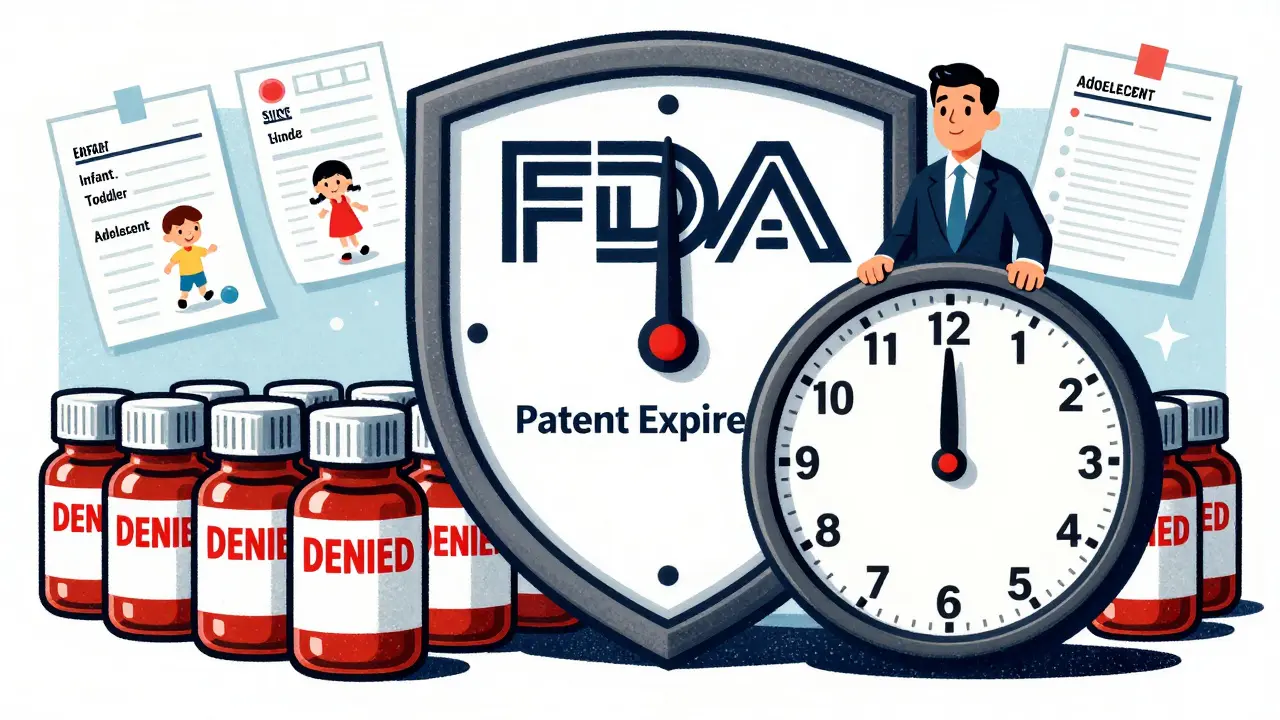
When a pharmaceutical company develops a new drug for adults, it doesn’t automatically mean that drug is safe or effective for children. For decades, doctors had to guess how to dose medications for kids because there was almost no clinical data. That changed when the FDA created pediatric exclusivity - a powerful tool that gives drug makers an extra six months of market protection, not by extending their patents, but by blocking generic competitors from entering the market.
What Pediatric Exclusivity Actually Does
Pediatric exclusivity isn’t a patent extension. It’s a regulatory delay. The FDA doesn’t change the patent’s expiration date. Instead, it refuses to approve any generic version of the drug - even if the patent has already expired - for six months. This means that if a drug’s patent runs out on January 1, 2026, but the company earned pediatric exclusivity, no generic can launch until July 1, 2026.
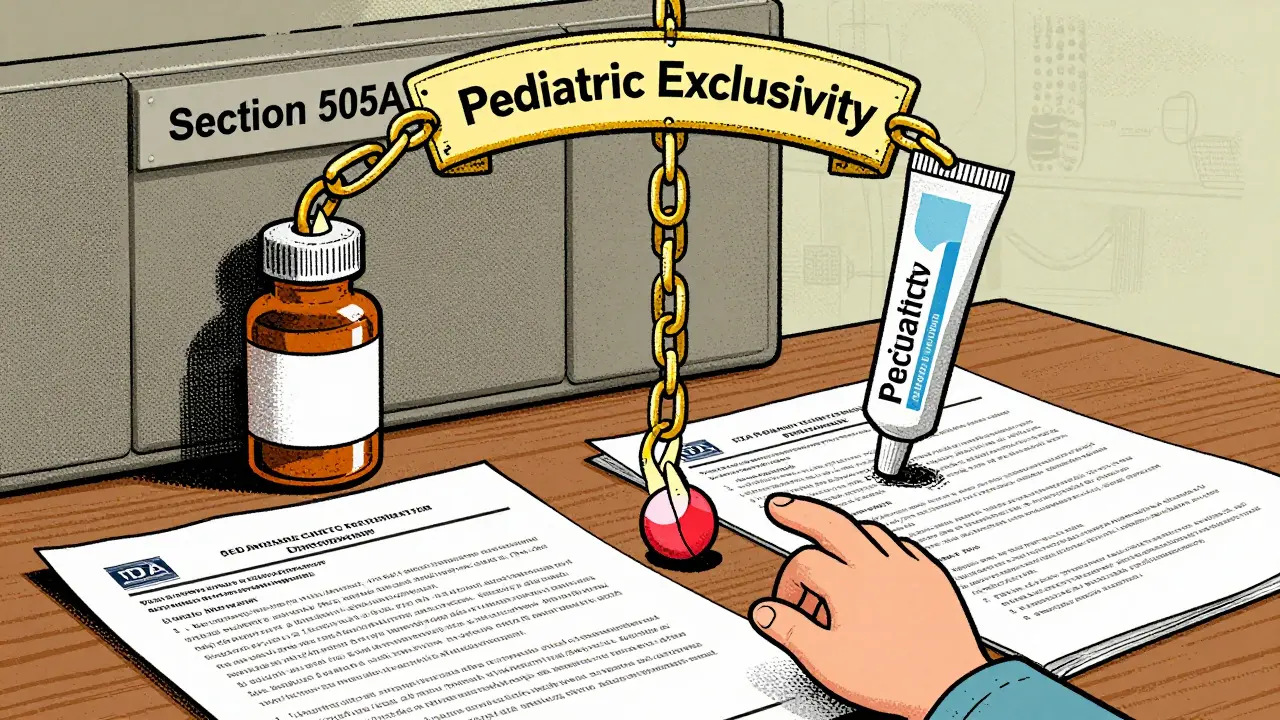
This system was created under Section 505A of the Federal Food, Drug, and Cosmetic Act, made permanent by the Best Pharmaceuticals for Children Act in 2002. Before this law, manufacturers had little incentive to study drugs in children. Why spend millions on pediatric trials when you could just sell the adult version and let doctors use it off-label? The FDA changed that by offering a financial reward: six months of market exclusivity.
How It Works: The Written Request System
The FDA doesn’t just hand out pediatric exclusivity. Companies must earn it. The process starts with a Written Request - a formal document from the FDA that outlines exactly what studies are needed. These aren’t random tests. They’re specific, scientifically sound studies on how the drug behaves in children of different ages: infants, toddlers, adolescents.
The drug maker then conducts those studies, submits the results to the FDA, and waits. The FDA has 180 days to review whether the studies met the request. If they did, the six-month exclusivity kicks in. Importantly, the FDA doesn’t require changes to the drug’s label to grant exclusivity. It’s enough that the studies were done correctly and submitted properly.
It Applies to Everything - Even After Patents Expire
One of the most powerful features of pediatric exclusivity is how broadly it applies. If a company has multiple versions of the same drug - say, a pill, a liquid, and a cream - and they conduct pediatric studies on one, the six-month delay covers all forms and all uses. That’s true even if the patent on one version has already expired.
For example, imagine a drug with a patent that expired in 2024. Without pediatric exclusivity, generics could have launched immediately. But if the company did the required pediatric studies, the FDA blocks all generic versions - including those for the expired-patent formulation - for six more months. This is why pediatric exclusivity is often called "ironclad." It doesn’t care if the patent is gone. It cares if the studies were done.
It Can Extend Other Types of Exclusivity Too
Pediatric exclusivity doesn’t just attach to patents. It can also extend other types of market protections:
- Five-year new chemical entity (NCE) exclusivity - for brand-new drugs with no prior history
- Three-year exclusivity - for new uses or formulations that require new clinical data
- Orphan drug exclusivity - for drugs treating rare diseases
There’s one catch: the underlying exclusivity must have at least nine months left. If a drug’s five-year exclusivity is down to just three months, adding six months of pediatric exclusivity brings it to nine. But if only six months remain, the pediatric exclusivity won’t apply. The law is strict about this.
Why It Matters for Generic Drug Makers
For companies trying to launch generic drugs, pediatric exclusivity is a major hurdle. Even if they win a patent lawsuit (a Paragraph IV challenge), the FDA still can’t approve their product during the exclusivity period - unless the brand company waives it or a court rules the exclusivity doesn’t apply. In one key case, Apotex won a patent challenge, but the FDA still blocked their drug because pediatric exclusivity was still active. The courts backed the FDA’s position: Congress intended this protection to be absolute.
That’s why generic manufacturers watch pediatric exclusivity dates as closely as patent expirations. A six-month delay can cost them hundreds of millions in sales. Some even try to time their filings so they’re ready to launch the day after exclusivity ends. Others seek waivers from the brand company - but those are rare. Why would a company give up six months of monopoly profits?
What It Doesn’t Cover
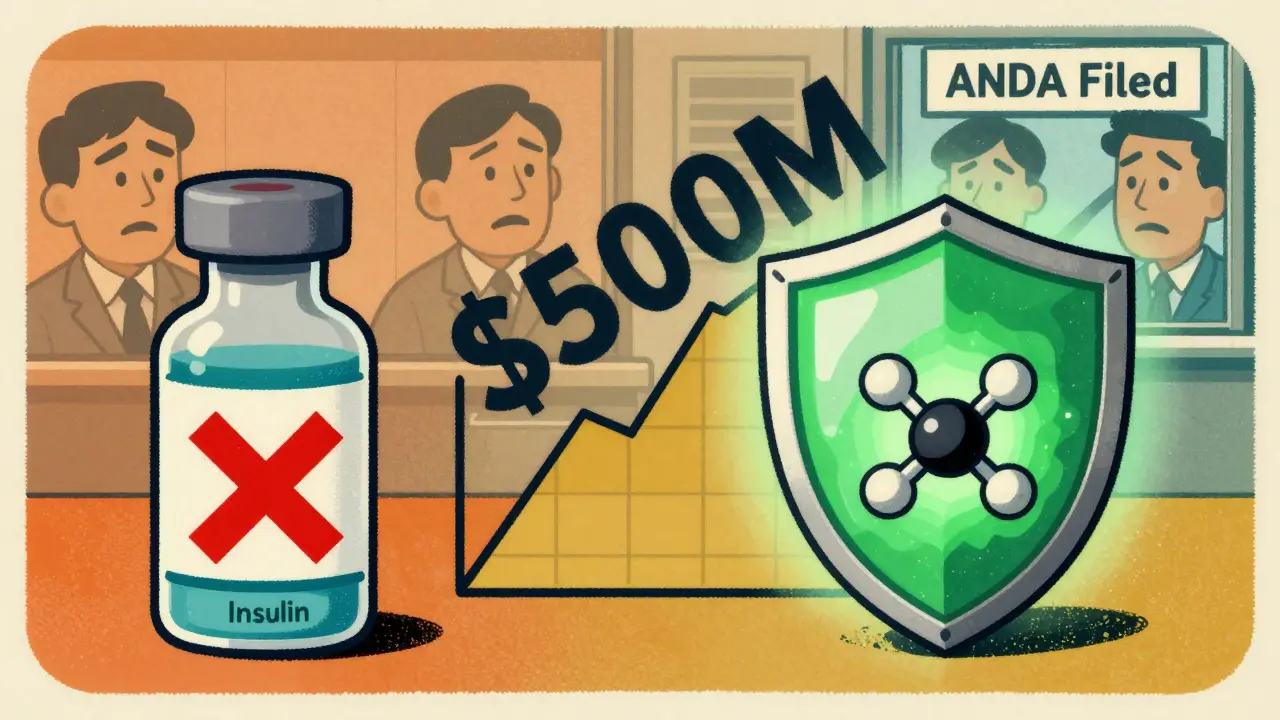
Pediatric exclusivity only applies to small-molecule drugs - not biologics. Biologics (like insulin, monoclonal antibodies, or vaccines) are regulated under a different law (the BPCIA), and their approval process doesn’t include patent linkage. So even if a biologic company does pediatric studies, they don’t get this six-month delay. That’s a major gap in the system.
Also, pediatric exclusivity can’t be granted to a drug with no patent or exclusivity at all - unless the company is applying for a new pediatric indication. In that case, if the FDA requires new clinical studies to approve the pediatric use, then the company can earn exclusivity even if the original drug’s protections are gone.
The Real Value: Millions in Extra Revenue
For blockbuster drugs, six months of exclusivity can mean $500 million or more in extra revenue. Take a drug that brings in $1 billion a year. Six months of monopoly sales? That’s $500 million. That’s why companies invest millions in pediatric studies - not because they care about children’s health (though that’s the stated goal), but because it’s one of the most profitable tools in pharmaceutical lifecycle management.
The FDA’s system is clever. It solves a public health problem - lack of pediatric data - while giving companies a powerful financial incentive. And unlike patent extensions, which are often challenged in court, pediatric exclusivity has held up legally every time. Courts consistently side with the FDA. It’s a rare win-win: kids get better data, and companies get extra time to profit.
What Happens After the Six Months?
Once the exclusivity period ends, the FDA immediately begins reviewing generic applications. There’s no grace period. No delay. No warning. If a company submitted its ANDA early and met all requirements, their drug can be approved the very next day. That’s why timing is everything. Generic manufacturers often file months in advance, ready to pounce the moment the clock runs out.
And because pediatric exclusivity applies to all dosage forms and indications, it can block generics across an entire product line - even those not directly studied. That’s why a company might study a pill in children, but the delay protects their liquid, injection, and cream versions too.
Does pediatric exclusivity extend the actual patent term?
No. Pediatric exclusivity does not change the patent’s legal expiration date. Instead, it prevents the FDA from approving generic versions of the drug for six months, even after the patent has expired. It’s a regulatory delay, not a patent extension.
Can a generic drug launch if the patent expired but pediatric exclusivity is still active?
No. Even if the patent has expired, the FDA cannot approve a generic drug during the pediatric exclusivity period unless the brand company grants a waiver, a court rules the exclusivity invalid, or the generic applicant has won a Paragraph IV patent lawsuit and the exclusivity is waived. In practice, waivers are rare.
Does pediatric exclusivity apply to biologics?
No. Pediatric exclusivity only applies to small-molecule drugs regulated under the Hatch-Waxman Act. Biologics, which are governed by the BPCIA, do not qualify for this six-month exclusivity, even if pediatric studies are conducted.
What if a drug has no patent or exclusivity left - can it still get pediatric exclusivity?
Yes - but only if the company is seeking approval for a new pediatric indication and the FDA requires new clinical studies to support it. In that case, the supplemental application itself qualifies for exclusivity, and pediatric exclusivity can attach even without existing patent protection.
Does pediatric exclusivity apply to all forms of the same drug?
Yes. If a company conducts pediatric studies on one formulation - say, a pill - the six-month exclusivity extends to all dosage forms (liquid, cream, injection) and all indications containing the same active ingredient, as long as they still have some form of patent or regulatory exclusivity.
13 Comments
Patrick JacksonMarch 4, 2026 AT 15:33
Wow. Just... wow. 🤯 I never realized how brilliant this system is - it’s like the FDA found a way to make pharma companies do the right thing *and* profit from it. Kids get better dosing info, companies get a six-month cash cow, and no one has to fight over patent extensions. It’s capitalism with a conscience. I’m genuinely impressed.
Also, the fact that it applies to ALL formulations? Genius. I bet generic makers hate this. Like, imagine spending millions to build a factory for a liquid version… only to be blocked because someone studied the pill. Brutal.
Adebayo MuhammadMarch 6, 2026 AT 10:13
Let me be clear: this isn't 'brilliant,' it's a legalized monopoly extension-masked as public health! The FDA is not a neutral regulator; it's a corporate enabler. Six months? That's 180 days of inflated prices, while children's lives hang in the balance! Where's the transparency? Where's the accountability? The system is rigged! And don't even get me started on how they don't even require label changes-just paperwork! This is regulatory capture at its finest!
Pranay RoyMarch 7, 2026 AT 14:09
They’re not doing this for kids. They’re doing it because Big Pharma owns Congress. You think the FDA actually cares about pediatric data? Nah. They care about the $500M in extra revenue. The whole thing’s a shell game. Patent laws are weak, so they invented this loophole. It’s not innovation-it’s extortion. And don’t even mention biologics. That’s not a gap. That’s a war crime. They left out cancer drugs for kids because they’re too expensive to test. You’re all being played.
Joe PrismMarch 8, 2026 AT 04:49
Smart design. No patent extension. Just a delay on generics. Elegant.
It aligns incentives. No coercion. No lawsuits. Just a clear path: do the studies, get the reward.
And it works. Every time.
That’s rare in pharma policy.
Bridget VerweyMarch 8, 2026 AT 07:55
Oh please. You all act like this is some noble humanitarian win. Let’s be real - companies aren’t doing this because they love kids. They’re doing it because 6 months = $500M. And the FDA? They’re letting them get away with it because it’s politically convenient.
But hey - at least kids aren’t getting dosed like tiny adults anymore. So… I guess we win? 🤷♀️
Andrew PoulinMarch 8, 2026 AT 23:21
Stop pretending this is ethical. This is profit-driven regulation. They didn’t care about kids until it became profitable. Now they’re patting themselves on the back. Meanwhile, parents are still guessing doses for their asthmatic 4-year-old. This system is a band-aid on a gunshot wound. And don’t even get me started on how it blocks generics for ALL forms. That’s not protection - that’s corporate theft.
Weston PotgieterMarch 10, 2026 AT 21:00
So they study one pill and block ALL the liquids creams injections even if the patent's dead? LMAO. Pharma's playing chess while the rest of us are playing checkers. And you think this is for kids? Nah. It's for the quarterly earnings report. The FDA's just the middleman in this rigged game. Who's really getting helped here? The kids? Or the shareholders? 🤔
Vikas VermaMarch 11, 2026 AT 21:57
The pediatric exclusivity mechanism represents a paradigm shift in regulatory incentive architecture. By decoupling market exclusivity from patent status and anchoring it to empirical pediatric data generation, the FDA has successfully internalized externalities previously borne by the public healthcare system. This is a textbook case of regulatory innovation aligning public health imperatives with private sector profitability. The 9-month minimum threshold ensures structural integrity of underlying exclusivity regimes. A masterstroke of policy engineering.
Sean CallahanMarch 12, 2026 AT 15:43
i just read this whole thing and now i feel like crying. like. why does it have to be this complicated? why cant they just say 'do the studies or no drug'?? and why does it take so long?? and what about the kids who need it NOW?? i just… i dont know. this is too much. also i think i spelled something wrong. sorry.
Joey PearsonMarch 14, 2026 AT 12:15
This is actually one of the few things in pharma that works. Yes, companies profit. But kids get real data. No more guessing. No more 'off-label' chaos. It’s messy, sure. But it’s better than what came before.
And hey - if you’re a generic maker? Time your launch. Be ready. Play the game. Don’t complain about the rules.
Roland SilberMarch 15, 2026 AT 23:17
One thing people miss: pediatric exclusivity doesn’t just help kids. It helps *everyone*. When you have proper dosing data for infants, you reduce ER visits. You cut down on adverse reactions. You save money long-term. The six-month delay? That’s the cost of building the evidence base. It’s not a loophole - it’s an investment. And unlike patents, it’s not being challenged in court every other week. That’s rare. That’s worth protecting.
Ferdinand AtonMarch 16, 2026 AT 02:42
Actually, I think this whole thing is overrated. If you’re a generic company, you should just wait six months. It’s not that hard. And if you’re a parent? You’re not losing anything - your kid gets better data. The system isn’t perfect, but it’s not evil either. Maybe we’re just too quick to call it a scam. Maybe it’s just… smart?
William MinksMarch 17, 2026 AT 09:56
As someone who grew up in a household where every medicine was 'a little bit less than mommy’s dose' - this system? It’s a godsend. I don’t care if Big Pharma made an extra $500M. My sister didn’t overdose because someone finally tested it on kids. That’s worth more than any patent.