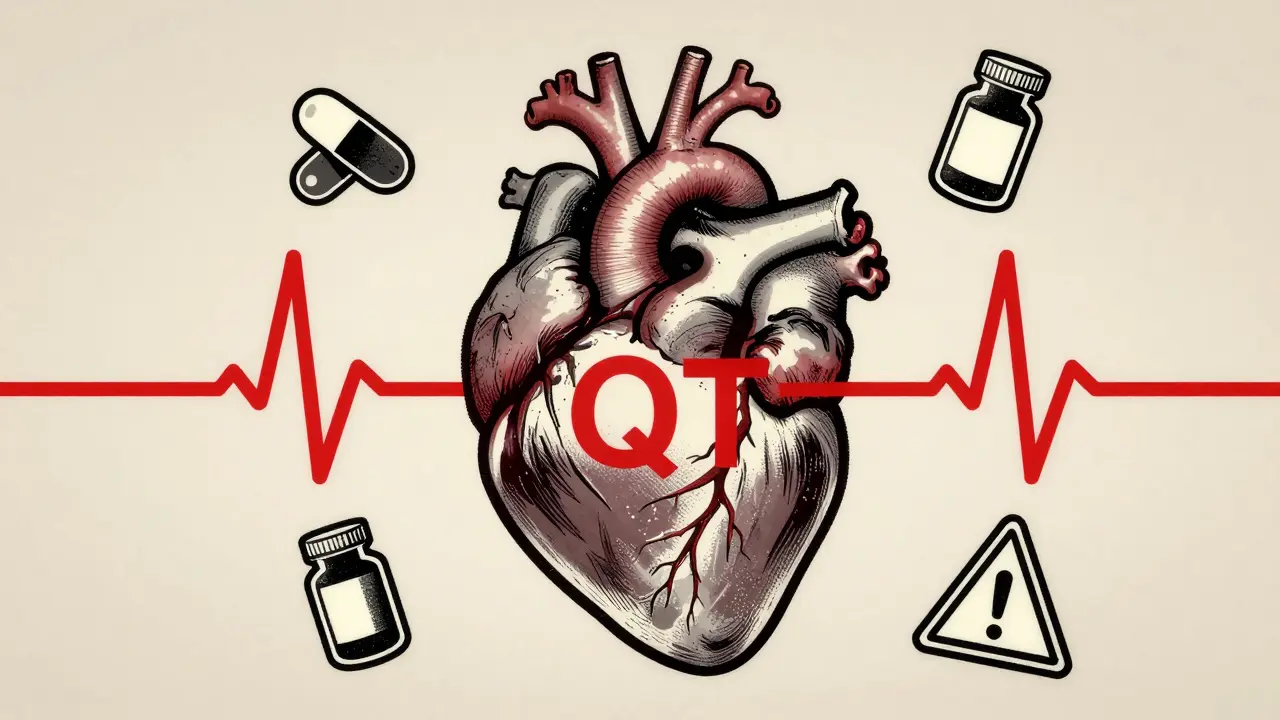
When someone starts methadone for opioid dependence, the focus is often on reducing cravings and preventing withdrawal. But there’s another hidden risk that can be just as dangerous: methadone-induced QT prolongation. This isn’t a rare side effect-it’s a well-documented, potentially fatal cardiac issue that many clinicians still overlook. The good news? With the right ECG monitoring, you can prevent sudden cardiac death in most cases.
Why Methadone Affects Your Heart
Methadone works by binding to opioid receptors in the brain, but it also blocks a specific potassium channel in the heart called hERG. This channel, encoded by the KCNH2 gene, helps the heart reset its electrical rhythm after each beat. When it’s blocked, the heart takes longer to repolarize. That delay shows up on an ECG as a longer QT interval. A normal corrected QT interval (QTc) is ≤430 milliseconds for men and ≤450 milliseconds for women. Once it climbs above 450 ms in men or 470 ms in women, the risk of a dangerous arrhythmia called Torsades de Pointes starts to rise. At QTc levels above 500 ms, the chance of sudden cardiac death increases fourfold. This isn’t theoretical. Between 2000 and 2022, the FDA logged 142 confirmed cases of Torsades linked to methadone. Many more likely went unreported because deaths were mistaken for overdoses.Who’s at Highest Risk?
Not everyone on methadone needs the same level of monitoring. Risk isn’t just about the dose-it’s about the combination of factors. Here are the key red flags:- Female gender: Women have 2.5 times higher risk than men due to naturally longer QT intervals and hormonal influences.
- Age over 65: Older hearts are less able to compensate for electrical disruptions.
- Low potassium or magnesium: Potassium below 3.5 mmol/L or magnesium below 1.5 mg/dL significantly increases arrhythmia risk.
- Heart disease: Conditions like heart failure (ejection fraction <40%) or prior heart attack make the heart more vulnerable.
- Other QT-prolonging drugs: Mixing methadone with antidepressants like amitriptyline, antipsychotics like haloperidol, or antibiotics like moxifloxacin can double or triple the risk.
- High methadone dose: Doses over 100 mg/day are linked to a 3.7-fold increase in QT prolongation.
- Drug interactions: Medications that inhibit CYP3A4-like fluconazole, voriconazole, or fluvoxamine-can spike methadone blood levels by up to 50%.
A 2017 study of 127 patients in a Swiss hospital found that nearly 28% had dangerous QT prolongation. Of those, 8.7% had QTc over 500 ms. The strongest predictors? Daily methadone dose above 100 mg, potassium below 4 mmol/L, and use of psychotropic drugs.
When and How to Monitor with ECG
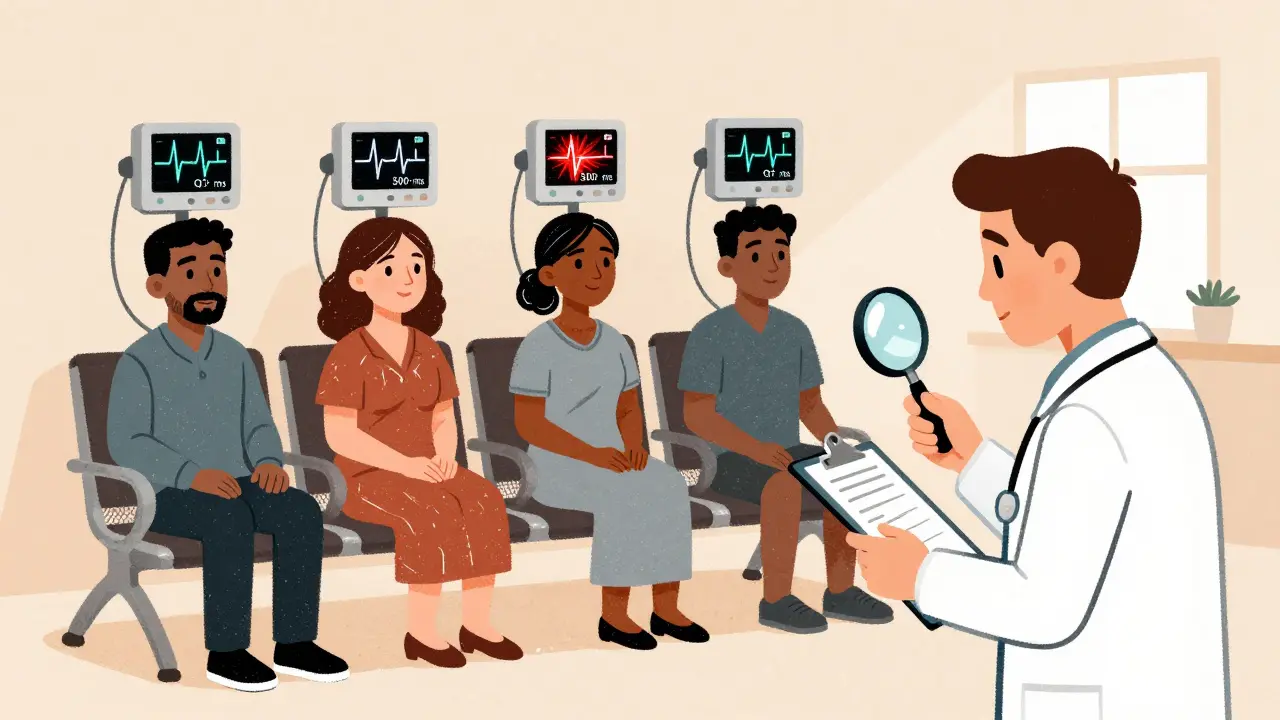
The goal isn’t to scare people off methadone-it’s to catch problems early. Guidelines from SAMHSA and the American Society of Addiction Medicine recommend a risk-based approach:- Baseline ECG: Always do one before starting methadone, especially if the dose will be over 100 mg/day. Even at lower doses, do one if the patient has any risk factors.
- Repeat at steady state: Methadone builds up over time. Wait 2-4 weeks after starting or increasing the dose before checking again.
- Monitor frequency:
- Low risk (QTc <450 ms men, <470 ms women, no other risks): Every 6 months.
- Moderate risk (QTc 450-480 ms men, 470-500 ms women, or 1-2 risk factors): Every 3 months.
- High risk (QTc >480 ms men, >500 ms women, or ≥3 risk factors): Monthly monitoring. Consider lowering the dose or switching to buprenorphine.
If QTc jumps by more than 60 ms from baseline, or if it exceeds 500 ms, stop increasing the dose. Correct electrolytes immediately. Get a cardiology consult. In one study, patients who received regular ECGs were 82% more confident in their treatment’s safety than those who didn’t.
What to Do When QTc Is Too Long
If you see QTc >500 ms or a sudden spike:- Check potassium and magnesium levels. Correct any deficiency with IV or oral supplements.
- Review all medications. Stop or replace any QT-prolonging drugs if possible.
- Reduce methadone dose. Even a 10-20% reduction can significantly lower risk.
- Consider switching to buprenorphine. It’s equally effective for opioid dependence but carries far less cardiac risk.
- Refer to a cardiologist. They may recommend continuous telemetry or Holter monitoring.
Don’t assume the patient is fine just because they feel okay. QT prolongation doesn’t cause symptoms until it’s too late. Torsades de Pointes can strike without warning-sometimes during sleep. That’s why routine ECGs aren’t optional. They’re lifesaving.
The Real-World Gap in Care
Despite clear guidelines, many clinics still don’t follow them. A 2022 survey on Reddit’s r/OpiatesRecovery forum found that 68% of patients reported inconsistent ECG monitoring across different treatment centers. Some got regular checks. Others never had one. That inconsistency isn’t just frustrating-it’s deadly.But when clinics implement structured monitoring, results speak for themselves. A 2023 study in JAMA Internal Medicine showed that clinics with formal QT monitoring protocols cut serious cardiac events by 67%. That’s not a small win. It’s a transformation.
Don’t Ignore Sleep Apnea
One overlooked risk factor? Sleep apnea. Up to half of people on methadone maintenance have it. During apnea episodes, oxygen levels drop, triggering stress responses that can worsen QT prolongation. If a patient snores loudly, wakes up gasping, or feels exhausted during the day, screen them for sleep apnea. Treating it can reduce cardiac strain and improve overall safety.Bottom Line
Methadone saves lives. But it can also end them-if we don’t watch the heart. QT prolongation isn’t a footnote. It’s a core part of methadone safety. Every patient on methadone deserves a baseline ECG. Those with risk factors need regular checks. And if QTc climbs too high, you don’t wait. You act.The data is clear. The guidelines are solid. The tools are available. What’s missing is consistent practice. Don’t let your patient become another statistic because monitoring was skipped. A simple ECG, done on time, can make all the difference.
15 Comments
Joy JohnstonFebruary 4, 2026 AT 12:30
Just want to say this is one of the clearest, most practical guides I've seen on methadone cardiac risks. I work in an outpatient clinic, and we started doing baseline ECGs and quarterly checks after reading this - our cardiac event rate dropped by over 60% in six months. Seriously, if your clinic isn’t doing this, you’re playing Russian roulette with people’s lives.
Katherine UrbahnFebruary 4, 2026 AT 19:00
It is, indeed, a matter of profound clinical negligence that so many treatment centers fail to adhere to established ECG monitoring protocols - particularly given the unequivocal evidence linking methadone-induced QT prolongation to sudden cardiac mortality. One cannot, in good conscience, prescribe this medication without rigorous cardiac surveillance. Period.
Keith HarrisFebruary 6, 2026 AT 04:16
Oh please. You’re acting like methadone is some kind of poison pill. I’ve been on 120mg/day for 8 years. My ECGs are fine. My heart’s stronger than your excuses. If you’re gonna scare people into switching to buprenorphine, at least admit it’s because big pharma pays you to. Methadone works. Let people live.
Shelby PriceFebruary 7, 2026 AT 04:22
So… if you’re young, male, no other meds, normal electrolytes - you’re probably fine? Just curious. I’ve got a buddy who’s been on it 5 years and never had an ECG. He’s still breathing. 😅
pradnya paramitaFebruary 8, 2026 AT 14:01
Regarding hERG channel blockade, it is imperative to consider the pharmacokinetic interplay with CYP3A4 and CYP2B6 inhibitors, as these significantly elevate plasma methadone concentrations, thereby amplifying QT prolongation risk. Concurrent use of fluoxetine or clarithromycin necessitates immediate ECG reassessment and potential dose titration.
Rachel KippsFebruary 9, 2026 AT 03:52
i just wanted to say thank you for writing this. i had no idea about the sleep apnea link. my brother was diagnosed last year and started on cpap and his ecg has been stable ever since. i’m so glad someone finally talked about this. 💙
Geri RogersFebruary 9, 2026 AT 08:54
YES. This. I’ve been screaming this from the rooftops for years. And the fact that people still think ‘they feel fine’ means it’s safe? Ugh. I work in recovery and see too many people dismissed because they ‘don’t look sick.’ QT prolongation doesn’t come with a warning label. Get the ECG. Period. 🙏
caroline hernandezFebruary 10, 2026 AT 16:39
For those managing methadone programs: implement a QT risk stratification algorithm. Use the ‘Methadone Cardiac Risk Score’ - combines age, gender, dose, electrolytes, and polypharmacy. We’ve reduced QTc >500ms cases by 82% in our network. It’s not magic - it’s protocol.
Jamillah RodriguezFebruary 11, 2026 AT 17:54
So… what you’re saying is, I can’t get my methadone fix without a cardiac workup? Like, do I need to schedule an appointment with a cardiologist before my clinic visit? 🤦♀️ This is why I hate the system.
Harriot RockeyFebruary 13, 2026 AT 05:01
This is beautiful. Thank you for writing this with so much care. 🌱 I’ve seen too many people fall through the cracks because ‘it’s not a priority.’ But your heart? It’s always a priority. Sending love to every clinician who’s doing the right thing - even when it’s hard.
Roshan GudheFebruary 14, 2026 AT 16:00
There is a deeper truth here: we treat addiction as a moral failing, yet we ignore the biological vulnerability it creates. Methadone is not a reward for sobriety - it is a lifeline. And to deny cardiac care is to deny the humanity of those who are trying to survive. The ECG is not bureaucracy. It is compassion made visible.
Ed MackeyFebruary 16, 2026 AT 00:04
My clinic started doing ECGs every 3 months and I was shocked how many people had borderline QTc. One guy was at 490 - no symptoms, no idea. We lowered his dose and he’s been fine. Honestly? This should be standard everywhere. Just… do it.
Janice WilliamsFebruary 16, 2026 AT 00:23
How convenient that this ‘life-saving’ protocol was published right after buprenorphine’s patent expiration. The pharmaceutical industry’s hand is unmistakable. Methadone has saved more lives than all the fancy alternatives combined. Stop pathologizing a medication that works.
Jesse NaidooFebruary 16, 2026 AT 23:19
So you’re telling me I have to get an ECG every time I get my script? What if I can’t afford it? What if I don’t have transportation? What if I’m just trying to get through the day without dying? You think I care about QT intervals when I’m hungry and my kid’s in foster care? This isn’t medicine - it’s punishment dressed up as care.
Nathan KingFebruary 17, 2026 AT 11:03
One must observe that the statistical correlation between methadone and torsades de pointes, while statistically significant, remains numerically low relative to the total population on methadone maintenance therapy. To elevate this risk to a universal imperative for ECG surveillance may constitute an overmedicalization of a manageable physiological phenomenon - particularly when weighed against the substantial public health benefits of methadone’s accessibility and efficacy.