
Drug Regulation Comparison Tool
Every pill you take, every injection you receive, has passed through a complex web of rules designed to keep you safe. But those rules aren’t the same everywhere. In the U.S., a single agency - the FDA - decides if a drug can reach patients. In Europe, 27 countries share oversight through the EMA, but each nation still has its own voice. Canada, Australia, and even developing nations like India and Nigeria follow different paths, with varying levels of resources, speed, and transparency. This isn’t just bureaucracy - it’s a matter of life and death. When a drug is pulled in one country but stays on shelves in another, patients are left guessing. And with more people taking medicines across borders than ever before, these differences aren’t just technical - they’re dangerous.
The U.S. System: Centralized, Fast, but Rigid
The U.S. Food and Drug Administration (FDA) is the gatekeeper for nearly every drug sold in America. It’s a single, powerful agency with legal authority under Title 21 of the Code of Federal Regulations. That means decisions are clear: approve or deny. There’s no confusion over who’s in charge. In 2022, the FDA approved new drugs in an average of 10.2 months - faster than most other major regulators. This speed helped during the pandemic, when vaccines and treatments needed to move quickly. But that speed comes with trade-offs. The FDA’s process is predictable, but inflexible. Once a drug is approved, changes - like new safety warnings - can take months to roll out. During the 2020-2021 surge in drug reviews, approval times jumped by 37%. Doctors and patients rely on MedWatch, the FDA’s reporting system, to flag side effects. In 2022, 83% of clinicians said these alerts were timely and actionable. But critics say the system doesn’t always catch subtle risks until it’s too late. For example, the FDA approved more rare disease drugs than the EU in 2022 - 18.3% more - because it’s more willing to accept higher risks for small patient groups. That’s a philosophy: faster access for those with no other options.The European Model: Collaborative, Complex, but Transparent
The European Medicines Agency (EMA) doesn’t make decisions alone. It coordinates with National Competent Authorities in each EU country. For new, complex drugs - like cancer therapies or gene treatments - the EMA handles centralized approval. But for generics and older medicines, each country can approve its own version. This hybrid system gives nations flexibility but creates chaos for drugmakers. Sixty-eight percent of European pharmaceutical companies say navigating multiple national rules is a major headache. The upside? Transparency. EMA publishes detailed benefit-risk assessments that doctors find easier to understand than FDA documents. In 2022, 71% of European physicians rated EMA reports as comprehensive and clear, compared to 63% for the FDA. When safety issues arise, the EU’s networked structure can act fast. After the Vioxx scandal, 22 EU countries coordinated a withdrawal in 14 days - faster than the U.S. system. But the downside? Approval times are slower. Centralized EU reviews took 12.7 months on average in 2022. And while the EU has mutual recognition agreements with Canada and others, it still lacks a formal deal with the U.S. for drug inspections, creating gaps in oversight.Canada and Australia: Bridging the Gap
Canada’s Health Canada sits between the U.S. and EU models. It’s centralized like the FDA, but it’s also part of a mutual recognition agreement with the EU, signed in 2019. That means inspections done in one region can count in the other. After the agreement, Canada’s safety decisions aligned with the EU in 87% of major cases. That’s one of the highest concordance rates globally. Australia’s Therapeutic Goods Administration (TGA) is leaner and more independent. It follows its own laws under the Therapeutic Goods Act 1989. It’s not part of the EU system, but it closely watches the FDA. In 2022, Australia matched U.S. safety decisions 79% of the time, but only 63% with the EU. The TGA is known for being cautious - it often waits for more data before approving drugs. That’s why Australians sometimes get new medicines later than Americans. But it also means fewer surprises down the line. The TGA’s approach has earned trust, especially for older patients who are more vulnerable to side effects.
Global Standards: The WHO and the Illusion of Uniformity
The World Health Organization (WHO) publishes guidelines on Good Manufacturing Practices (GMP) that over 150 countries use as a reference. But here’s the catch: WHO rules aren’t legally binding. They’re suggestions. That’s why two drugs made in the same factory can have different safety profiles depending on where they’re sold. The EU enforces GMP with a 98.7% compliance rate among its manufacturers. The FDA hits 92.3%. But in low-income countries, compliance can dip below 30%. In Africa, only 37% of manufacturing sites meet basic GMP standards, according to the African Union’s 2023 scorecard. This isn’t just about quality control. It’s about access. When a drug is approved in the U.S. but not in Nigeria, patients there can’t get it legally - even if it’s the same medicine. Some end up buying it online, risking counterfeit products. The WHO’s 2023 Global Benchmarking Tool tried to fix this by creating 89 measurable indicators for national regulators. By the end of 2022, 67 countries reached a "functional" rating. But that’s still far from full compliance.The Real Cost of Disconnected Systems
For drug companies, navigating these differences is expensive. On average, it costs $1.2 million just to set up global regulatory compliance. A single new drug application can run 15,000 to 20,000 pages in the U.S., and 12,000 to 18,000 in Europe. That’s not just paperwork - it’s time, money, and delays. Pediatric testing rules alone differ between the U.S. and EU, and 61% of companies struggled to meet both in 2022. The International Council for Harmonisation (ICH) has made progress. Its E6(R3) guidelines, adopted by 89% of major regulators by mid-2023, cut clinical trial documentation by 22%. But even that’s not enough. A landmark 2019 study found that safety warnings issued by the U.S., Canada, the U.K., and Australia matched up in only 10.3% of cases. That means if you take a drug approved in all four countries, you could get different safety advice depending on where you live. The Institute of Medicine warned this could affect up to 200 million patients annually.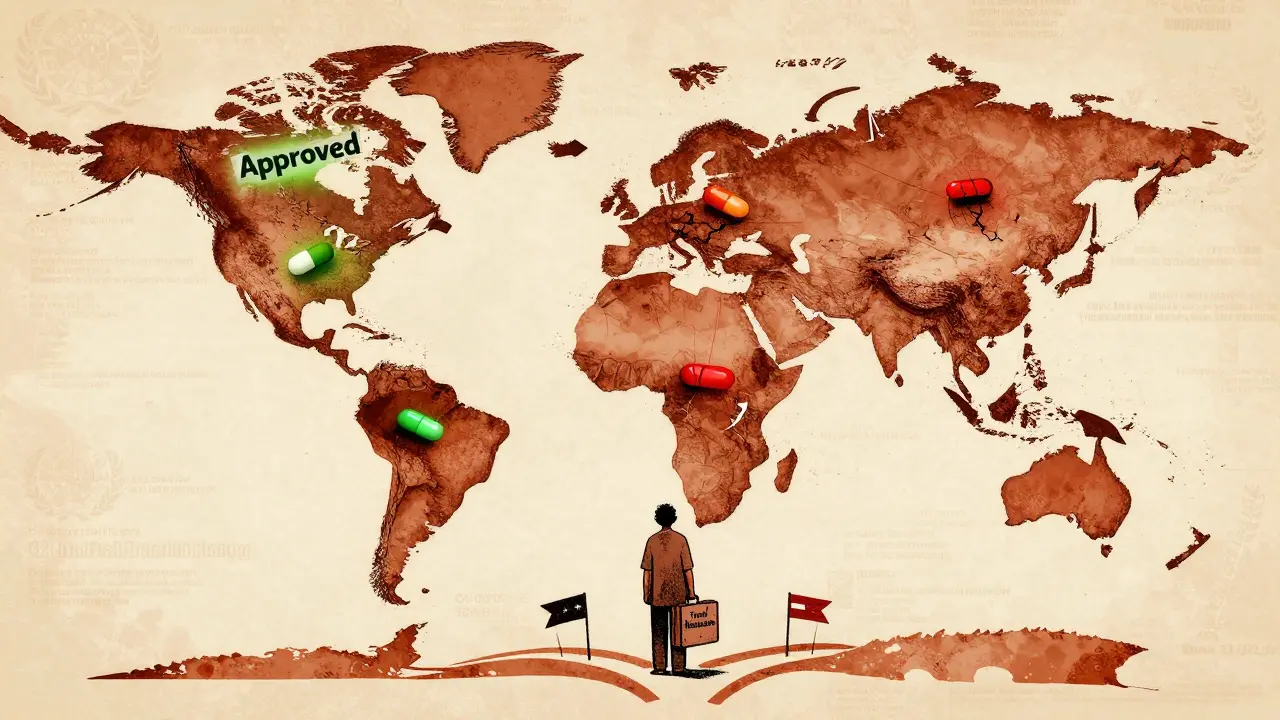
What’s Changing? AI, Digital Tools, and the Push for Alignment
The future of medication safety isn’t just about more rules - it’s about smarter ones. The FDA is already using AI to review 43% of routine manufacturing inspections. The EMA reviewed 189 advanced therapy applications in 2022, up from just 12 in 2019. These tools are cutting review times. The FDA’s 2022 Modernization Act 2.0 removed mandatory animal testing for some drugs, potentially shaving 18-24 weeks off approval timelines. The EU’s Pharmaceutical Strategy for Europe aims to cut approval times by 25% by 2025. But the biggest challenge isn’t technology - it’s politics. The U.S. wants speed. The EU wants transparency. Canada wants alignment. And low-income countries just want access. The ICH’s 2023 roadmap targets 75% alignment across the U.S., EU, Japan, and Canada by 2028. But experts like Dr. Thomas Frieden, former CDC director, warn that without real convergence, patients will keep paying the price. "The 10.3% concordance rate isn’t a statistic - it’s a gap in care," he wrote in the New England Journal of Medicine.What This Means for You
If you’re taking a prescription, especially one bought abroad or online, ask: Is this drug approved where I live? Just because it’s sold in one country doesn’t mean it’s safe under your local rules. Check your national health agency’s website - the FDA, EMA, or TGA - for safety alerts. If you’re traveling, bring your medication in its original packaging with a doctor’s note. Many countries don’t recognize foreign prescriptions. And if you’re a patient with a rare disease or chronic condition, know that your access depends on where you live. A drug approved in the U.S. might still be years away in parts of Africa or Asia. Advocacy groups are pushing for global databases to track drug safety alerts - but until then, you’re your own best protector.Why do different countries approve the same drug differently?
Each country weighs risk and benefit differently. The U.S. often prioritizes faster access, especially for life-threatening conditions. The EU focuses on long-term safety data and transparency. Canada and Australia tend to be more cautious, waiting for stronger evidence. Cultural, legal, and economic factors also play a role - some countries can’t afford to wait for full global trials.
Can a drug be safe in one country but unsafe in another?
Yes. The same drug can have different side effect profiles based on population genetics, diet, other medications people take, or even climate. For example, a drug that causes liver issues in older Europeans might be fine for younger Americans due to differences in metabolism. Regulatory agencies also use different data thresholds - one might act on a rare side effect reported in 1 in 10,000 patients, while another waits for 1 in 5,000.
Are generic drugs regulated the same way everywhere?
No. In the U.S. and EU, generics must prove they’re bioequivalent to the brand-name drug. But in some countries, especially in Africa and parts of Asia, enforcement is weak. A 2023 study found that 28% of generics sold in Nigeria failed basic quality tests. Always get generics from trusted pharmacies - and never buy them online without checking your country’s regulatory site.
How do I find out if my medication has been recalled?
Check your national health authority’s website. In the U.S., visit fda.gov/safety. In the EU, go to ema.europa.eu. Australia uses tga.gov.au. These sites list recalls and safety alerts. You can also sign up for email alerts. Don’t rely on news reports - they’re often delayed or incomplete.
Is the U.S. or EU system better?
Neither is "better" - they serve different goals. The U.S. system is faster and more predictable, which helps patients needing urgent treatment. The EU system is more transparent and collaborative, which builds trust among doctors. The best system depends on what you value: speed or safety. For most people, a mix of both - like Canada’s model - offers the strongest balance.
12 Comments
Babe AddictDecember 27, 2025 AT 21:01
FDA moves fast because they don’t care if you die slowly. EMA’s just overcompensating with 12-page PDFs no one reads. Real talk: if your drug needs a PhD to understand the safety doc, it’s already too late.Liz MENDOZADecember 29, 2025 AT 18:28
This is why I always check my national health site before refilling. I had a friend in India who got a fake version of her blood pressure med - ended up in the ER. Don’t assume ‘same pill = same safety.’Nikki ThamesDecember 30, 2025 AT 17:45
The notion that regulatory systems are merely bureaucratic is a dangerous oversimplification. Each jurisdiction operates under distinct epistemological frameworks shaped by historical, cultural, and economic determinants. To reduce this to a speed-versus-safety binary is to ignore the ontological weight of patient autonomy, collective risk tolerance, and institutional legitimacy.Anna WeitzJanuary 1, 2026 AT 16:20
They’re all lying. The FDA and EMA are both owned by the same pharma conglomerates. The ‘differences’ are just theater to make you think you have a choice. Meanwhile your pills are being tested on people in Nigeria while the CEOs vacation in the MaldivesJane LucasJanuary 2, 2026 AT 23:52
i just took my med and checked the tga site like u said and it was flagged for liver stuff in europe but not here. why is this even a thingSatyakki BhattacharjeeJanuary 4, 2026 AT 17:32
In India, we don’t have the luxury of waiting. If a drug saves even one life, it’s worth it. Western countries act like they’re above the world, but they forget that millions here survive on generics they’d never touch at home.Kishor RaiboleJanuary 5, 2026 AT 05:38
The fundamental dissonance between regulatory paradigms reveals a deeper crisis of epistemic authority in global health governance. The hegemony of Western regulatory models, while ostensibly scientific, perpetuates a colonial hierarchy wherein low-income nations are relegated to the status of passive recipients of risk assessments they did not co-create.Miriam PiroJanuary 6, 2026 AT 14:20
You think this is about safety? Nah. It’s about patents. The FDA approves faster so pharma can lock in profits before generics hit. The EU drags its feet so they can charge more. And WHO? They’re just the PR department. You think they care if your grandma dies from a fake pill? They got a new logo.Caitlin FosterJanuary 6, 2026 AT 18:22
OMG YES!!! 😤 The FDA is basically a corporate cheerleader with a lab coat. And don’t even get me started on how they ‘approve’ supplements - it’s a joke! I’m not even mad, I’m just disappointed.Kylie RobsonJanuary 7, 2026 AT 11:41
The ICH E6(R3) harmonization initiative reduced clinical trial documentation by 22% - a statistically significant reduction in administrative burden, but it doesn’t address the latent heterogeneity in pharmacovigilance infrastructure across LMICs. The GMP compliance gap remains a systemic failure of transnational regulatory architecture.Elizabeth AlvarezJanuary 7, 2026 AT 13:31
They’re all in cahoots. The same people who approved Vioxx are now pushing AI to speed up approvals. They don’t want to catch side effects - they want to sell more pills before the lawsuits start. You think your ‘safe’ meds are clean? Look up the whistleblower reports from 2021. They buried 400+ deaths in ‘statistical noise’.John BarronJanuary 8, 2026 AT 17:22
I work in pharma compliance. Let me tell you - the 15,000-page U.S. dossier? Half of it is boilerplate. The EU’s 12k pages? 70% is just translated U.S. docs. The real difference? The FDA has a 3-month window to act on post-market signals. The EU? 9. The real danger isn’t the rules - it’s the delay. And yes, I use emojis because I’m tired of being ignored. 🤷♂️💊