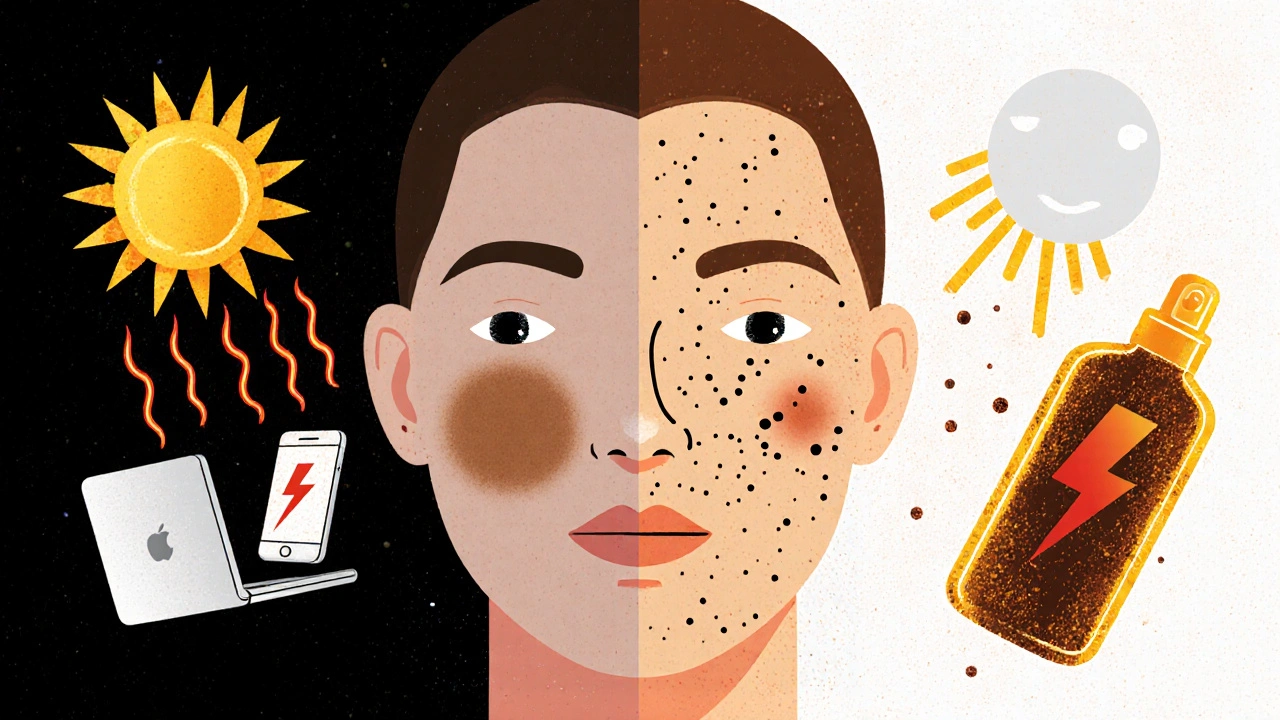
When your skin starts showing dark patches-especially on your face-it’s easy to assume it’s just sun damage. But what if it’s not? What if those brown spots aren’t from the sun at all, but from hormones, heat, or something deeper? That’s the real problem with hyperpigmentation: it looks simple, but it’s not. Two of the most common types-melasma and sun damage-look almost identical. Yet they need completely different treatments. Get one wrong, and you could make it worse.
What’s Really Going On With Your Skin?
Hyperpigmentation means your skin is making too much melanin. That’s the pigment that gives skin its color. But why? And where? That’s where things split apart.Sun damage, or solar lentigines, is straightforward. It’s caused by years of UV exposure. Think of it like a sunburn that never faded. These spots show up on your face, hands, shoulders-anywhere the sun hits. They’re small, round, and well-defined. Around 90% of people over 60 with fair skin have them. The skin cells in those spots are just overloaded with melanin. No new melanocytes (pigment cells) are born-just more pigment packed into the old ones.
Melasma is different. It’s not just about the sun. It’s about hormones, heat, and visible light. You’ll see it as large, blotchy patches on the cheeks, forehead, upper lip, or chin. It’s symmetrical-same on both sides. It mostly affects women, especially those with medium to dark skin tones (Fitzpatrick types III-VI). Pregnancy, birth control pills, or hormone therapy can trigger it. Even indoor light through windows can make it worse. And here’s the kicker: heat from your phone, laptop, or even a warm room can stimulate melanin production. That’s why melasma doesn’t just fade when you avoid the beach.
There’s a third type-post-inflammatory hyperpigmentation (PIH)-that shows up after acne, eczema, or a scratch. But unlike melasma or sun damage, it doesn’t show up in sun-exposed areas. It shows up where the skin got irritated. And it’s more common in darker skin tones.
Why Sunscreen Isn’t Enough (Even If You’re Using It)
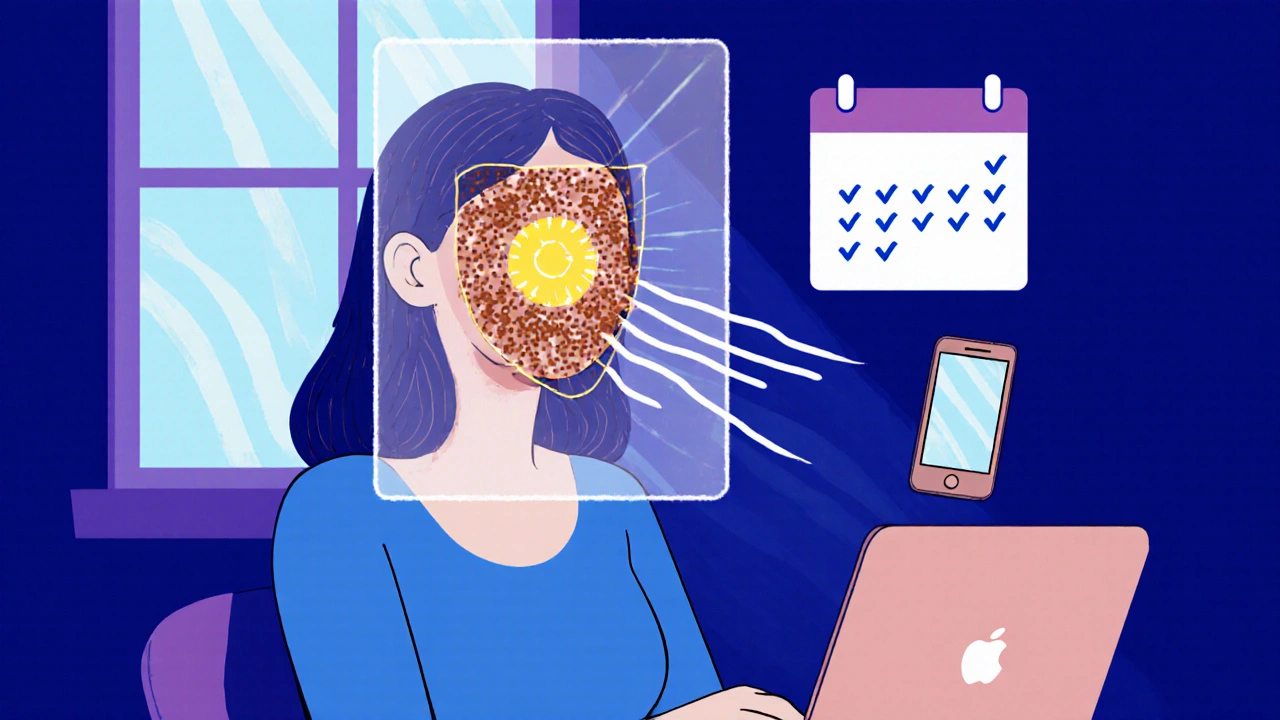
Most people think SPF 30 is enough. They slap it on in the morning and call it a day. But if you have melasma, that’s not enough. Standard sunscreens block UV rays. But melasma is triggered by more than UV.Visible light-blue light from screens, fluorescent bulbs, even sunlight-penetrates deeper. It makes melanocytes go crazy. And infrared heat? It activates the same pathways. That’s why someone can sit indoors near a window and still see their melasma darken.
Harvard Medical School’s Dr. Kourosh says it bluntly: “The sun is stronger than any medicine I can give you.” And he’s right. Studies show that without strict photoprotection, melasma comes back within six months of stopping treatment-95% of the time.
So what sunscreen actually works? You need mineral-based formulas with zinc oxide or titanium dioxide-and crucially, iron oxides. Iron oxides block visible light. Look for tinted sunscreens. They’re not just for coverage. They’re medical-grade protection. The American Academy of Dermatology says you need SPF 30+ daily, even inside. And you need to reapply every two hours if you’re near a window or outside.
Topical Treatments: What Actually Works
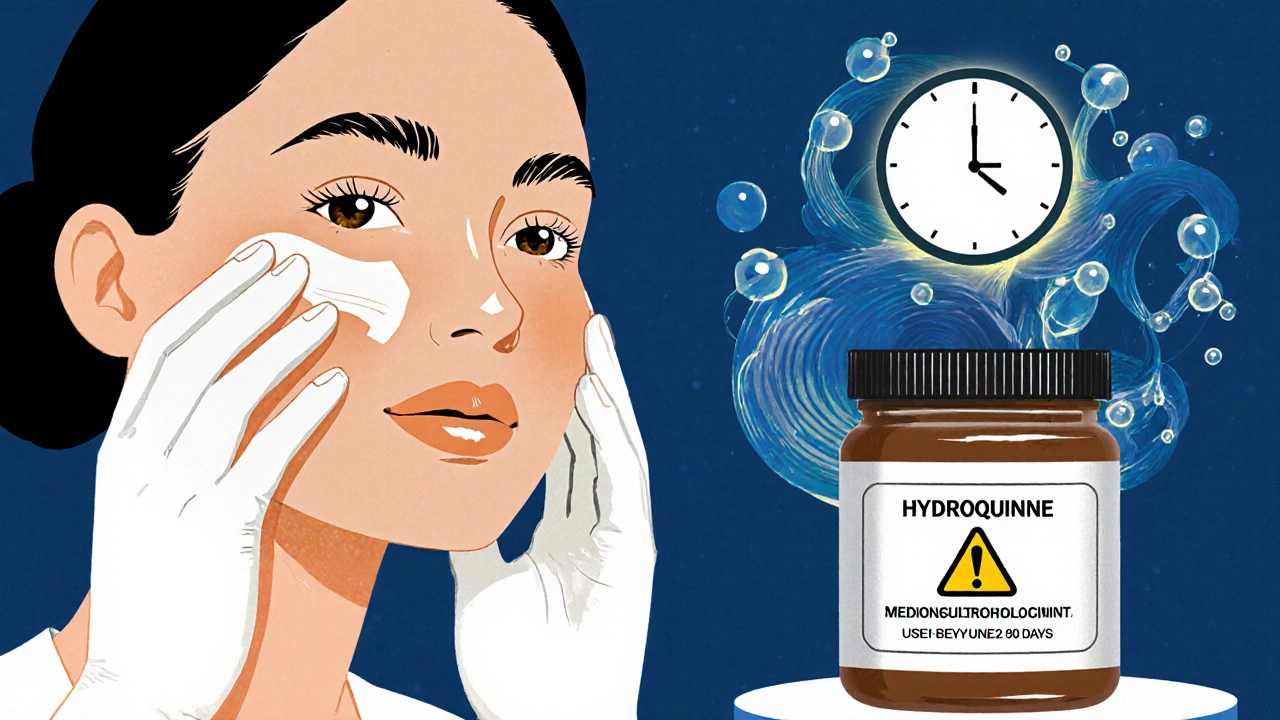
There are dozens of creams, serums, and “miracle” products out there. But only a few have real science behind them.Hydroquinone is the gold standard. It blocks tyrosinase-the enzyme that makes melanin. At 4% concentration, it’s the most effective topical for melasma. But it’s not a magic bullet. Used alone, it helps about 30% of people. Used in a triple combination with tretinoin and a corticosteroid, it works for 50-70%. That’s why dermatologists now prescribe triple creams as first-line treatment for moderate melasma-up from 45% in 2018 to 75% today.
But there’s a catch. Hydroquinone can’t be used longer than 3 months. After that, there’s a 2-5% risk of exogenous ochronosis-a rare but permanent blue-black discoloration. That’s why it’s prescription-only in the U.S. and banned in the EU and Japan.
Tretinoin (0.025-0.1%) doesn’t lighten pigment directly. It speeds up skin turnover. Think of it like a gentle exfoliator that pulls melanin out of the skin faster. It’s usually used at night, alternating with hydroquinone to avoid irritation. About 30-40% of users get redness or peeling, especially at first. That’s why dermatologists recommend starting with a low dose and building up over 4-6 weeks.
Vitamin C (L-ascorbic acid) is an antioxidant. It doesn’t stop melanin production-it neutralizes the oxidized melanin that makes skin look darker. At 10-20% concentration, it’s effective. Used in the morning, it also boosts sunscreen protection. It’s gentle, stable, and safe for long-term use. Many people use it as a maintenance step after stopping hydroquinone.
Other options like niacinamide, kojic acid, and tranexamic acid are gaining traction. Tranexamic acid, applied topically at 5%, showed 45% improvement in melasma in a 12-week study. It’s not as strong as hydroquinone, but it’s safer for long-term use. Cysteamine cream (10%) is new-showing 60% improvement in trials with almost no irritation. These are becoming popular for people who can’t tolerate hydroquinone or want to avoid it entirely.
Laser and Light Therapies: When They Help-and When They Hurt
Laser treatments sound like the quick fix. But for melasma? They’re risky.IPL (Intense Pulsed Light) works great for sun damage. It targets melanin with light energy, heating and destroying the dark spots. The spots darken, then flake off in 3-5 days. Success rate? 75-90% improvement in 2-3 months.
But for melasma? IPL has a 30-40% chance of making it worse. Why? Because heat triggers melanocytes. If your melanocytes aren’t already suppressed by topical treatment, IPL can turn a mild case into a chronic one.
Dermatologists now use a “melanocyte rest” protocol for melasma: 8-12 weeks of topical treatment first. Then-if the pigmentation has faded enough-they consider laser. This cuts recurrence from 60% down to 25%.
Chemical peels (glycolic, salicylic, or trichloroacetic acid) can help too. Used every 4-6 weeks, they boost topical treatments by 35-50%. But again-only if your skin is calm. In darker skin tones, peels carry a 25% risk of causing PIH. That’s why they’re done cautiously.
The Real Cost-Money, Time, and Patience
The global hyperpigmentation market is worth $12.7 billion. And it’s growing. But most people start with over-the-counter products. A 2023 survey found 85% of melasma patients try drugstore creams first. They buy vitamin C serums, niacinamide lotions, brightening masks. They spend $30-$60 a month. And they wait. And wait.When that doesn’t work, they go to a dermatologist. Prescription topicals cost $50-$150 a month. Laser sessions? $300-$600 each. And you might need 3-5.
But the biggest cost isn’t money. It’s time. Melasma takes 3-6 months to improve. Sun damage? 8-12 weeks. And even then, if you skip sunscreen for a week, it comes back.
Studies show only 35% of patients stick with their treatment for the full recommended time. Why? Because it’s tedious. Applying three products every day. Reapplying sunscreen. Avoiding heat. It’s exhausting. That’s why simplifying regimens matters. Some dermatologists now combine hydroquinone and tretinoin into one cream. Others offer once-daily formulas.
What You Can Do Right Now
If you’re dealing with dark patches:- Take a photo of the spots. Compare it in 4 weeks.
- Check if they’re symmetrical (melasma) or scattered (sun damage).
- Stop using any product that stings or burns. That’s not working-it’s irritating.
- Switch to a tinted mineral sunscreen with iron oxides. Use it every day, even indoors.
- Don’t touch your face with your phone or laptop. Heat matters.
- If it’s been 3 months and nothing changed? See a dermatologist. Don’t wait.
There’s no cure for melasma. But there’s control. And it starts with understanding what you’re really dealing with. Sun damage? You can remove it. Melasma? You manage it. And the most powerful tool isn’t a cream or a laser-it’s consistency. Daily sunscreen. No exceptions. Because even one missed day can undo weeks of progress.
What’s Next for Hyperpigmentation Treatment?
The future is personal. Dermatologists are starting to look at genetic markers to predict who responds to what. Dr. Pearl Grimes predicts that within five years, genetic testing will guide treatment choices.Meanwhile, new agents are coming. Tranexamic acid pills (oral) are being studied for melasma. Cysteamine cream is getting FDA approval. And non-hydroquinone options are growing fast-up 15% a year in prescriptions.
But the biggest breakthrough won’t be a new ingredient. It’ll be better education. Most people don’t know that visible light causes melasma. Or that sunscreen needs iron oxides. Or that hydroquinone has a 3-month limit. Once you know, you can fight smarter.
Is melasma the same as sun spots?
No. Melasma appears as large, symmetrical patches on the face, often triggered by hormones and heat. Sun spots (solar lentigines) are small, scattered, and caused by UV exposure. They look similar, but melasma doesn’t respond to the same treatments-and can get worse with lasers if mismanaged.
Can I treat melasma with over-the-counter products?
Some OTC products help-like vitamin C serums, niacinamide, or tranexamic acid creams. But they won’t match the results of prescription treatments like hydroquinone or tretinoin. Most people try OTC first, but if there’s no improvement in 8-12 weeks, see a dermatologist. Melasma needs targeted therapy.
Why does my melasma come back after treatment?
Because melasma is chronic. It’s not just a surface issue-it’s driven by hormones, heat, and light exposure. Even after clearing, 95% of people see it return within 6 months if they stop sun protection. Maintenance is lifelong: daily sunscreen, avoiding heat, and occasional topicals.
Is hydroquinone safe to use long-term?
No. Hydroquinone should be limited to 3 months at a time due to a 2-5% risk of ochronosis-a permanent blue-black discoloration. After 3 months, switch to alternatives like tranexamic acid, vitamin C, or niacinamide. Never use hydroquinone continuously without supervision.
Do I need to wear sunscreen indoors?
Yes-if you have melasma. Visible light from windows, lamps, and screens can trigger pigmentation. Standard sunscreens don’t block this. Use a tinted mineral sunscreen with iron oxides every day, even if you’re working from home.
Can lasers remove melasma permanently?
No. Lasers like IPL can worsen melasma if used too early. Even when used correctly, recurrence rates are high. Lasers are only considered after 8-12 weeks of topical treatment to suppress melanocytes. Even then, maintenance is required. Melasma is managed, not cured.
13 Comments
Clay JohnsonNovember 29, 2025 AT 02:01
Sun damage is a transaction. Melasma is a relationship. One you didn’t sign up for but can’t leave. The skin remembers every photon, every warm screen, every hormonal shift. You can’t out-cream your biology. You can only out-consistency it.
Jermaine JordanNovember 30, 2025 AT 02:27
This is the most important skin article I’ve read in a decade. Not because it’s complex-but because it strips away the marketing noise. Hydroquinone isn’t a miracle. Sunscreen isn’t optional. And yes-your laptop is literally darkening your skin. We need more science like this, not more influencers selling ‘brightening’ serums.
Chetan ChauhanNovember 30, 2025 AT 11:46
uuhh wait so iron oxides? like the stuff in rust? lol. i thought sunscreen was just for beach. my mom says sunblock is for old people. also i use ceraVe and its fine. why u so serious?
Phil ThorntonDecember 2, 2025 AT 11:21
Three words: tinted. mineral. sunscreen.
Pranab DaulagupuDecember 2, 2025 AT 15:05
The melanocyte rest protocol is brilliant. It’s not about aggression-it’s about harmony. Let the skin reset before introducing energy-based interventions. This aligns with Ayurvedic principles of dhatus and agni-balance before intervention. A truly holistic approach.
Barbara McClellandDecember 4, 2025 AT 11:51
Starting with a tinted sunscreen is the easiest win. I used to skip it indoors-now I wear it like a second skin. No more midday panic when I see my cheeks darkening. Also-stop touching your face with your phone. I know you think it’s fine. It’s not.
Alexander LevinDecember 6, 2025 AT 10:27
They’re lying about iron oxides. Big Pharma doesn’t want you to know you can block visible light with $12 mineral sunscreen. The real solution? Faraday cages for your face. Or just move to a cave.
Ady YoungDecember 7, 2025 AT 14:55
I tried hydroquinone for 2 months. Got red, peely, and scared. Switched to niacinamide + vitamin C. Took 4 months but my melasma faded 60%. No ochronosis risk. No drama. Just consistency. I’m not a dermatologist-but I’m living proof it works.
Travis FreemanDecember 8, 2025 AT 21:40
As someone from a culture where dark skin is prized, I’ve seen how melasma is stigmatized. This article doesn’t just explain the science-it validates the emotional weight. You’re not broken. You’re not lazy. You’re just fighting invisible triggers. Thank you.
Sean SlevinDecember 9, 2025 AT 16:28
Wait-so visible light? From LED bulbs? From my monitor? From the sun through my window? And I’ve been using SPF 50… but not iron oxides? Oh my god. I’ve been fighting the wrong enemy. This changes everything. I’m buying a tinted sunscreen tonight. And maybe a hat. And maybe a blackout curtain. And maybe… I’ll just move to Alaska.
Chris TaylorDecember 9, 2025 AT 18:58
My mom had melasma after having my sister. She never talked about it. I didn’t know it was hormonal. I thought she just got old. This makes so much sense now.
Melissa MichaelsDecember 10, 2025 AT 03:54
For those considering tranexamic acid: topical 5% is FDA-cleared for melasma in the U.S. as a cosmetic ingredient. Oral is still investigational. Do not self-prescribe pills. Consult a board-certified dermatologist. Safety first.
Nathan BrownDecember 10, 2025 AT 11:58
It’s not about treating the spot. It’s about silencing the signal. Melasma isn’t a flaw-it’s a response. A cry from your melanocytes saying, ‘We’re stressed.’ Sunscreen isn’t protection-it’s peacekeeping. And consistency? That’s the quiet rebellion against a world that tells you to chase quick fixes. I’ve been melasma-free for 18 months. Not because I found the magic cream. But because I stopped fighting my skin-and started listening to it.