
When you’re on a medication like warfarin or phenytoin, even a tiny change in dose can mean the difference between staying healthy and ending up in the hospital. These are NTI drugs - narrow therapeutic index drugs - and they don’t play by the same rules as most other prescriptions. The gap between a safe, effective dose and a dangerous one is razor-thin. That’s why swapping a brand-name version for a generic isn’t just a routine pharmacy decision. For NTI drugs, it can be risky.
What Makes a Drug an NTI Drug?
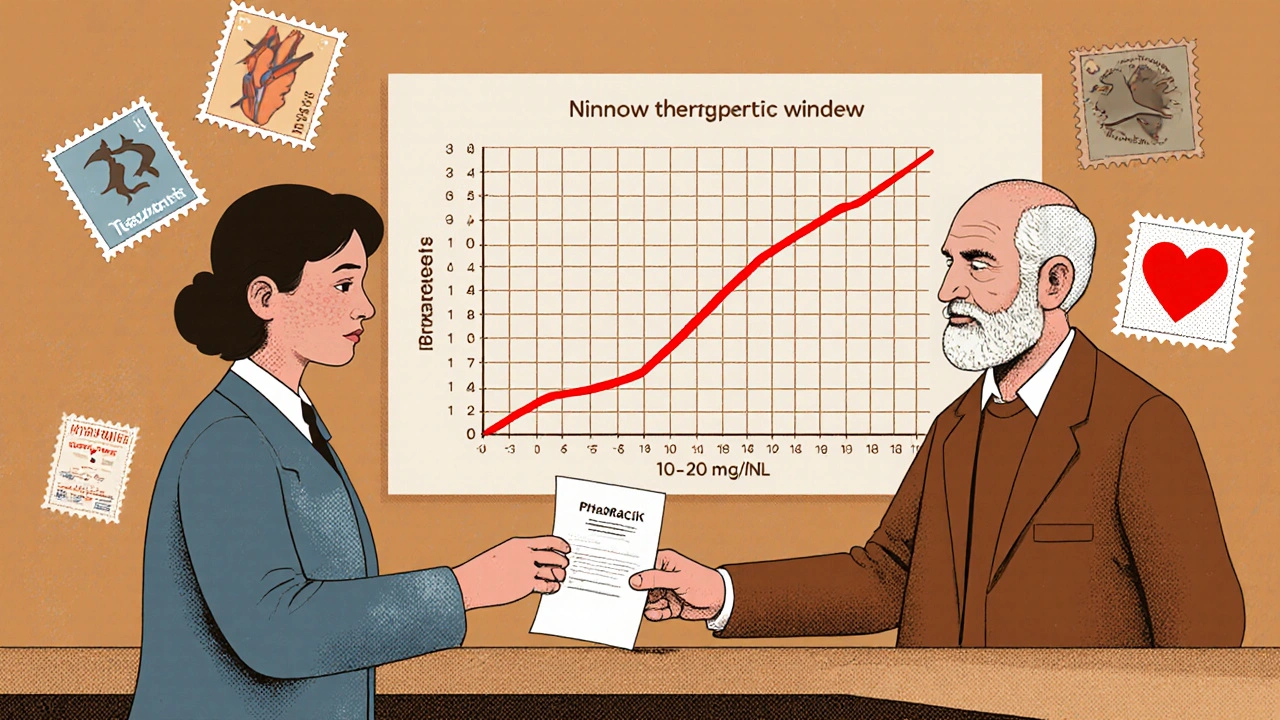
An NTI drug has a therapeutic window so narrow that a small change in blood concentration can cause serious harm. The FDA defines it simply: small differences in dose or blood levels can lead to therapeutic failure or life-threatening side effects. For example, warfarin, a blood thinner, needs to keep your INR between 2.0 and 3.0. If it drops below 2.0, you could get a clot. If it rises above 3.0, you could bleed internally. That’s a range of just one point - and a 10% shift in how your body absorbs the drug can push you out of it.
Phenytoin, used for seizures, has a similar problem. Its safe range is 10 to 20 mcg/mL. Go above 20, and you get dizziness, slurred speech, even loss of coordination. Below 10, and seizures return. Lithium, used for bipolar disorder, works the same way - too much causes tremors, confusion, kidney damage; too little, and mood swings return. These aren’t hypothetical risks. Real patients have had breakthrough seizures after switching from brand-name to generic phenytoin. Others have had strokes or major bleeding after switching warfarin brands.
Why Generic Bioequivalence Rules Don’t Work for NTI Drugs
Generic drugs must prove they’re bioequivalent to the brand. That means their absorption rate and peak concentration in the blood must fall within 80% to 125% of the original. Sounds fair - until you realize that 80% to 125% is a 45% spread. For a drug with a 2:1 safety margin, that’s way too wide.
Imagine your warfarin dose is calibrated to keep your INR at 2.5. You switch to a generic that’s 120% as bioavailable. Suddenly, your INR jumps to 3.5. You’re now at risk of bleeding. Or, if the generic is only 80% as potent, your INR drops to 1.8 - now you’re not protected from clots. That’s not a theoretical problem. Studies have shown patients switching between Coumadin and generic warfarin had significant INR fluctuations, even when no other factors changed.
The FDA says generics are therapeutically equivalent. But experts disagree. The American Medical Association (AMA) has been clear since 1999: the prescribing physician should decide whether to allow substitution. Pharmacists might be confident in generics, but many doctors aren’t. And patients? They’re the ones paying the price.
Real Cases, Real Consequences
In 2008, a 68-year-old man in Ohio was switched from brand-name warfarin to a generic without his doctor’s knowledge. His INR dropped from 2.6 to 1.4 within two weeks. He suffered a stroke. He survived, but with permanent brain damage. His case wasn’t unique. Similar stories appear in medical journals across the U.S. and Europe.
One 2015 study tracked 1,200 patients on phenytoin. After switching to generic versions, 17% had seizures within 30 days. Another 12% developed signs of toxicity - tremors, nausea, confusion. The pharmacy didn’t notify the doctor. The patient didn’t know to ask for a blood test.
Opioids like methadone are another concern. The therapeutic index for methadone is as low as 2:1 in opioid-naïve patients. That means the dose that relieves pain is almost the same as the dose that stops breathing. A generic version with slightly higher absorption could cause respiratory failure. A less potent one could leave chronic pain uncontrolled. Either way, someone suffers.
Why Do Some Studies Say It’s Safe?
You’ll find studies claiming generic warfarin is just as safe. A 2007 study in a large HMO found no increase in adverse events after switching. But here’s the catch: those patients were monitored closely. Their INRs were checked every two weeks. Their doctors adjusted doses quickly. That’s not how most people get care.
In community pharmacies, substitutions often happen automatically. No doctor’s note. No patient consultation. No follow-up blood test. That’s the real problem. The studies that say it’s safe assume perfect conditions. Real-world practice doesn’t.
Even when studies show no difference, they don’t prove safety. They prove no statistical difference in a controlled group. For NTI drugs, even one bad outcome is too many.
What Do Experts Really Think?
There’s no consensus. The FDA maintains that approved generics are safe. But the AMA, the American Society of Health-System Pharmacists, and many neurologists and cardiologists disagree. Some call for stricter bioequivalence standards - maybe 90% to 111% for NTI drugs, not 80% to 125%. Others say automatic substitution should be banned outright for these drugs.
North Carolina, for example, has a state law that lists NTI drugs and restricts automatic substitution. Pharmacists there must get a doctor’s permission before switching. Other states don’t. That means where you live determines your risk.
Pharmacists, especially those in independent pharmacies, are more likely to question substitutions than those in big chains. Female pharmacists show more skepticism than male ones, according to a 2019 survey. That’s not about gender - it’s about experience. Those who’ve seen a patient bleed or seize after a switch are less likely to take chances.
What Should You Do If You’re on an NTI Drug?
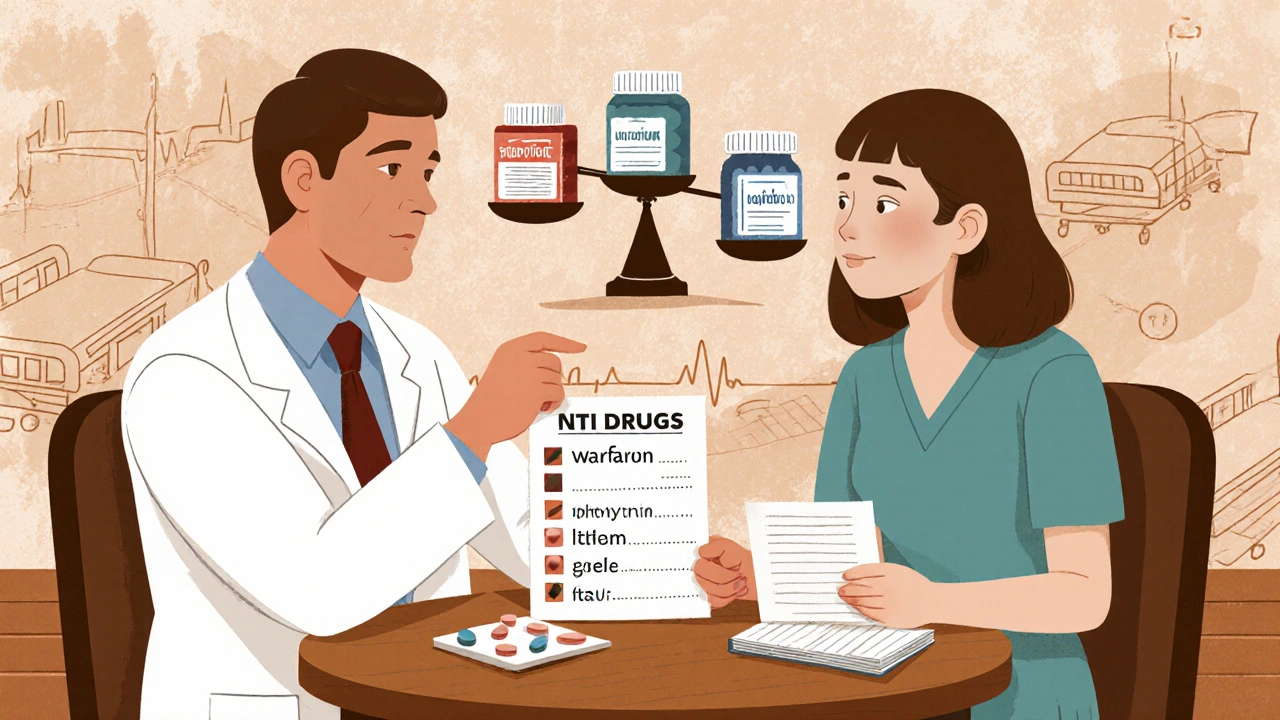
If you take warfarin, phenytoin, lithium, digoxin, or any other NTI drug, here’s what you need to do:
- Ask your doctor: Is this drug on the NTI list? If yes, insist on staying on the same brand unless they say otherwise.
- Ask your pharmacist: Is this the same brand I’ve been taking? If it’s different, ask why and whether you need a blood test.
- Keep a medication list. Include the brand name, dose, and when you started. Bring it to every appointment.
- Don’t assume generics are interchangeable. Even if the label says “equivalent,” that doesn’t mean safe for you.
- If you switch brands and feel different - dizzy, confused, more tired, more anxious - get your blood levels checked immediately.
Some pharmacies will let you request the brand name. If your insurance won’t cover it, ask your doctor to write a letter of medical necessity. Many insurers will approve it if you explain the risk.
The Bigger Picture
Generic drugs save billions. That’s good. But not at the cost of patient safety. For most medications - antibiotics, statins, blood pressure pills - the 80-125% bioequivalence range is fine. The body can handle small variations.
NTI drugs aren’t most medications. They’re the ones that demand precision. Treating them like ordinary drugs ignores decades of clinical evidence. The FDA’s standards were set for broad categories, not for drugs where a 5% change can kill.
Until stricter bioequivalence rules are enforced for NTI drugs, the safest choice is to avoid switching unless your doctor explicitly says it’s okay. And even then - monitor closely. Blood tests aren’t optional. They’re essential.
Frequently Asked Questions
Are all generics unsafe for NTI drugs?
No. Some patients switch without issue. But the risk is unpredictable. Two people on the same generic version might respond completely differently. Because of this, experts recommend avoiding automatic substitution. Always consult your doctor before switching.
Which drugs are considered NTI drugs?
Common NTI drugs include warfarin, phenytoin, lithium, digoxin, theophylline, carbamazepine, cyclosporine, and methadone. Some newer anticoagulants and epilepsy drugs are also being studied for NTI status. Always check with your doctor or pharmacist if you’re unsure.
Can I switch generics if I’m monitored regularly?
Regular monitoring reduces risk, but doesn’t eliminate it. Even with weekly INR checks, switching warfarin brands can cause delays in dose adjustment. Many patients don’t get frequent monitoring - and those who do often miss appointments. The safest approach is to stay on the same formulation unless your doctor recommends a change.
Why doesn’t the FDA require stricter standards for NTI drugs?
The FDA says the current standards are adequate, but many experts disagree. Changing the rules requires more data, which takes time and money. The pharmaceutical industry resists stricter limits because they make generics harder to produce. Until there’s strong evidence of harm - and enough pressure from doctors and patients - the rules stay the same.
What should I do if my pharmacy switches my NTI drug without asking?
Call your doctor immediately. Ask for a blood test to check your levels. If you’re on warfarin, get an INR test within 3-5 days. If you’re on phenytoin or lithium, ask for a serum level test. Don’t wait for symptoms. If your doctor agrees, ask your pharmacy to fill future prescriptions with the original brand - and request a written note for your records.
8 Comments
Neoma GeogheganNovember 24, 2025 AT 21:11
NTI drugs are not toys. Switching generics without monitoring is medical roulette. I’ve seen patients crash after a switch-INR out of range, seizures, the whole mess. Pharmacies need to stop treating these like aspirin.
Bartholemy TuiteNovember 25, 2025 AT 20:59
Man I remember when my cousin got switched from Coumadin to some generic warfarin-no warning, no blood test, just a new bottle. Two weeks later he had a mini-stroke. Docs and pharmacists act like it’s no big deal but the numbers don’t lie. 80-125% range for a drug where 5% can kill? That’s not science, that’s corporate math. North Carolina gets it. Why don’t the rest of us?
Sam JepsenNovember 27, 2025 AT 03:00
As a pharmacist in Ontario, I’ve seen this play out too many times. Patients come in confused because their meds ‘feel different’ after a switch. We’re trained to trust bioequivalence, but NTI drugs? That’s a whole other ballgame. I always flag them. I call the prescriber. I tell the patient: ‘Don’t assume it’s the same.’ It’s not about being anti-generic-it’s about being pro-safety.
Yvonne FranklinNovember 27, 2025 AT 19:28
Phenytoin levels don’t lie. One patient I worked with had steady seizures for months after a switch. Blood test showed 8.2 mcg/mL. He was below therapeutic. Pharmacy didn’t notify anyone. Doctor didn’t know. Patient thought he was just ‘getting worse.’ This isn’t about brand loyalty. It’s about precision medicine. We need mandatory testing after any NTI switch. Period.
Nikhil ChaurasiaNovember 28, 2025 AT 14:46
Respectfully, I have seen both sides. In India, generics are lifelines. But I also read about the warfarin cases. It is a tragedy when a patient suffers because of a switch. Perhaps the answer is not to ban generics, but to create a special category for NTI drugs-like ‘critical use only’-with mandatory monitoring. We must balance access and safety. Both matter.
Holly SchumacherNovember 30, 2025 AT 08:37
Oh please. The FDA has approved these generics. If you’re having issues, it’s because you’re not compliant or your doctor is incompetent. Studies show no significant difference in outcomes. You’re just fearmongering. People who panic over generic switches are the same ones who think vaccines cause autism. Get a grip. Science isn’t your feelings.
Michael FitzpatrickDecember 1, 2025 AT 13:36
I get why people are worried, but I also think we’re overcomplicating it. Most people on warfarin are monitored anyway-monthly INRs, right? So if a switch happens, just check the level after a week. Problem solved. It’s not that generics are dangerous-it’s that we don’t follow up. If every pharmacy had a protocol: ‘Switch NTI? Call doc. Get test in 5 days.’-we’d cut the risks way down. No need for laws. Just better habits.
Shawn DaughheteeDecember 2, 2025 AT 12:17
My mom’s on lithium. She switched generics last year and got super shaky for a week. We didn’t realize it was the med until her doctor checked her levels. Now we only get the brand. Insurance hates it but we don’t care. One bad reaction is one too many. If you’re on one of these drugs, don’t let the pharmacy decide for you. Be your own advocate. Ask. Test. Repeat.