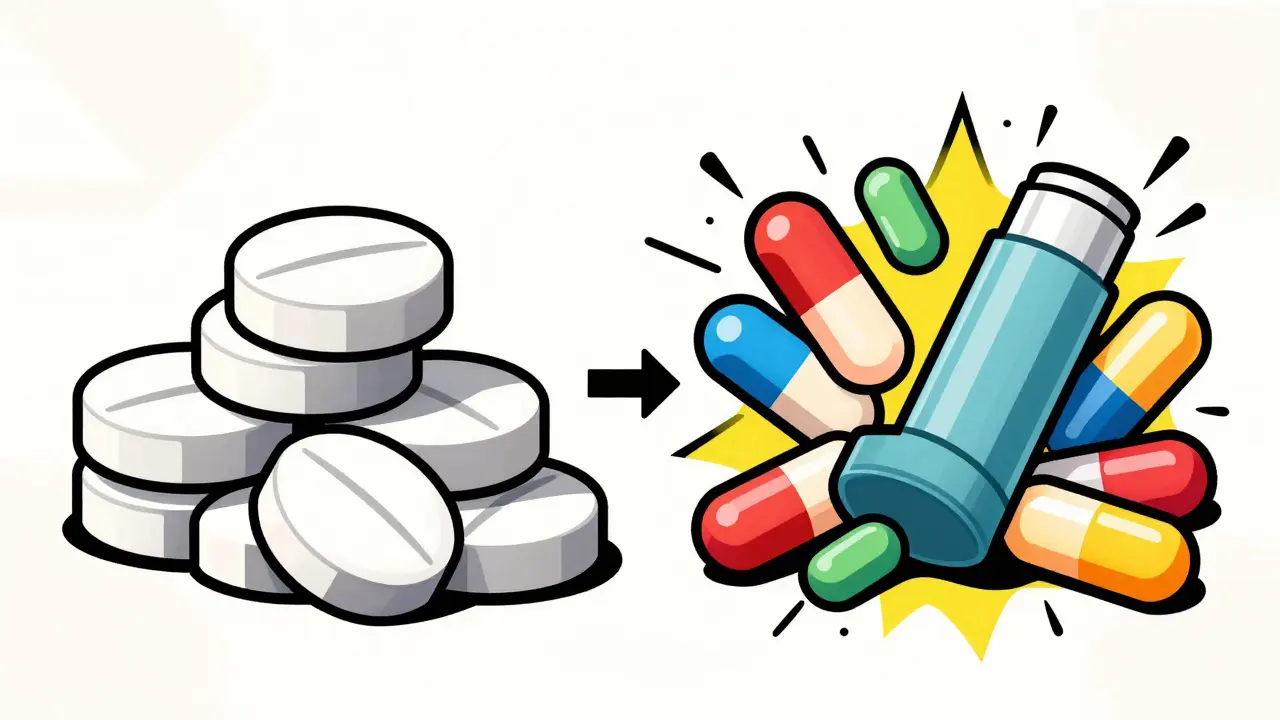
For decades, the word "generic" meant one thing to patients and payers: cheap. You got the same active ingredient as the brand-name drug, usually in a white pill, for a fraction of the cost. But that era is ending. The pharmaceutical landscape is shifting toward generic combinations, which are advanced pharmaceutical products that merge multiple active ingredients, innovative delivery systems, or complex formulations to offer therapeutic advantages over traditional generics. These aren't just copies; they are engineered solutions designed to improve patient compliance, enhance efficacy, and navigate crowded markets.
If you are looking at the data from 2025 and projecting into 2035, the trend is undeniable. The market for these advanced products-often called "super generics"-is exploding. Future Market Insights projects this segment will grow from USD 235.6 billion in 2025 to nearly USD 475 billion by 2035. That is a compound annual growth rate (CAGR) of 7.2%. Why? Because healthcare systems are squeezed. They need the affordability of generics but the clinical outcomes of branded innovations. Generic combinations sit right in that sweet spot.
What Exactly Are Generic Combinations?
To understand where this market is going, we first need to define what we are talking about. It isn't just putting two pills in one bottle. Fixed-dose combinations (FDCs) are pharmaceutical products that combine two or more active pharmaceutical ingredients into a single dosage form to treat a condition or improve adherence. This is the most common type, representing about 62% of the current market volume. Think of a blood pressure medication that combines an ACE inhibitor with a diuretic. It’s simpler for the patient-one pill instead of two-and it ensures they take both components consistently.
But the real action is happening in more complex categories. Drug-device combinations, like inhalers or auto-injectors, make up about 28% of the market but are growing much faster, at a 9.8% CAGR. Then there are the "super-complex" combinations, such as nanoparticle-based systems or multi-component injectables. While they only hold 10% of the market volume now, they are growing at a staggering 12.7% CAGR. These products require sophisticated manufacturing, like hot-melt extrusion or lipid-based delivery systems, and precision equipment that maintains combination ratios within a ±2% tolerance.
| Category | Market Share (2025) | Growth Rate (CAGR) | Complexity Level |
|---|---|---|---|
| Simple FDCs (Oral Solids) | 62% | 5.2% | Low |
| Complex (Drug-Device, Injectables) | 28% | 9.8% | High |
| Super-Complex (Nanoparticles, Multi-component) | 10% | 12.7% | Very High |
The Regulatory Hurdle: Why It's Harder Than Before
You might think that because these are generics, the regulatory path is straightforward. It isn't. Traditional generics follow the Abbreviated New Drug Application (ANDA) pathway, proving bioequivalence to a reference product. Generic combinations face a steeper climb. According to FDA internal metrics from 2024, developing these complex products requires 30-50% more clinical data and takes 18-24 months longer to approve than standard generics.
The challenge lies in proving equivalence when the delivery mechanism itself is part of the innovation. For example, modified-release profiles must demonstrate bioequivalence through specialized pharmacokinetic studies using population PK modeling, as outlined in the FDA's 2024 guidance. A major pain point? The Regulatory Affairs Professionals Society (RAPS) found in 2025 that 78% of generic combination failures stem from inadequate demonstration of equivalence in complex delivery systems, not issues with the active ingredients themselves.
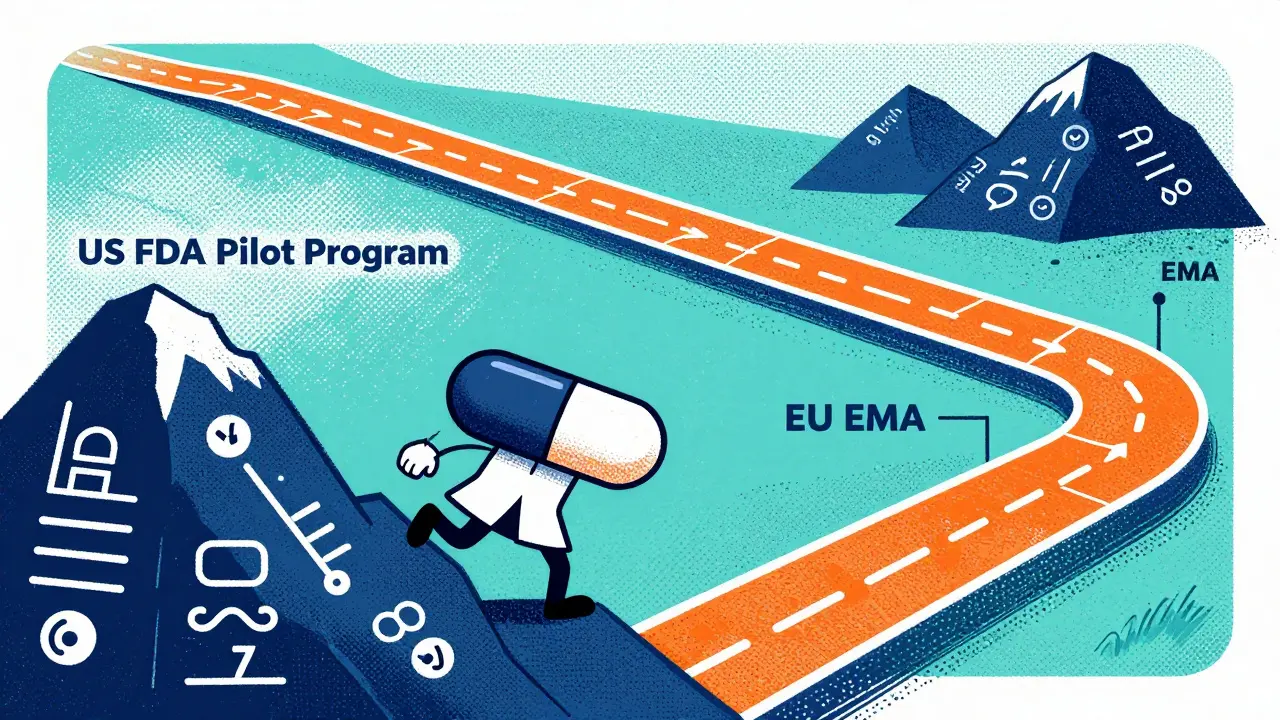
Regulators are aware of this bottleneck. Dr. Janet Woodcock, former director of the FDA’s Center for Drug Evaluation and Research, noted in a 2025 interview that the agency is actively modernizing the ANDA pathway. In October 2025, the FDA launched a pilot program to speed up reviews for generic drugs manufactured entirely in the United States. This move is expected to cut approval timelines by 3-6 months. However, global harmonization remains tricky. The European Medicines Agency (EMA) has taken a more conservative stance. Through the first quarter of 2025, the EU approved only 12 complex generic combinations compared to 37 in the US. If you are a manufacturer, you have to decide whether to prioritize the larger US market with its faster approvals or wait for the EU to catch up.
Market Economics: The Price Premium for Complexity
Why go through the trouble of spending $15-50 million on development (compared to $1-5 million for simple generics) and waiting 4-7 years? The answer is pricing power. Traditional generics suffer from brutal price erosion. Within two years of launch, prices often drop by 80-90% as competitors flood the market. IQVIA’s 2025 analysis shows that generic combinations maintain 40-60% of their price over five years. That retention is lifeblood for profitability.
Look at the margins. Simple generics in high-volume areas like statins operate on less than 5% margins. Generic combinations in specialized areas like central nervous system (CNS) disorders or complex cardiovascular conditions command 20-35% margins. Take Teva’s Budeprion XL, an extended-release bupropion. It achieved $187 million in annual sales before facing significant generic competition. Compare that to traditional bupropion generics, which combined for only $42 million in sales. The complexity created a moat around the revenue.
This economic reality is driving consolidation. In Q2 2025, Viatris and Credence completed a $2.3 billion merger specifically to bolster capabilities in complex generics. Sandoz, after separating from Novartis, positioned itself as a pure-play generics company focused heavily on these higher-value products. The message is clear: if you want to survive as a generics manufacturer, you need to be good at making things that are hard to copy.

Therapeutic Hotspots: Where the Money Is Going
Not all therapeutic areas are created equal when it comes to generic combinations. The wave of patent expirations between 2025 and 2030 is massive, with branded drugs generating $217-$236 billion in annual sales losing exclusivity. But where should companies focus their R&D?
- Oncology: This is the fastest-growing segment, with an 11.3% CAGR. Kinase inhibitor combinations are particularly promising. As cancer treatments become more complex, requiring multiple targets to be hit simultaneously, FDCs simplify regimens for patients undergoing chemotherapy.
- Respiratory: Growing at 9.89% CAGR, driven by inhalable generics. High-value targets include combinations like Trelegy Ellipta (fluticasone/umeclidinium/vilanterol), which had $2.8 billion in US sales in 2024. Developing a generic version of a dry powder inhaler is technically demanding but financially rewarding.
- Central Nervous System (CNS): With an 8.7% CAGR, CNS disorders offer strong opportunities. Drugs like Austedo (deutetrabenazine) for movement disorders generated $1.2 billion in sales in 2024. Complex CNS formulations often involve modified-release mechanisms to manage side effects and improve tolerability.
Interestingly, the GLP-1 market is also heating up. Aspen Pharmacare reported in 2025 significant progress on "generic semaglutide combinations," targeting the $100+ billion diabetes and obesity market. Fixed-dose versions combining semaglutide with other diabetes medications are currently in development. This signals that even blockbuster biologics-inspired small molecules are becoming targets for generic combination strategies.
Future Outlook: Risks and Opportunities
The trajectory for generic combinations is positive, but it’s not without risks. Dr. Aaron Kesselheim of Harvard Medical School warned in a 2025 NEJM article that the therapeutic equivalence standard for complex generics remains inadequately defined. As companies push the boundaries of what constitutes a "super generic," there is potential for safety gaps if regulators don’t keep pace with scientific rigor.
Additionally, pricing pressure is intensifying. Morningstar warns that unless companies successfully transition to higher-value combinations, margins for all generics could erode by 30% over the next decade. The US market, which dominates with 42% share due to favorable reimbursement policies, is seeing net price growth of 11.4% in 2025 (up from 4.9% in 2024). However, this growth is largely driven by these complex products.
Three dominant trends will shape the next five years:
- Increasing Complexity Premium: Products with multiple innovations (e.g., a novel device plus a modified-release formulation) will command 2-3x the pricing of traditional generics.
- Regional Regulatory Divergence: Expect the US to continue adopting more flexible approaches for complex combinations while the EU remains cautious. Companies will need dual-track regulatory strategies.
- Strategic Partnerships: We’ll see more collaborations between device manufacturers and generic pharma firms. For instance, Catalent partnered with Hikma on auto-injectors, leveraging each other’s strengths in hardware and chemistry.
By 2030, analysts project that super generics will capture 35-40% of the total generics market value. This isn't just an evolutionary step; it's a strategic necessity. For manufacturers, the question is no longer "should we make complex generics?" but "how fast can we build the capability to do so?" The window of opportunity, driven by the 2025-2030 patent cliff, is open now. Those who master the regulatory and technical challenges will define the next era of affordable healthcare.
What is the difference between a traditional generic and a generic combination?
A traditional generic replicates a single active ingredient from a branded drug, focusing on cost reduction. A generic combination merges multiple active ingredients, uses innovative delivery systems (like inhalers or auto-injectors), or employs modified-release technologies to offer therapeutic advantages such as improved efficacy, safety, or patient compliance, often commanding higher prices and longer market exclusivity.
How long does it take to get FDA approval for a complex generic combination?
According to 2024 FDA internal metrics, complex generic combinations typically require 18-24 months longer to approve than traditional generics. The entire development cycle can take 4-7 years, compared to 2-3 years for simple generics, due to the need for additional clinical data and specialized bioequivalence studies.
Which therapeutic areas are growing fastest for generic combinations?
Oncology is the fastest-growing segment with an 11.3% CAGR, followed by respiratory at 9.89% CAGR, and central nervous system (CNS) disorders at 8.7% CAGR. These areas benefit from high unmet needs and complex treatment regimens that lend themselves well to combination therapies.
Why are generic combinations more profitable than traditional generics?
Traditional generics face severe price erosion, often dropping 80-90% within two years. Generic combinations maintain 40-60% of their price over five years due to higher barriers to entry (technical complexity and regulatory hurdles). This allows them to achieve margins of 20-35%, compared to less than 5% for simple generics.
Is the regulatory environment for generic combinations different in the US vs. Europe?
Yes. The US FDA has been more aggressive in approving complex generic combinations, with 37 approved through Q1 2025 compared to only 12 in the EU under the EMA. The FDA also launched a pilot program in October 2025 to speed up reviews for US-manufactured generics, creating a regional disparity that manufacturers must navigate.