Why Your Kidneys Need Checking - Even If You Feel Fine
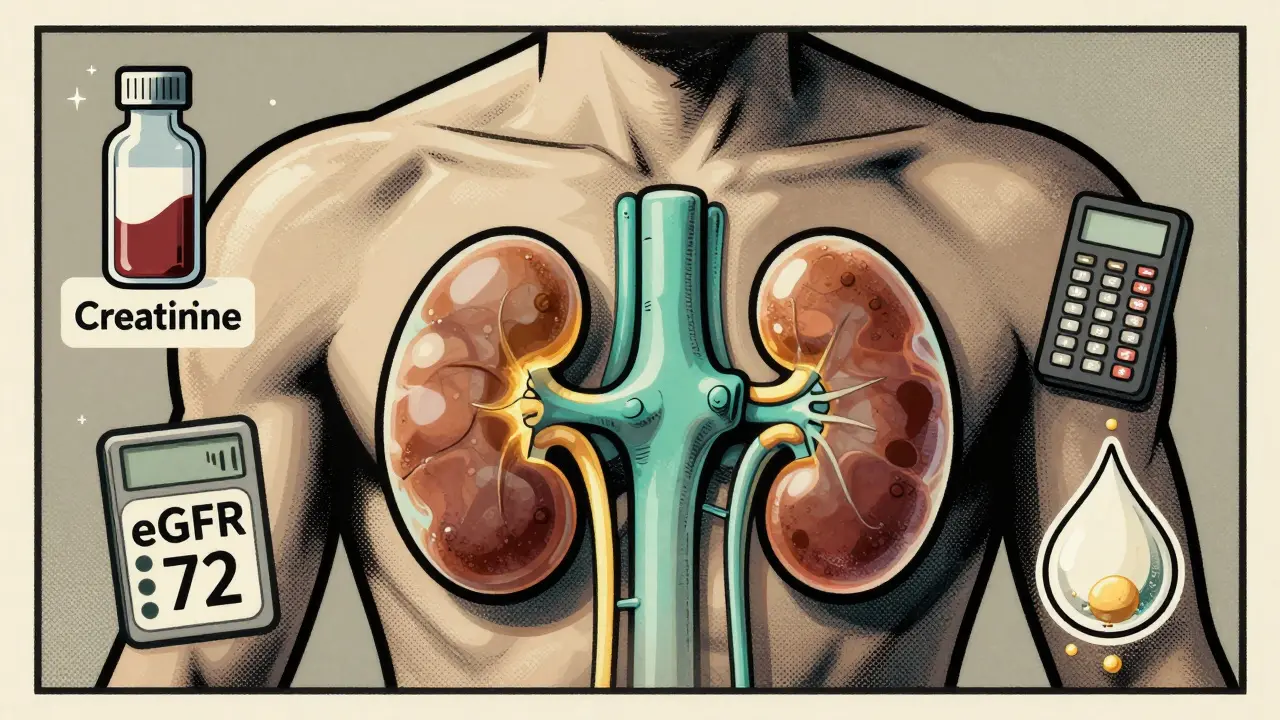
Your kidneys filter about 120 to 150 quarts of blood every day. That’s roughly 50 gallons. They remove waste, balance fluids, control blood pressure, and even help make red blood cells. But here’s the thing: your kidneys don’t scream when they’re in trouble. By the time you feel tired, swollen, or nauseous, you might have already lost half their function. That’s why simple blood and urine tests - creatinine, GFR, and urinalysis - are the quiet heroes of kidney health. These aren’t fancy scans or invasive procedures. They’re quick, cheap, and often done during your annual check-up. And if you’re over 40, have high blood pressure, diabetes, or a family history of kidney problems, skipping them is like ignoring a check-engine light on your car.
What Creatinine Tells You - And What It Doesn’t
Creatinine is a waste product made when your muscles break down. Your kidneys filter it out and send it into your urine. When your kidneys slow down, creatinine builds up in your blood. That’s why doctors measure it in a simple blood test.
But here’s the catch: creatinine doesn’t rise until you’ve lost about half your kidney function. It’s not a sensitive early warning sign. A 60-year-old man with 40% kidney function might still have a "normal" creatinine level because his muscle mass is higher than average. A small-framed woman with the same level of damage might show a higher creatinine because she has less muscle to begin with. That’s why creatinine alone isn’t enough. It’s a clue - not the full story.
Normal creatinine levels vary by age, sex, and body size. In most labs, the range is around 0.7 to 1.3 mg/dL for men and 0.6 to 1.1 mg/dL for women. But numbers alone don’t tell you if your kidneys are failing. That’s where GFR comes in.
Understanding GFR: The Real Measure of Kidney Performance
Glomerular Filtration Rate, or GFR, is the gold standard for measuring how well your kidneys filter blood. It’s not directly measured - it’s calculated. And that calculation? It uses your creatinine level, age, sex, and sometimes race.
The most accurate formula used today is called CKD-EPI. It replaced the older MDRD equation around 2010 because it’s more precise, especially for people with near-normal kidney function. Most UK labs now report eGFR (estimated GFR) automatically alongside your creatinine result. You don’t need to ask for it.
Here’s what the numbers mean:
- 90 or above: Normal kidney function - even if there’s mild damage
- 60-89: Mildly reduced - watch for other signs
- 45-59: Moderately reduced - time to talk to your doctor
- 30-44: Severely reduced - likely need specialist care
- 15-29: Very severe - preparation for dialysis or transplant may begin
- Below 15: Kidney failure - treatment is urgent
But eGFR isn’t perfect. If you’re very muscular, pregnant, under 18, or severely overweight, the calculation can be misleading. In those cases, doctors might use cystatin C - another blood marker that’s less affected by muscle mass. It’s not routine yet, but it’s becoming more common in complex cases.
Urinalysis: The Silent Sign of Early Damage
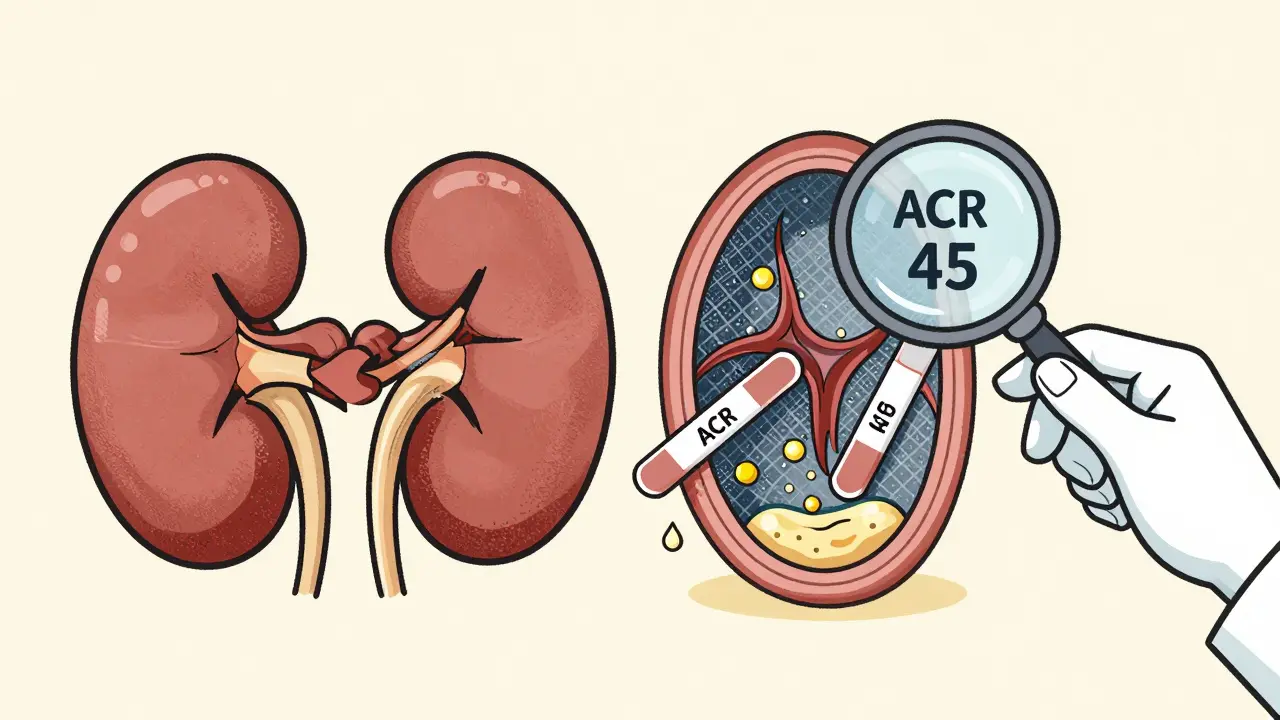
One of the earliest signs of kidney disease isn’t seen in blood - it’s found in your urine. When the filters in your kidneys get damaged, they start leaking protein - mostly a type called albumin. That’s called albuminuria.
Back in the day, doctors used dipstick tests: you pee on a paper strip, and it changes color if protein is present. But those are unreliable. They miss small amounts of protein and can give false positives from dehydration or infection. Today, the UK Kidney Association recommends a urine albumin-to-creatinine ratio (ACR) instead.
Here’s how it works: you give a single urine sample - no 24-hour collection needed. The lab measures how much albumin is in your urine compared to creatinine. That gives a clear, standardized number.
- Less than 3 mg/mmol: Normal
- 3 to 70 mg/mmol: Mild to moderate protein leakage - needs retesting
- Over 70 mg/mmol: Significant damage - likely kidney disease
One high ACR doesn’t mean you have kidney disease. It needs to be confirmed with a second test, usually three months later. But if you have diabetes or high blood pressure and your ACR is above 3, you’re already at higher risk. Catching it early means you can start medications like ACE inhibitors or SGLT2 inhibitors - drugs that not only protect your kidneys but also lower your risk of heart attacks.
Why You Need Both Tests - Blood AND Urine
Here’s where most people get confused. You might think: "My creatinine is normal, so my kidneys are fine." But what if your ACR is 45? That means your kidneys are leaking protein - a sign of early damage - even though they’re still filtering creatinine okay.
That’s why guidelines from the UK Kidney Association and the National Kidney Foundation say you need both eGFR and ACR. One tells you how well your kidneys are filtering. The other tells you if the filters themselves are broken.
Think of it like a sieve. If the holes get bigger, small stuff (like albumin) leaks through. The sieve might still let water pass - so the flow rate (GFR) looks fine. But the damage is happening. Only the ACR catches it.
People with diabetes, high blood pressure, heart disease, or a history of acute kidney injury should get both tests at least once a year. Even if you’re not in a high-risk group, asking for them during your annual blood work is smart. Many people with early kidney disease have no symptoms until it’s advanced.
What Happens If Your Results Are Abnormal?
If your eGFR drops below 60 or your ACR is high, your doctor won’t panic. They’ll want to repeat the tests. Kidney function can dip temporarily due to dehydration, infection, or certain medications like NSAIDs (ibuprofen, naproxen).
If the results stay abnormal after 3 months, you’re likely dealing with chronic kidney disease (CKD). The next steps depend on the stage:
- Stage 1 or 2 (eGFR 60+ with proteinuria): Focus on controlling blood pressure and blood sugar. Stop smoking. Avoid NSAIDs. Eat less salt. Your doctor might prescribe an ACE inhibitor or ARB - drugs that protect your kidneys even if your blood pressure is normal.
- Stage 3 (eGFR 30-59): You’ll likely be referred to a nephrologist. Blood tests for phosphate, calcium, and vitamin D may be added. You’ll need to monitor your diet - less protein, less potassium if levels are high.
- Stage 4 or 5 (eGFR below 30): Planning for dialysis or transplant begins. You’ll work with a team that includes dietitians, nurses, and social workers.
The good news? Slowing or stopping kidney disease progression is possible - especially in the early stages. Many people with Stage 2 CKD live for decades without needing dialysis.
What About 24-Hour Urine Tests?
You might have heard about collecting urine for 24 hours. That test measures total protein, sodium, potassium, and other substances. It’s accurate - but it’s a pain. You need to save every drop for a full day, keep it cool, and bring it in. Most doctors don’t use it anymore unless they suspect a rare condition like nephrotic syndrome or kidney stones.
For routine screening, ACR is better. It’s just as accurate, much easier, and cheaper. Save the 24-hour test for when your doctor specifically asks for it.
Who Should Get Tested - And How Often?
You don’t need to be sick to need these tests. If you fall into any of these groups, ask your GP for eGFR and ACR:
- You have diabetes (type 1 or 2)
- You have high blood pressure
- You’re over 60
- You have heart disease or have had a heart attack
- You’ve had acute kidney injury in the past
- A close relative has kidney failure
- You’re on long-term NSAIDs or certain antibiotics
For high-risk people: test every year.
For average-risk adults over 40: ask once during your annual check-up. If everything’s normal, you can repeat it every 2-3 years.
What You Can Do Right Now
You don’t have to wait for your next appointment. Here’s what you can do today:
- Check your last blood test results. Look for "eGFR" and "ACR" - not just creatinine.
- If you don’t see them, call your GP and ask: "Can I get my eGFR and urine ACR checked?"
- If you have diabetes or high blood pressure, make sure you’re on the right meds. ACE inhibitors or SGLT2 inhibitors can protect your kidneys.
- Reduce salt. Cut back on processed foods. Drink water - but not excessive amounts.
- Avoid regular ibuprofen or naproxen. Use paracetamol instead if you need pain relief.
Kidney disease doesn’t happen overnight. It creeps up. But catching it early? That’s your best shot at keeping your kidneys working - and your life normal - for years to come.
Can I check my kidney function at home?
No reliable home tests exist for eGFR or ACR. You can buy urine dipsticks online, but they’re not accurate enough for early detection. The only way to get trustworthy results is through a lab test ordered by your doctor. Don’t rely on apps or wearable devices - they don’t measure kidney function.
Does drinking more water improve kidney function?
Drinking water helps your kidneys flush out waste, but it won’t fix damaged filters. If you’re dehydrated, your creatinine might rise temporarily - but that’s not kidney disease. Drinking excessive water won’t lower your eGFR or stop protein leakage. Stick to normal hydration - about 6 to 8 glasses a day. If you’re not thirsty, you’re probably fine.
Why does race matter in eGFR calculations?
Older formulas included a "race correction" for Black patients because studies showed they tend to have higher muscle mass on average, which raises creatinine. But this approach is being phased out. Many UK labs now use race-neutral formulas. The NHS is moving toward more accurate, individualized calculations. If you’re unsure, ask your lab or GP which formula they’re using.
Can kidney damage be reversed?
Once kidney tissue is scarred, it can’t regenerate. But early damage - like inflammation or protein leakage - can often be slowed or even reversed with proper treatment. Controlling blood pressure, managing diabetes, and taking kidney-protective medications can stop further harm. The goal isn’t always to fix what’s broken - it’s to stop it from getting worse.
What foods should I avoid if my kidney function is low?
If your eGFR is below 45, you may need to limit salt, phosphorus, and potassium. Avoid processed meats, canned soups, cheese, nuts, bananas, oranges, and potato products. But don’t change your diet without talking to a dietitian. Too many restrictions can cause malnutrition. A simple rule: eat whole foods, cook at home, and avoid adding salt. Your doctor can refer you to a renal dietitian if needed.
9 Comments
Donna MacaranasFebruary 2, 2026 AT 10:10
Just got my bloodwork back and saw my eGFR was 62. I didn't even know what that meant until I read this. Thanks for breaking it down so clearly - I'm scheduling my ACR test this week. No more ignoring the quiet stuff.
Naomi WalshFebruary 4, 2026 AT 08:24
Ugh. Another oversimplified article that treats CKD like it's a glitch you can fix with a blood test and some tea. The fact that we still use race-adjusted formulas in some places is a scandal. And don't get me started on how GFR is just a statistical guess wrapped in a lab coat. Real nephrologists use cystatin C + creatinine + urine osmolality + 24-hour clearance - not some algorithm spit out by an EHR.
Jaden GreenFebruary 5, 2026 AT 05:56
Look, I'm not saying this isn't useful, but let's be real - most people who read this are already hypochondriacs or have diabetes. The rest of us? We're fine. My creatinine's 0.9, I don't take NSAIDs, I drink water, I don't eat processed crap. Why am I supposed to care about some "ACR" number that's probably just a billing code? I mean, if I'm not peeing blood or swelling up like a balloon, why does it matter? I'm not paying for a yearly kidney audit just because some algorithm says I might be "at risk."
And don't even get me started on the "avoid bananas" thing. My aunt's on dialysis and she still eats a banana every morning. She's 82. She's happy. Maybe the real problem is we're medicalizing normal aging.
Angel FitzpatrickFebruary 6, 2026 AT 22:18
They don't want you to know this, but the real reason they push eGFR and ACR is because Big Pharma owns the labs. ACE inhibitors? SGLT2 inhibitors? Those are billion-dollar drugs. The kidney industry is a cash cow - and they need you scared enough to get tested every year so you'll keep buying the pills.
Meanwhile, the real causes? Glyphosate in your food. PFAS in your water. EMF radiation from your phone frying your tubules. But nope - let's just blame your salt intake and call it a day. They'll tell you to "eat whole foods" while the same corporations sell you the processed stuff in the next aisle.
Check your water filter. Stop using non-stick pans. And if your doctor mentions "race correction," walk out. That's eugenics wrapped in a lab report.
Nidhi RajparaFebruary 7, 2026 AT 09:37
Dear Author, I appreciate your detailed explanation regarding kidney function assessment. However, I would like to respectfully suggest that the term "quiet heroes" may be overly anthropomorphic and semantically imprecise in a medical context. Furthermore, the phrase "check-engine light" is a metaphor that, while accessible, may undermine the scientific rigor of the content. I have attached a peer-reviewed citation regarding the validation of CKD-EPI in South Asian populations, which you may wish to incorporate for greater global relevance. Thank you for your consideration.
With sincere regards,
Nidhi Rajpara, M.Sc. (Biomedical Sciences)
Chris & Kara CutlerFebruary 8, 2026 AT 14:41
YESSSS! 👏 I told my dad to get his ACR checked after reading this - he’s 68, diabetic, and thought he was fine because his creatinine was "normal." Turned out his ACR was 52. Now he’s on an SGLT2 inhibitor and his numbers are improving! 🙌 Don’t wait till you feel bad - your kidneys don’t yell, they whisper. Listen. 💪❤️
Rachel LiewFebruary 8, 2026 AT 22:36
i just got my results and my eGFR was 58... i was scared. but reading this made me feel like it’s not the end of the world. i’m gonna cut back on salt, ask my doc about the med, and get my ACR redone. thank you for writing this like you actually care. 💛
Jamie Allan BrownFebruary 9, 2026 AT 13:08
There’s something deeply human about how quietly our bodies fail us. We live in a world that screams for attention - alarms, notifications, ads - but our kidneys? They just… stop. No fanfare. No warning siren. Just a slow fade.
I lost my mother to CKD. She never complained. Never said she felt off. Just got tired. Then she stopped cooking. Then she stopped answering texts.
This post? It’s not just medical advice. It’s a lifeline for people who don’t know how to ask for help. Thank you for saying what so many doctors won’t: "Get tested. Even if you feel fine."
Lisa RodriguezFebruary 9, 2026 AT 20:47
My dad had a kidney transplant 5 years ago and I’ve been obsessed with this stuff ever since. One thing nobody talks about: ACR can fluctuate with UTIs or even a really intense workout. So if your number’s borderline, don’t panic. Get it retested in 3 months. And if your doc doesn’t mention eGFR or ACR automatically - ask. It’s your body. You deserve to know what’s going on.
Also - paracetamol over ibuprofen? Yes please. I’ve been doing that for years. No more stomach issues and my kidneys thank me.
PS: I’m not a doctor but I’ve read a lot of nephrology papers. This info is solid.