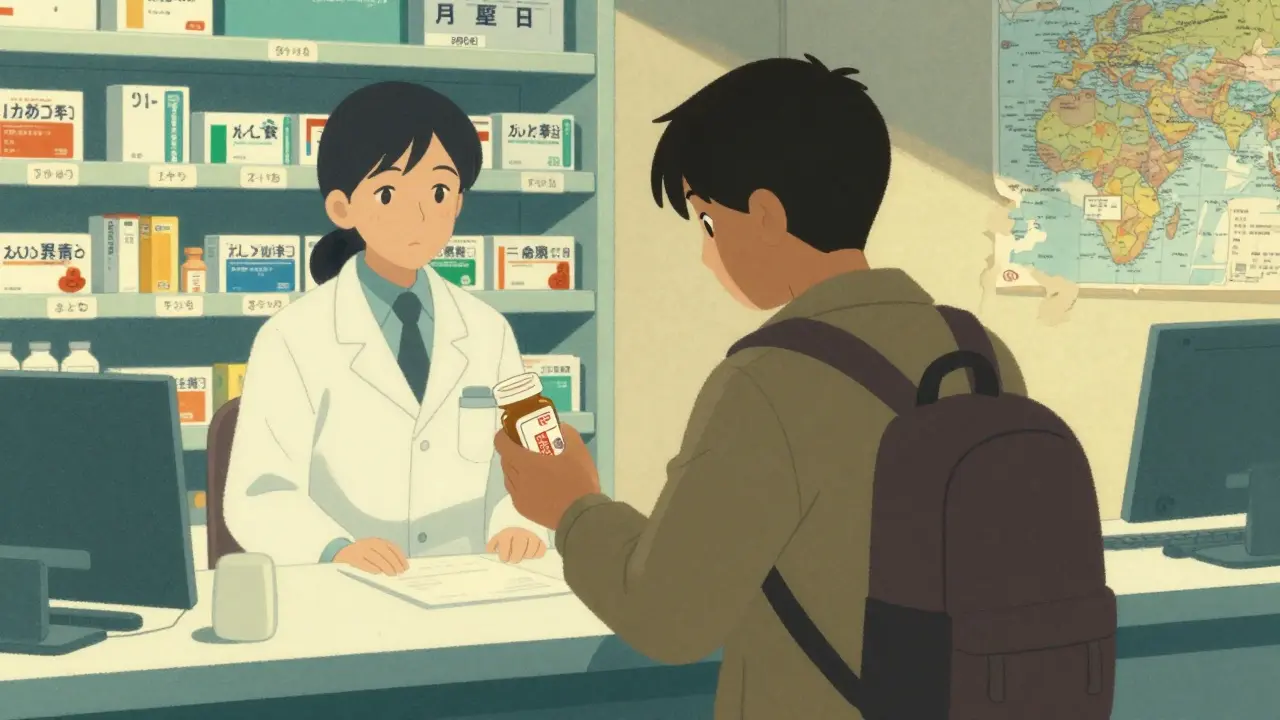
Imagine you’re halfway through your trip in Tokyo, and your anxiety medication runs out. You go to a pharmacy, show your prescription, and they hand you a blank stare. Or worse - they confiscate it. This isn’t rare. In fact, medications abroad are one of the top three medical emergencies travelers face, according to the CDC’s 2025 Yellow Book. The problem isn’t just running out of pills. It’s that what’s legal in your home country might be illegal, restricted, or completely unavailable overseas - even if you have a doctor’s note.
Why Your Prescription Doesn’t Work Everywhere
Not all drugs are created equal across borders. What’s a common over-the-counter sleep aid in the U.S. - like zolpidem (Ambien) - is a strictly controlled narcotic in Japan and the UAE. In Australia, pseudoephedrine (found in cold medicines like Sudafed) is banned because it’s used to make methamphetamine. In Malaysia, even diazepam (Valium) is illegal, no matter how many prescriptions you bring. The root of this mess? International drug treaties from the 1960s that gave countries freedom to set their own rules. Today, 184 countries follow the 1971 Psychotropic Substances Convention, but how they enforce it? Totally different. The World Health Organization says 56% of low- and middle-income countries don’t have enough pain meds for their own citizens. That means even if you’re carrying legal medication, local pharmacies might not stock it - or won’t refill it without a local doctor’s approval.What You Can and Can’t Bring Across Borders
Most countries allow you to carry a 90-day supply of your regular meds - but not all. Japan limits narcotics to 30 days. Singapore caps it at 14 days. And some places, like the UAE, require you to get approval before you even land. Here’s what you must do before you fly:- Keep every pill in its original bottle with the pharmacy label - no pill organizers, no ziplock bags.
- Bring a doctor’s letter on official letterhead. It must include your name, the generic drug name, dosage, reason for use (with ICD-11 code), and your doctor’s license number.
- Get a notarized translation if the destination country doesn’t use English. This isn’t optional in places like Thailand, South Korea, or Russia.
- Double-check the International Narcotics Control Board (INCB) database for your destination. As of October 2025, only 68 countries have published clear rules. The rest? You’re guessing.
What to Do If You Lose or Run Out of Medication
If you run out, don’t panic - but don’t try to buy something off the street either. Here’s what actually works:- Find a local clinic or hospital. Many major cities have international medical centers that deal with travelers. Look for the International Association for Medical Assistance to Travellers (IAMAT) network - they vet over 1,400 clinics worldwide.
- Bring your original prescription and doctor’s letter. Even if they can’t refill your exact brand, they can often prescribe a generic equivalent.
- Ask for the generic name. If you take Lexapro, ask for escitalopram. If you take Adderall, ask for amphetamine/dextroamphetamine. Brand names vary wildly - generics don’t.
- Be prepared to pay out-of-pocket. Most foreign clinics won’t accept U.S. insurance. Budget $50-$150 for a consultation and new prescription.
Europe vs. Asia vs. North America: What’s Easier?
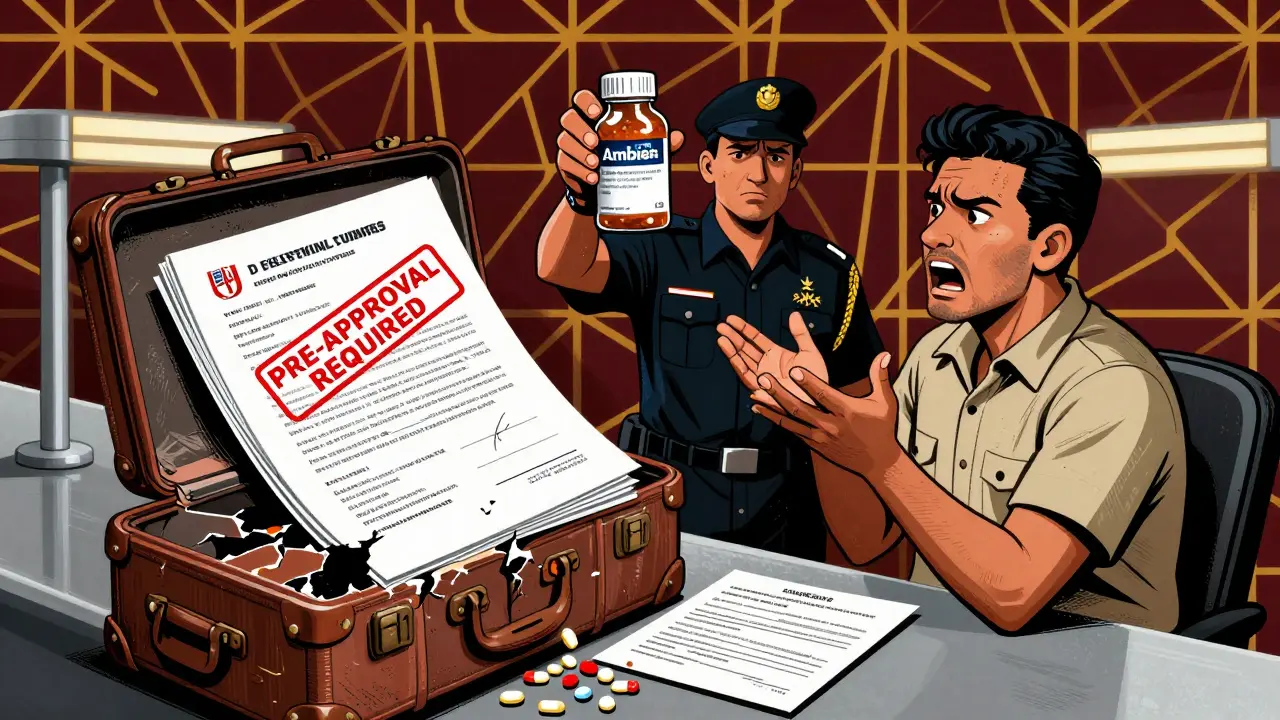
Your chances of getting meds abroad depend heavily on where you are. Europe (EU/EEA): Best-case scenario. If you have a prescription from Germany, France, or Spain, you can walk into a pharmacy in any other EU country and get it filled. The EU’s electronic prescription system works across 24 countries. No doctor’s letter needed - just your prescription and ID. Success rate? Over 98%. United States: Tough. The U.S. is ranked 23rd globally for traveler medication access. ADHD meds like Adderall are Schedule II controlled substances. You can’t bring them into Japan, Singapore, or the UAE without a special permit - and even then, approval takes weeks. Canada is easier: under the 2025 Importation Act, you can legally bring in a 90-day supply from approved countries like the UK or EU. Asia: High risk. Japan, Singapore, Thailand, and the UAE are the big trouble spots. Japan doesn’t allow any opioid painkillers without pre-approval. Singapore bans benzodiazepines unless you’ve applied for a permit 30 days ahead. Thailand is more relaxed - most meds are available with a local prescription - but don’t assume. Middle East: Extreme caution. The UAE confiscated 1,247 medications in 2024 - mostly sleep aids, anxiety meds, and painkillers. Even if you have a doctor’s note, customs may still seize it. Some travelers report being detained for hours while officials call embassies. Don’t risk it.Real Stories: What Went Wrong
A student in Berlin lost her Adderall and tried to get a refill. The clinic said no - U.S. stimulants aren’t recognized. She ended up flying to Vienna, where a doctor wrote a new prescription using the generic name. A couple in Dubai had their Ambien taken at customs. They had the prescription and a doctor’s letter - but the UAE requires pre-approval for zolpidem. They missed three days of their honeymoon waiting for paperwork. A retiree in Thailand ran out of his blood pressure pills. He walked into a local pharmacy, showed his U.S. bottle, and the pharmacist handed him the same brand - no questions asked. He paid $3 for a 30-day supply. The difference? Preparation. One person knew the rules. The others didn’t.How to Prepare - Step by Step
Start at least 8-12 weeks before you leave. Here’s your checklist:- Check the INCB database for your destination. Search by country and drug name.
- Contact the embassy of your destination country. Ask: “What are the rules for bringing [drug name] into your country?” Get it in writing.
- Visit your doctor. Ask for a letter with: your full name (matches passport), drug names (generic + brand), dosage, quantity, ICD-11 code, and their license number. Don’t skip the ICD-11 code - 78% of refusals happen because it’s missing.
- Get translations notarized if needed. Use a certified translator - Google Translate won’t cut it.
- Carry extra copies - one in your carry-on, one in your checked bag, one emailed to yourself.
- Use TSA Cares if flying from the U.S. Call 1-855-787-2227 72 hours before your flight. They’ll help you get through security without hassle.
What to Do If You’re Denied Medication
If customs takes your meds:- Stay calm. Arguing won’t help.
- Ask for a written receipt. It’s your proof you had them.
- Call your country’s embassy immediately. They can’t get your meds back, but they can help you find local care.
- Use IAMAT or local hospitals to get a replacement prescription.
- Report the incident to WHO’s Access to Medicines program. Your experience helps push for change.
The Future Is Changing - But Slowly
Good news: The WHO released a new standardized template for international medication documentation in May 2025. It’s set to roll out in 2026. This means one form, one language, one process - for controlled drugs. It’s the biggest step forward in 15 years. The U.S. is also moving. The 2025 Importation Act lets Americans legally buy certain meds from Canada, the UK, and EU countries - as long as the pharmacy is certified. That could cut costs and reduce risk. But until then? You’re on your own. And the only way to avoid disaster is to plan ahead.Final Tip: Don’t Trust Online Forums
Reddit threads say “I brought my Adderall to Japan and no one cared.” That’s a lie. Or a lucky exception. The same forum has 1,427 posts from people who got arrested, fined, or had their meds confiscated. Don’t gamble your health on one person’s story. Check official sources. Call embassies. Talk to your doctor. Use the WHO and INCB. The rules aren’t always fair - but they’re real. And ignoring them doesn’t make you brave. It makes you vulnerable.Can I bring my prescription medication on a plane?
Yes - but only if it’s in its original container with the pharmacy label. The TSA allows reasonable quantities of medically necessary liquids over 3.4 ounces if declared at security. Always carry a doctor’s letter, especially for controlled substances like opioids, stimulants, or sedatives.
What if my medication isn’t available in the country I’m visiting?
Find a local clinic through the IAMAT network or a major hospital. Bring your original prescription and doctor’s letter. Ask for the generic drug name - it’s more likely to be available. You’ll likely need to pay out-of-pocket, but most countries will write you a new prescription if your condition is verified.
Are over-the-counter meds safe to bring abroad?
No. Many OTC drugs contain ingredients banned overseas. Pseudoephedrine (in cold pills) is illegal in Australia, New Zealand, and the UAE. Dextromethorphan (in cough syrup) is controlled in Canada and Singapore. Always check the active ingredients - not just the brand name.
Can I get a local prescription for my U.S. medication?
Maybe. Some countries will accept your U.S. prescription if it’s translated and includes the generic name. Others require you to see a local doctor first. Countries in the EU are most likely to honor it. In Asia and the Middle East, expect to pay for a consultation and get a new script.
How far in advance should I plan for international medication needs?
At least 8-12 weeks. If you need special permits (like for opioids or stimulants), start 3-4 months ahead. Embassy approvals can take weeks. Doctor’s letters, translations, and notarizations take time. Don’t wait until the last minute - you might be stuck without your meds.
10 Comments
RAJAT KDJanuary 8, 2026 AT 16:47
Just got back from Bangkok-ran out of my antidepressants. Walked into a local pharmacy, showed my bottle, they handed me the exact same brand for $2. No paperwork. No drama. Maybe the system isn’t as broken as they say.
Micheal MurdochJanuary 10, 2026 AT 03:28
Look, I get the fear-mongering, but let’s be real-most people who get caught with meds abroad are either dumb or lazy. I’ve traveled to 27 countries with my Adderall in a Ziploc. Never once had an issue. The real problem? Not knowing your own body’s needs and then panicking when bureaucracy gets in the way. Prepare? Sure. Obsess? No. There’s a middle ground.
Aron VeldhuizenJanuary 11, 2026 AT 13:28
You say ‘don’t trust Reddit threads’-but you cite a 1,427-post thread about arrests as your main evidence. That’s not skepticism, that’s confirmation bias dressed up as caution. The fact that some people got caught doesn’t mean all of us are walking targets. I’ve flown with Ambien into Japan twice. They didn’t even glance at my bottle. The system isn’t monolithic-it’s chaotic, inconsistent, and often absurd. Your checklist feels like a cult manual for medical paranoia.
Diana StoyanovaJanuary 13, 2026 AT 00:26
Okay but imagine you’re a single mom with anxiety, flying to Italy with your 8-year-old, and your doctor’s office won’t give you a letter because ‘it’s not medically necessary to document your SSRIs for travel.’ What then? You’re not a criminal for needing to function. You’re a human. The system should adapt to real lives, not the other way around. I’ve had to call three embassies just to confirm if my Prozac is allowed. This isn’t preparation-it’s bureaucratic torture disguised as safety.
Phil KemlingJanuary 13, 2026 AT 14:04
There’s a deeper philosophical tension here: autonomy versus sovereignty. We expect our personal medical needs to be universally recognized, yet nations guard their pharmacopeias like state secrets. The 1971 Convention was never meant to criminalize depression. But now, a person’s right to mental stability is contingent on a notarized document from a foreign jurisdiction. We’ve turned self-care into a diplomatic negotiation. And the worst part? We’ve normalized it.
Jacob PatersonJanuary 14, 2026 AT 02:25
Let me guess-you also think ‘I’m just a traveler’ makes you above the law? You carry Adderall into Singapore like it’s a souvenir? Congrats, you’re not brave-you’re reckless. And now you’re putting other travelers at risk because your ignorance becomes someone else’s headline. The UAE doesn’t care if you ‘just needed it.’ They care that you broke their rules. Your ‘I’ve never had a problem’ is the exact mindset that lands people in jail. Stop romanticizing your privilege.
Chris KauweJanuary 15, 2026 AT 06:06
It’s not about ‘preparation’-it’s about systemic asymmetry. The Global North exports pharmaceuticals while the Global South enforces prohibitionist frameworks rooted in colonial-era drug policies. The WHO’s 2026 template is a band-aid. What we need is decolonization of pharmacological governance. Until then, the ‘checklist’ is just a neoliberal coping mechanism for structural violence disguised as personal responsibility.
tali murahJanuary 15, 2026 AT 08:58
Wow. Just… wow. You wrote a 3,000-word essay on how to not get arrested while carrying your anxiety pills, and somehow still missed the point: the real crisis isn’t border control-it’s that your country lets pharmaceutical companies dictate mental health access. You’re not preparing for travel-you’re preparing to beg for your own sanity. And you call this ‘practical’? Pathetic.
Drew PearlmanJanuary 17, 2026 AT 06:19
Hey, I just want to say-I read this whole thing while waiting for my flight to Tokyo, and honestly? I felt seen. I’ve been there-lost my meds in Seoul, cried in a hospital lobby, ended up with a local doctor who gave me a generic that worked even better. It’s scary, yeah-but it’s not impossible. And you know what? People help. The pharmacist in Thailand who gave me my pills for $3? He didn’t need a notarized letter. He just saw I was scared. Sometimes the system fails, but humans don’t. So yeah, plan ahead. But don’t forget: kindness still exists, even in bureaucracy.
Elisha MuwangaJanuary 17, 2026 AT 21:18
As an American, I’m tired of being told to beg for permission to carry my own medicine overseas. We’re the world’s largest pharmaceutical producer. We invented modern pharmacology. And yet, we’re treated like criminals just for needing to survive. This isn’t ‘global cooperation’-it’s global condescension. The U.S. should be negotiating drug recognition treaties, not handing out checklists. We don’t need to adapt to their archaic rules-we should be leading the reform. But no, we’d rather make our citizens jump through hoops. Shameful.