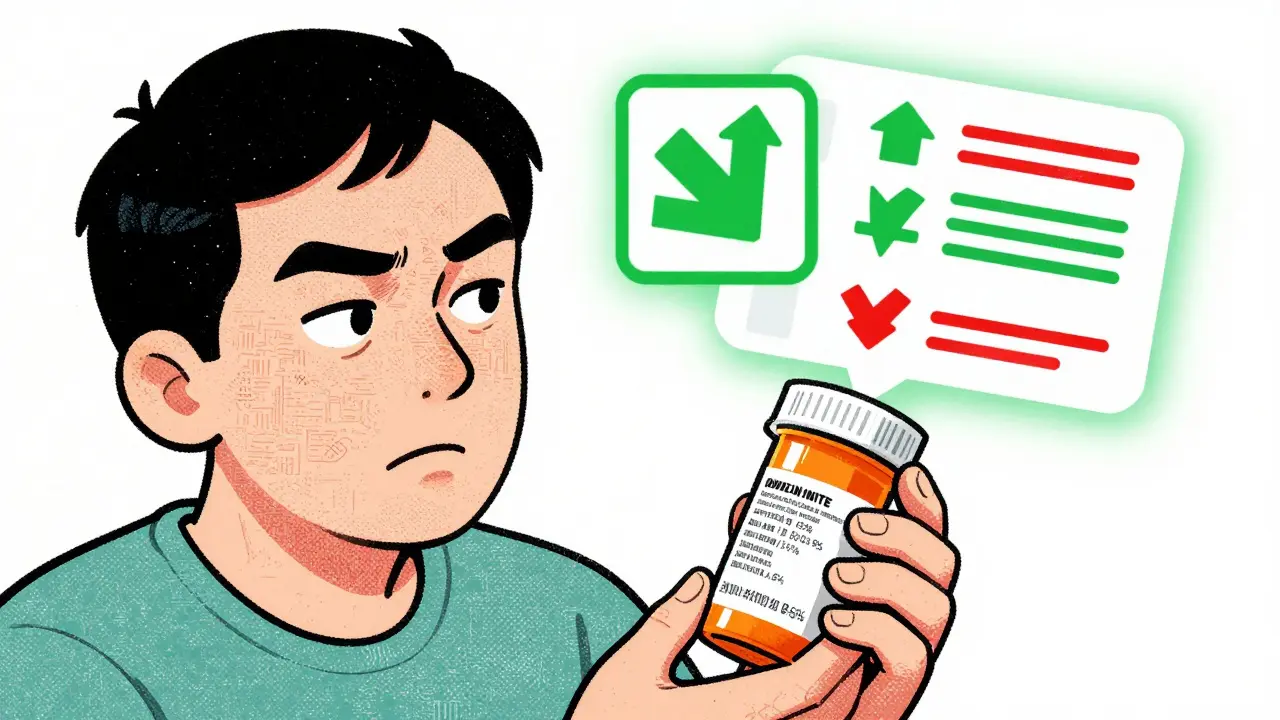
Benefit-Risk Calculator
Understand Your Drug's Benefit-Risk Balance
Input your drug's risk information to see the real impact. The FDA often shows relative risk reduction, but this calculator reveals the absolute risk reduction that matters most to patients.
Your Results
Absolute Risk Reduction
This is the real impact of the drug - the actual percentage point reduction in risk.
Number Needed to Treat
How many people need to take this drug for one person to benefit.
Understanding Your Results: A small absolute risk reduction (like 1%) means that out of 100 people who take this drug, 1 person might benefit while 99 receive no benefit but still face side effects.
Why This Matters
FDA labels often show relative risk reduction (e.g., '25% reduction'), which makes drugs seem more effective than they are. Your absolute risk reduction shows the real benefit.
For example: If your baseline risk of stroke is 4%, a 25% relative reduction means your risk drops from 4% to 3%. That's only a 1% absolute reduction. But this calculator shows you exactly how much benefit you can expect.
The FDA's new pilot program for cancer drugs now requires clearer benefit-risk summaries. Use this tool to better understand the information you see in labels.
When you pick up a prescription, the label tells you what the drug does, how to take it, and what side effects to watch for. But it rarely tells you something more important: Is this drug worth it for you? The FDA requires drug makers to include a risk-benefit statement in every label, but most patients can’t make sense of it. That’s not because they’re not smart - it’s because the language is buried in medical jargon, numbers without context, and vague phrases like "some patients may experience."
What the FDA Actually Requires
The U.S. Food and Drug Administration doesn’t just approve drugs based on lab results. It makes a formal judgment: do the benefits outweigh the risks? This isn’t a guess. It’s a structured review done by teams of doctors, statisticians, and pharmacologists. Under 21 CFR 314.50(c)(5)(viii), drug companies must submit an integrated summary of benefits and risks. The FDA then uses this to write the official label.
That summary isn’t just for regulators. It’s supposed to help you and your doctor decide. But here’s the problem: the version you see on the label is a watered-down, legalistic version of the real assessment. The full internal analysis includes data on survival rates, hospitalization risks, quality-of-life changes, and even how often side effects lead to stopping treatment. None of that makes it into the final label.
Where to Find the Real Risk-Benefit Info
The most useful parts of the label aren’t in the warnings section. Look at these four areas:
- Section 14: Clinical Studies - This is where you’ll find actual numbers. For example: "In a trial of 1,200 patients, 6.5% of those taking Jardiance died from heart-related causes over 3.8 years, compared to 10.5% on placebo." That’s a 38% reduction in risk. That’s concrete.
- Section 8: Use in Specific Populations - This tells you if the drug works differently for older adults, pregnant women, or people with kidney disease. If you’re in one of these groups, this section matters more than the general warnings.
- Section 5: Contraindications - These are the "DO NOT USE" situations. If you have liver failure and the label says "contraindicated," that’s not a suggestion. It’s a hard stop.
- Section 6: Adverse Reactions - This lists side effects, but the real value is in the frequency. "Common" means at least 1 in 10 people. "Serious" means it led to hospitalization, disability, or death.
Most labels skip the comparison to other treatments. If you’re taking a new antidepressant, the label won’t say whether it’s better than fluoxetine or sertraline. That’s a gap. But some newer labels are starting to include this. The 2023 FDA pilot program for oncology drugs now requires sponsors to compare outcomes with standard care.
Why Numbers Alone Don’t Help
Let’s say a label says: "This drug reduces the risk of stroke by 25%." Sounds good, right? But here’s what it doesn’t tell you:
- 25% of what? If the baseline risk is 4%, then 25% of 4% is 1%. So instead of a 4% chance of stroke, you now have a 3% chance. That’s a 1% absolute reduction.
- How many people need to take the drug for one stroke to be prevented? That’s the number needed to treat (NNT). If the NNT is 50, you’d need to treat 50 people to prevent one stroke. That means 49 people take the drug and get no benefit - but still face side effects.
Dr. Thomas Fleming from the University of Washington pointed out in the Journal of Clinical Epidemiology that most labels rely on relative risk ("25% reduction") instead of absolute risk ("1% reduction"). Relative numbers make drugs look more powerful than they are. That’s misleading.
What Patients Are Asking For
The FDA collected over 1,200 patient comments through its Patient-Focused Drug Development program. Here’s what they said:
- 78% wanted clear comparisons to other treatments.
- 63% asked for visual charts showing benefit vs. risk.
- Only 22% felt "very confident" they understood the risks and benefits.
- Among people with low health literacy, that number dropped to 9%.
Reddit threads like "How do you interpret FDA drug labels?" are full of patients saying they feel "scared but confused." One user wrote: "I read the label and thought, ‘I’ll take my chances.’ But I had no idea what those chances were."
Some companies are trying to fix this. Jardiance’s label, for example, doesn’t just say "reduced cardiovascular death." It says: "10.5% with placebo vs. 6.5% with JARDIANCE." That’s specific. That’s useful.
The New Push for Simpler Labels
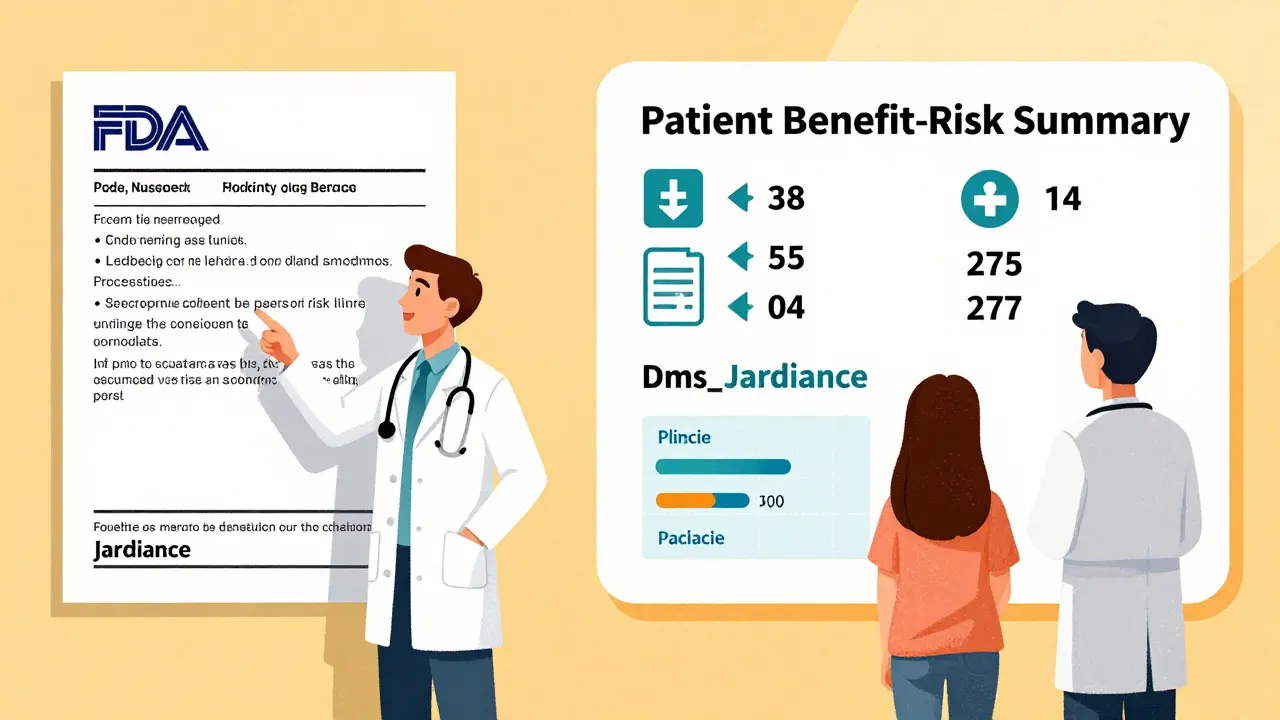
In September 2023, the FDA launched a pilot program requiring six new cancer drugs to include a "Patient Benefit-Risk Summary" in their labels. These summaries:
- Are written at a 6th-grade reading level.
- Use simple icons to show the size of benefit and risk.
- Compare outcomes directly to standard treatments.
For example, one icon might show a red arrow pointing down for risk of severe nausea (common), and a green arrow pointing down for survival benefit (moderate). No numbers. Just visuals.
The National Institutes of Health is testing standardized "Benefit-Risk Icons" with 1,500 patients across 12 clinics. Early results show patients understand the trade-offs 40% better than with text-only labels.
Why This Matters for You
You’re not supposed to be a statistic. You’re a person with a body, a life, and priorities. Maybe you’re willing to risk a 1 in 100 chance of liver damage if it means you can live another 5 years. Maybe you’d rather avoid side effects entirely and accept a shorter lifespan. The FDA’s job is to make decisions for the average patient. Your job is to decide for yourself.
But you can’t do that if the information is hidden. The FDA’s framework is solid. The science is sound. But the delivery? It’s broken.
The good news? Change is coming. By 2026, Evaluate Pharma predicts 45% of new drug labels will include visual benefit-risk summaries - up from just 8% in 2022. That’s a massive shift. And it’s driven by patients demanding clarity.
What You Can Do Today
You don’t need to wait for labels to improve. Here’s how to take control:
- Ask your doctor: "Compared to other options, what’s the real chance this drug will help me? What’s the chance it will hurt me?" Push for numbers, not generalizations.
- Check the FDA’s website: Go to Drugs@FDA (accessed via fda.gov/drugs) and look up your drug. Download the full prescribing information. Scroll to Section 14. That’s the gold.
- Use patient-friendly tools: Sites like MedlinePlus and Drugs.com now include plain-language summaries pulled from the FDA label. Compare them side by side.
- Track your own experience: If you start a new drug, write down how you feel. Did the side effects start within a week? Did your symptoms improve? That’s data your doctor needs.
The goal isn’t to scare you away from medicine. It’s to make sure you’re not choosing blindly. Every drug has trade-offs. The best ones don’t hide them. And slowly, thanks to patient pressure and FDA reform, they’re getting better at showing them.
Why don’t drug labels just say if a drug is worth taking?
Drug labels are designed to meet legal and regulatory standards, not patient communication needs. The FDA requires a summary of benefits and risks, but the wording is often written for lawyers and regulators, not patients. The language is vague, numbers are presented without context, and comparisons to other treatments are rarely included. While the FDA has started requiring clearer summaries for new drugs - especially in oncology - most existing labels still lack the clarity patients need to make informed decisions.
Can I trust the "common side effects" listed on my prescription label?
"Common" means at least 1 in 10 people experienced the side effect. But that doesn’t mean it’s likely to happen to you. The list includes everything observed in clinical trials, even if it happened in just 2% of patients. What’s missing is context: How severe was it? Did it go away? Did it lead to stopping the drug? For example, "headache" is common, but if 95% of those cases were mild and resolved in a day, that’s very different from a headache that lasted weeks. Always ask your doctor: "Is this side effect usually mild or serious?"
Do all drugs have the same level of benefit-risk detail?
No. Oncology drugs tend to have the clearest benefit-risk data because survival rates and tumor shrinkage are easy to measure. Psychiatric drugs, pain medications, and some diabetes drugs often have vague descriptions because their benefits - like "improved mood" or "reduced pain" - are harder to quantify. A 2022 FDA review found that only 17% of new drugs included any visual summary of benefit vs. risk. That number is rising, but most labels still rely on text alone.
Why does the FDA use relative risk instead of absolute risk in labels?
Relative risk (e.g., "reduces risk by 50%") makes drugs look more effective than they are. Absolute risk (e.g., "lowers risk from 2% to 1%") shows the real impact. The FDA acknowledges this issue and has urged sponsors to include absolute numbers. But many drug companies still use relative risk because it sounds better. The FDA’s 2021 guidance encourages clearer reporting, but it’s not mandatory for all drugs yet. That’s why patients often misunderstand how much a drug actually helps.
Are there any drugs with truly patient-friendly labels?
Yes. A few newer drugs, especially those approved under FDA’s breakthrough therapy program, now include patient-friendly summaries. Jardiance (for type 2 diabetes) clearly states: "In adults with type 2 diabetes and cardiovascular disease, JARDIANCE reduced the risk of cardiovascular death by 38% (10.5% with placebo vs. 6.5% with JARDIANCE)." That’s direct, specific, and understandable. The FDA’s 2023 pilot program for six cancer drugs now requires similar language, written at a 6th-grade level with icons. These are the first steps toward labels that patients can actually use.
Understanding your medication isn’t about memorizing science. It’s about knowing what matters to you. And the system is slowly learning to speak your language.
9 Comments
Davis teoFebruary 18, 2026 AT 17:29
I read my diabetes label and thought, 'Wow, this drug cuts my heart death risk by 38%' - until I saw the fine print: 10.5% vs. 6.5%. That’s a 4% absolute difference. So I’m paying $500/month to maybe live 6 months longer? My dog has better odds. I’m done.Also, why does my doctor act like I’m lucky to be alive? I’m not a statistic. I’m a guy who just wants to eat tacos without worrying if his liver’s gonna explode.
Michaela JorstadFebruary 19, 2026 AT 12:19
I’m so glad someone finally said this. I’ve been screaming into the void for years about how labels are written for lawyers, not humans.My mom took a new blood pressure med last year - the label said 'common side effects: dizziness, fatigue.' But it didn’t say if those were 'you’ll feel like a zombie for a week' or 'you’ll get a little lightheaded once.' She quit after 3 days because she was terrified. We had to go back and ask the pharmacist to explain it like she was five.
Please, FDA - just use emojis. A crying face for 'serious,' a sleepy face for 'mild.' I’d understand it faster.
Caleb SciannellaFebruary 19, 2026 AT 15:51
The systemic disconnect between regulatory compliance and patient communication is not merely an oversight - it is a structural failure rooted in the historical evolution of pharmaceutical labeling as a legal instrument rather than a public health tool. The FDA’s adherence to codified standards under 21 CFR 314.50(c)(5)(viii) prioritizes liability mitigation over translational clarity. Consequently, while the underlying clinical data may be rigorously analyzed, its dissemination is filtered through a linguistic prism designed to satisfy legal defensibility rather than cognitive accessibility. The introduction of visual benefit-risk summaries, particularly those employing standardized iconography and simplified language, represents a paradigmatic shift toward patient-centered pharmacovigilance - one that aligns with principles of health literacy and informed consent as articulated by the Institute of Medicine in 2004. The 40% improvement in comprehension observed in NIH pilot studies is not merely statistically significant - it is ethically imperative.Oana IordachescuFebruary 21, 2026 AT 01:55
I’ve been waiting for this. The FDA has always been in bed with Big Pharma.Did you know that the same people who write the labels also work for the drug companies?
And the 'pilot programs'? They’re just PR stunts. Look at the timeline - they only started when patients started suing over side effects.
And don’t get me started on 'relative risk' - it’s a mathematical trick to make you think you’re getting a miracle drug.
I’ve seen the internal memos. They know it’s misleading. They just don’t care.
Next thing you know, they’ll be putting QR codes on labels that link to a 2-hour webinar you have to pay for to understand the truth.
Trust no one.
- Oana
Arshdeep SinghFebruary 22, 2026 AT 20:42
You think this is bad? Wait till you see the labels for antidepressants. They say 'may improve mood' like it's a spa day. Bro, I took one and felt like a zombie who lost his WiFi. The 'benefit'? 3% better than placebo. The 'risk'? I cried for 3 weeks, couldn't sleep, and my cat stopped liking me.Meanwhile, the drug company made $2 billion.
That’s not medicine. That’s a pyramid scheme with a stethoscope.
James RobertsFebruary 23, 2026 AT 06:55
Oh wow. A 6th-grade reading level? That’s progress? I thought we were aiming for 'human' level.Also, 'icons' - yeah, because nothing says 'I understand my life-or-death decision' like a little green arrow and a red cloud.
Meanwhile, my doctor still says 'it’s safe' while scrolling through TikTok.
At least the labels are trying. I’ll give them that. But we’re still in the Stone Age of patient info.
Next step: voice-activated labels that scream 'THIS DRUG MAY KILL YOU' when you open the bottle.
Danielle GerrishFebruary 23, 2026 AT 16:48
I cried reading this. Not because I’m dramatic - though I am - but because I’ve been through this. My sister took a new heart drug after her second stroke. The label said 'reduced risk of death.' We thought, 'Great!' Then we dug into Section 14 and found out: 12% chance of death on placebo, 9% on the drug. That’s 3%. Three percent.She paid $800 a month. She got nausea, weight gain, and nightmares.
And the worst part? Her doctor didn’t even know the numbers. He just said, 'It’s the best option.'
So now I print out the full FDA label for every new prescription. I highlight Section 14. I bring it to every appointment.
And if they look at me funny? I say, 'You’re my doctor. I’m your patient. I deserve to know what I’m risking.'
Liam CreanFebruary 24, 2026 AT 14:05
I read the whole thing. Took me 45 minutes. I’m not a doctor. I don’t have time for this.But I get it. The system is broken.
I’m not mad. Just tired.
I’ll keep taking my pills. And hoping the next one doesn’t turn me into a human pincushion.
madison winterFebruary 26, 2026 AT 02:21
I don’t care. I just take what the doctor gives me. If I die, I die. At least I didn’t have to think about it.