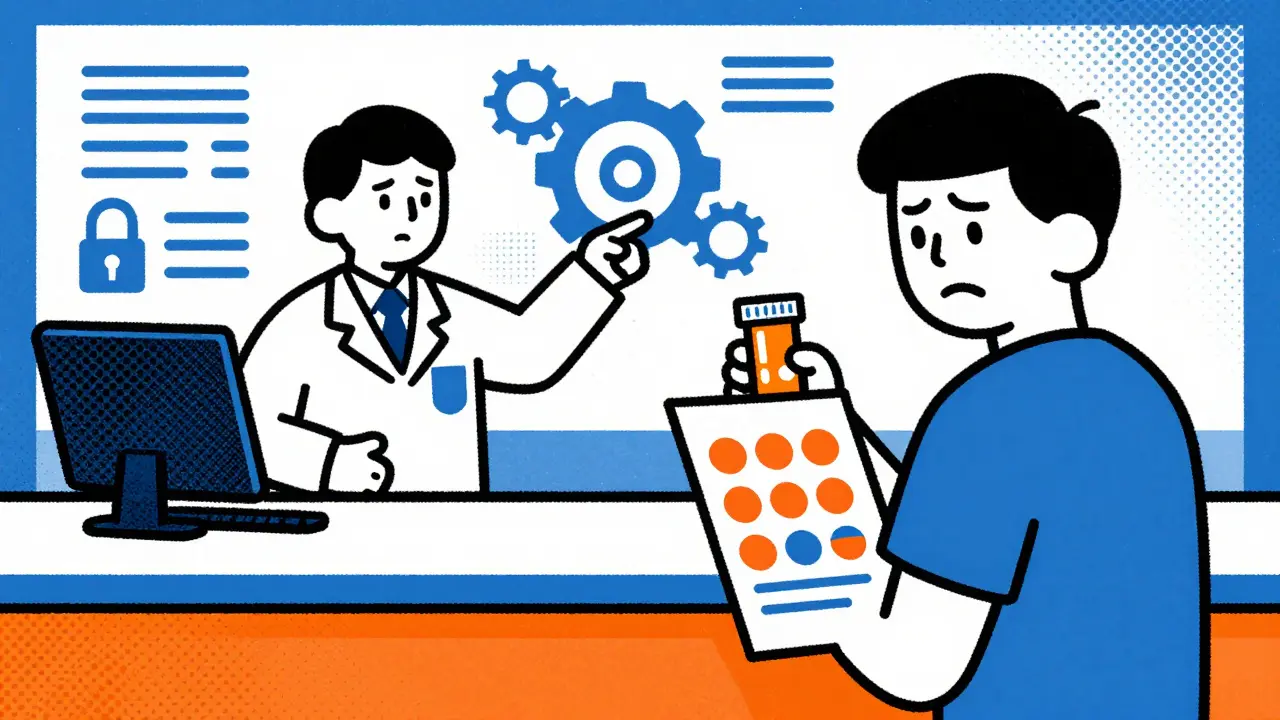
You expect generic drugs to be easy to get. They cost less than brand names, so it makes sense that insurance companies would push you toward them. But here is the surprising twist: sometimes, those cheap generic pills are the ones hitting an administrative wall. You walk up to the pharmacy counter, and the pharmacist hands you a notice saying Prior Authorization is required before coverage begins. This situation has flipped the script on how most of us view medication access. Instead of fighting to get the expensive version covered, you are now filling out forms to prove you need the cheaper option.
This isn't a small problem affecting just a few rare cases. Recent reports show that roughly 20% of generic prescriptions now trigger these approval requests. That is a massive jump from a few years ago when generic prior authorization was rare. If you manage a chronic condition like diabetes or high blood pressure, you likely know the frustration of waiting days or weeks for a decision. Your doctor writes the prescription, the insurance company says "wait," and then they ask for more paperwork. By the time you get the green light, you have been without medicine longer than necessary. Let’s break down exactly why this is happening and how you can handle it without losing your mind.
What Is Prior Authorization?
Prior Authorization is a formal process where doctors must get permission from an insurance provider before a specific drug is covered. Think of it as a gatekeeper system. Before the insurer pays for a medication, the doctor’s office sends clinical evidence explaining why you need that specific treatment. Usually, this happens for brand-name drugs or expensive specialty medicines. Insurance wants to make sure you aren’t getting something costlier when a simpler option exists.
However, the system has expanded. In 2026, we see Generic Medications, which copycat drugs offer the same active ingredients at lower prices, are now subject to these checks more often. Even if a drug is off-patent and widely available, your plan might flag it. The logic usually comes down to Insurance Formularies lists approved drugs ranked by cost-effectiveness. Sometimes, your insurance carrier decides you must try a different generic first, even if your current doctor prefers the one prescribed. If you don’t submit the authorization request, the bill for the pharmacy drop could land on your credit card statement instead of being covered.
Why Are Insurers Blocking Generic Drugs?
It feels backward, right? Insurance companies claim to save money. Generics are cheaper. Why stop them? The answer lies in how Pharmacy Benefit Managers operate behind the scenes. These third-party administrators negotiate rebates between manufacturers and insurance plans. While you think you are saving money with a generic, a PBM might have a financial incentive to route you to a specific manufacturer or formulary tier.
There is also a concept called Step Therapy protocols. This means you must “step through” treatments in a specific order. If your plan considers Drug A the first step, they will deny Drug B until you try A. If both are generics, you still face the hurdle. Data from 2025 shows major insurers like UnitedHealthcare require approval for about 22% of generics in their formularies. Aetna is slightly higher at 25%. This variance depends heavily on your employer group or state regulations. Some regions are tightening the rules, while others are loosening them due to new laws passed recently.
In 2024, the Federal government introduced stricter reporting requirements for these denials. By 2026, the goal was clearer transparency. However, the implementation phase means there is confusion. One day, the rule changes. The next, a policy update goes out to providers who may not read every email immediately. As a patient, you sit in the middle of this administrative tug-of-war.

How the Process Works From Start to Finish
If your pharmacy tells you that approval is needed, here is what actually happens in the background. Your doctor’s staff logs into a portal like CoverMyMeds. This platform connects directly to the insurer’s digital network. They upload your chart notes and diagnostic codes. The medical team at the insurance company reviews the file to see if your diagnosis matches their criteria for that medication.
- Submission: The clinic sends the request electronically. Doing this digitally cuts processing time significantly compared to faxes.
- Review: A pharmacist or nurse practitioner employed by the insurance company checks the clinical necessity.
- Decision: Under current rules implemented early this year, standard decisions take 72 hours or up to ten business days for non-urgent cases.
- Notification: You receive a call or letter telling you whether the medication is covered.
The timeline varies wildly. Cigna documents state standard approvals happen in five to ten business days. Mayo Clinic suggests it can stretch further depending on urgency. If your blood pressure skyrockets because you cannot get your lisinopril refill, you need to mark the request as “ourgent.” Urgent requests force the insurance company to respond within 72 hours. Without that flag, they stick to their standard calendar, regardless of your health condition worsening.
Real-World Impacts on Patients and Providers
This administrative friction creates tangible harm. We are seeing documented cases where treatment delays worsen outcomes. A study cited by the Kaiser Family Foundation highlighted a diabetic patient whose HbA1c levels jumped from 6.8% to 8.2% during a two-week wait for metformin authorization. Metformin is one of the most basic, common generics ever prescribed. Seeing that flag causes genuine alarm among primary care physicians.
Doctors hate this. An average physician practice completes about 43 prior authorizations weekly. Nearly half involve generic drugs. Clinics hire full-time administrative staff just to chase these calls. One verified comment from a healthcare professional noted they spent 17.3 hours weekly on generic paperwork alone. That is time stolen from direct patient care. You do not see the doctor talking to you; you see them arguing with an automated system over your insulin type.
| Metric | Brand Name Drugs | Generic Medications |
|---|---|---|
| Approval Rate | Approximately 75% | 15% to 20% |
| Average Decision Time | Standard: 1-2 weeks | Urgent: 72 hours |
| Clinician Burden | High documentation required | Frequent volume of requests |
| Common Restriction | Requires generic alternative | Requires step therapy first |

Navigating the 2026 Reforms and Changes
There is some good news emerging as we move through 2026. Major insurance players agreed to reforms announced last summer aimed at streamlining this mess. These new rules, which took effect around January 2026, mandate standardized templates for electronic submissions. Previously, UnitedHealthcare might want one form, and Humana might want another. Now, they are moving toward a unified digital format. This reduces the back-and-forth errors that cause rejections.
Specifically, several commonly prescribed classes are being removed from mandatory authorization lists entirely. ACE inhibitors, statins, and metformin are seeing reduced hurdles in many plans. California has already set a precedent with SB 1024, banning this requirement for essential meds on their state list. Other states are watching closely. If your plan allows it, ask if your medication is on a “waiver list.”
Even with reforms, gaps remain. Medicare Advantage plans operate under different federal mandates than private commercial insurance. Recent federal law requires electronic processing for these plans by 2026, which is why you are seeing the speed increase right now. If you rely on Medicaid, check your state guidelines. Thirty-four states have restricted authorization for certain generic classes, recognizing that the administrative cost outweighs the savings.
Strategies for Handling Delays
When you face a denied claim, stay proactive. Here are practical steps to minimize the wait time on your own dime.
- Check the Formulary First: Log into your insurance member portal before visiting the doctor. See if the drug is “Preferred” or “Non-Preferred.” Non-preferred usually triggers authorization.
- Request Urgent Status: If the delay poses a health risk, explicitly tell the doctor to flag it as urgent. Cite specific symptoms like pain or elevated lab values in the request.
- Save Documentation: Keep records of every fax, email, and call log. About two-thirds of denials are successfully overturned with proper appeal evidence.
- Use Electronic Submissions: Ask your clinic if they use portals like CoverMyMeds. Paperwork sent via fax gets lost or delayed more often than digital files.
Finally, consider calling the customer service line directly. Automated systems sometimes reject a code incorrectly. Speaking to a human representative can sometimes override a glitch. While it sounds old-fashioned, it often works faster than submitting an online appeal form that sits in a queue for days.
Can I buy the generic drug without approval if I pay cash?
Yes, you can purchase almost any generic medication without insurance involvement if you pay the cash price. The prior authorization requirement only applies when using insurance benefits. Many pharmacies offer discount cards that bring cash prices down near the copay amount, bypassing the wait times completely.
Why does my doctor need to send paperwork for a common drug?
Insurers use utilization management tools to control spending. Even if a drug is cheap, the insurance company may require proof that you need that specific formulation or dosage. This prevents patients from switching to higher-tier options that might not fit your plan’s preferred formulary list.
How long does the process usually take in 2026?
With the new reform standards, standard decisions generally aim for 72 hours. Urgent requests must be processed within that same window. Non-urgent matters might still take up to ten business days depending on the complexity of the medical review required.
Are there drugs exempt from these rules?
Recent agreements in early 2026 eliminated requirements for twelve common classes, including statins and ACE inhibitors. Additionally, medications listed on state Essential Drug Lists are often exempt from approval processes, varying significantly by location.
What happens if my request gets denied?
You have the right to appeal a denial. Submitting additional clinical notes from your doctor often resolves the issue. Statistics show that roughly 67% of initial denials are reversed once the insurance medical director reviews the full patient history and specific diagnosis codes.
14 Comments
Carolyn KaskMarch 31, 2026 AT 17:59
It is honestly insulting how they gatekeep basic medicine.
You would think saving money would mean faster access.
Instead, they add layers of bureaucracy just to look busy.
Americans always get stuck in the middle of corporate profit games.
The system pretends to care while draining your patience dry.
We deserve transparency instead of these sneaky blocks on cheap drugs.
Beccy SmartApril 1, 2026 AT 23:26
This whole situation is just ridiculous 🙄
They could fix this so easily 🛑💊
Why does it take forever to approve something basic 😤
Honestly nobody cares about the patients here 💔
Just another way to make money off sickness 🤮
dPhanen DhrubRaajApril 3, 2026 AT 11:27
its really confusing sometimes when you just want your pills without the fighting i know many people here struggle with same thing
Kendell Callaway MooneyApril 4, 2026 AT 01:22
So let me break down what is actually happening here regarding these rules.
Insurance companies claim they help costs go down overall for everyone.
In reality, the paperwork creates a huge wall for ordinary people.
Many doctors waste hours filling out forms just to prove a diagnosis.
You might find your blood sugar spikes while waiting for approval.
It is important to check your specific plan before visiting the pharmacy.
Sometimes a different brand is listed as preferred on the formulary list.
If you get denied, you have a right to appeal the decision immediately.
Keep every receipt and email you send to their support desk.
Electronic portals are much faster than sending fax machines nowadays.
Some states like California are starting to ban these requirements entirely.
It really depends on where your employer gets their insurance coverage plan.
Medicare has different rules compared to commercial private plans mostly.
Don't forget to ask if your drug is on the waiver list completely.
These new reforms in 2026 might speed things up eventually though.
Knowledge is power when facing these administrative hurdles head on.
Cameron RedicApril 5, 2026 AT 21:41
Your advice sounds nice but ignores the financial incentives driving PBMs deeply.
The data clearly shows that rebates outweigh efficiency gains consistently.
Patients are collateral damage in these larger negotiation wars.
Stop pretending that electronic portals solve the root cause effectively.
Charles RogersApril 7, 2026 AT 20:13
People complain too much about administrative processes without understanding the logic behind them.
These authorizations prevent abuse of prescription pads across large regions effectively.
Doctors might prescribe unnecessary medications without strict oversight protocols in place.
Insurance funds are shared resources that require careful management to sustain operations.
Without these checks, premiums would skyrocket for the entire population group significantly.
It is not personal against you specifically when the system denies a claim initially.
There are complex algorithms analyzing risk factors for every single patient submission daily.
Generic drugs vary by manufacturer quality standards that insurers track closely.
A cheaper pill from one company might lack stability compared to another batch.
Safety is the ultimate goal even if the process feels incredibly slow now.
Patience is a virtue required when navigating modern healthcare logistics successfully.
Most decisions happen within the legal timeframe mandated by federal regulations recently passed.
You should document every interaction meticulously in case you need escalation.
Ignoring the rules leads to higher out-of-pocket costs for your family budget.
Understanding the formulary tiers saves money in the long run financially.
Education is the best tool to fight these battles proactively rather than passively.
Trust the process to work correctly over the extended duration period.
Rick JacksonApril 8, 2026 AT 02:18
Safety matters but delays hurt the vulnerable members of our society greatly.
Balance is needed between cost control and immediate patient access needs always.
Katie RistonApril 9, 2026 AT 10:20
The philosophical question here revolves around control versus individual liberty fundamentally.
We trade autonomy for the promise of security within social contracts.
Bureaucracy often becomes an end itself rather than a means to safety.
When gates are placed on medicine, we question who holds the keys truly.
Power dynamics shift heavily toward corporations during moments of medical vulnerability.
This dynamic creates anxiety that permeates through every family affected directly.
Ethics demand that we prioritize human life over ledger sheet optimization primarily.
Waiting periods introduce uncertainty into chronic disease management strategies completely.
Time is a finite resource that cannot be recovered once lost to admin.
Empathy fails when systems are designed purely for risk mitigation purposes alone.
The soul of medicine lies in service, not in obstructionism disguised as policy.
We must remain vigilant against policies that normalize suffering for efficiency goals.
History repeats when institutions lose touch with the people they serve originally.
Change comes from public pressure applied consistently over many years of advocacy.
True healing includes removing barriers that block the flow of care quickly.
emma ruth rodriguezApril 9, 2026 AT 21:22
That statement is incredibly profound!!
Indeed!
This situation highlights systemic flaws!!
It requires serious attention from regulators!!
We must act fast!!!
Every delay counts!!!!
Please share more details soon!!!!!
Thank you for posting this insight!!!!!!!!!
sanatan kaushikApril 11, 2026 AT 03:03
Just pay cash and ignore the insurance bull crap.
Adryan BrownApril 12, 2026 AT 10:13
I understand the frustration but paying cash is expensive for some families financially.
Not everyone has savings to cover full pricing without insurance subsidies available locally.
We should push for laws that eliminate these hurdles permanently instead of working around them.
Peaceful dialogue helps change policy more than anger ever could achieve alone.
Unity among patients creates louder voices for reform discussions nationally.
Everyone deserves affordable access regardless of their bank account status currently.
Biraju ShahApril 13, 2026 AT 06:44
Companies are greedy and it ends at the patient cost.
Jonathan AlexanderApril 14, 2026 AT 08:11
My doctor cried today because of these forms.
Marwood ConstructionApril 15, 2026 AT 10:16
Regulations are shifting in 2026 which helps compliance.