
FDA Drug Label Explorer
Find Key Information in Drug Labels
Enter a drug name to explore key sections of the FDA label
Key Sections Found
Boxed Warning (Section 5)
No boxed warning found for this drug.
Recent Major Changes (Section 17)
No recent changes found for this drug.
NDC Code Verification (Section 16)
NDC verification not available for this search.
Patient Counseling Information (Section 17)
No specific counseling information found.
How to Use This Information
Always check all these sections before taking a new medication. Even if your doctor has prescribed it, you should:
- Look for Boxed Warnings - these indicate serious safety risks
- Check Recent Major Changes for updates in the last 6 months
- Verify the NDC code on your bottle matches the label
- Ask your provider about Patient Counseling Information
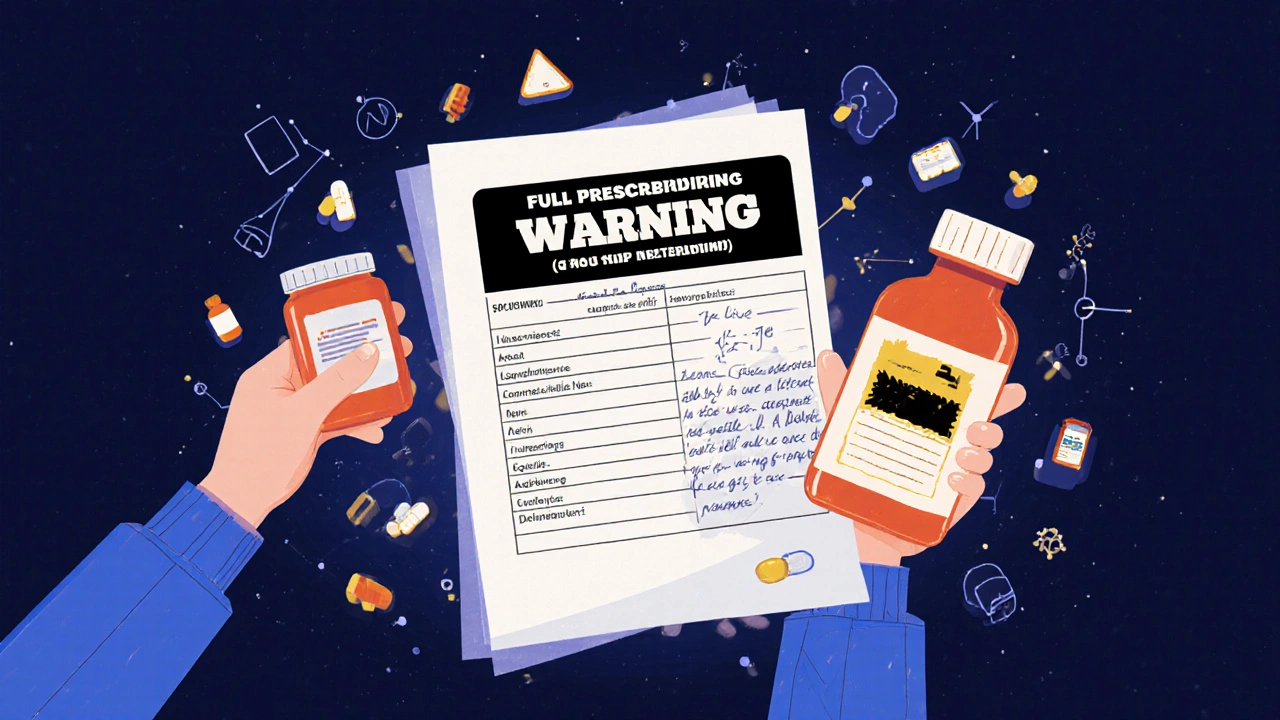
Reading an FDA drug label isn’t just for doctors or pharmacists. If you’re taking medication - or helping someone who does - understanding what’s on that label could prevent a serious mistake. The FDA doesn’t just slap a label on a pill bottle. Every prescription drug in the U.S. comes with a detailed, legally required document called the Full Prescribing Information (FPI). It’s long, it’s technical, and it’s designed to keep you safe. But if you know where to look, you can turn it from a wall of text into a clear guide.
What’s on the FDA Drug Label? The 17 Sections Explained
The FDA’s drug label isn’t random. It’s split into 17 fixed sections, each with strict rules about what must be included. This structure was created in 2006 to make information easier to find. Before that, labels varied wildly - one drug might bury a warning in the middle of a paragraph, another might hide dosing info in tiny print. Now, you can expect the same layout across every prescription drug.
Let’s break down the most important sections:
- Section 1: Indications and Usage - This tells you exactly what the drug is approved to treat. If your condition isn’t listed here, the drug isn’t officially approved for it - even if a doctor prescribes it off-label.
- Section 2: Dosage and Administration - This is where you find the right dose, how often to take it, and how to take it (with food? on an empty stomach?). It also includes special instructions for people with kidney or liver problems.
- Section 3: Dosage Forms and Strengths - Lists all available versions of the drug: tablets, capsules, injections, strengths like 10mg or 50mg. This helps avoid confusion if you switch brands or get a refill.
- Section 4: Contraindications - This section says flat-out: “Don’t use this drug if…” Examples: if you’re allergic, have a certain heart condition, or are pregnant. This is non-negotiable.
- Section 5: Warnings and Precautions - This is where the big risks live. The most serious ones appear in a Boxed Warning - a black border around the text that grabs your attention. These are life-threatening risks like liver failure, severe allergic reactions, or increased suicide risk.
- Section 6: Adverse Reactions - Lists side effects and how often they happened in clinical trials. “Common” means 1 in 10 people or more. “Rare” means less than 1 in 1,000. Don’t panic if you see a long list - most side effects are mild.
- Section 7: Drug Interactions - Tells you which other drugs, supplements, or even foods can cause dangerous reactions. For example, grapefruit juice can interfere with dozens of medications.
- Section 8: Use in Specific Populations - Covers pregnancy, breastfeeding, kids, and older adults. Many drugs aren’t tested well in these groups, so this section flags where data is limited.
- Section 16: How Supplied/Storage and Handling - Includes the NDC code (a 10-digit number unique to that drug, dose, and packaging). This helps pharmacies and insurers track exactly what you’re getting. Also tells you how to store the drug - some need refrigeration, others must stay dry.
- Section 17: Patient Counseling Information - This is the only section written for patients. It gives healthcare providers exact phrases to use when explaining the drug to you. Things like: “Take this at bedtime to avoid drowsiness during the day.”
There’s also a Highlights section - a half-page summary at the very top. It’s meant to be quick, but the FDA warns: “This is not a complete list.” Never skip the full label just because the Highlights look simple.
The Boxed Warning: What It Really Means
If you see a black box on a drug label, stop and read it. That’s the Boxed Warning - the FDA’s strongest safety alert. It’s reserved for risks that can cause death or serious injury. Think: heart attack, severe bleeding, suicidal behavior, or organ failure.
For example, the diabetes drug Avandia has a Boxed Warning for heart failure. The blood thinner Xarelto warns of spinal blood clots if you get an epidural. These aren’t hypothetical. They’re based on real patient data reviewed by the FDA.
Doctors don’t ignore Boxed Warnings - they weigh them against benefits. But if you’re told, “This drug has a black box warning, but it’s fine,” ask: “What’s the risk for me? Are there safer alternatives?”
Recent Major Changes: Don’t Skip This
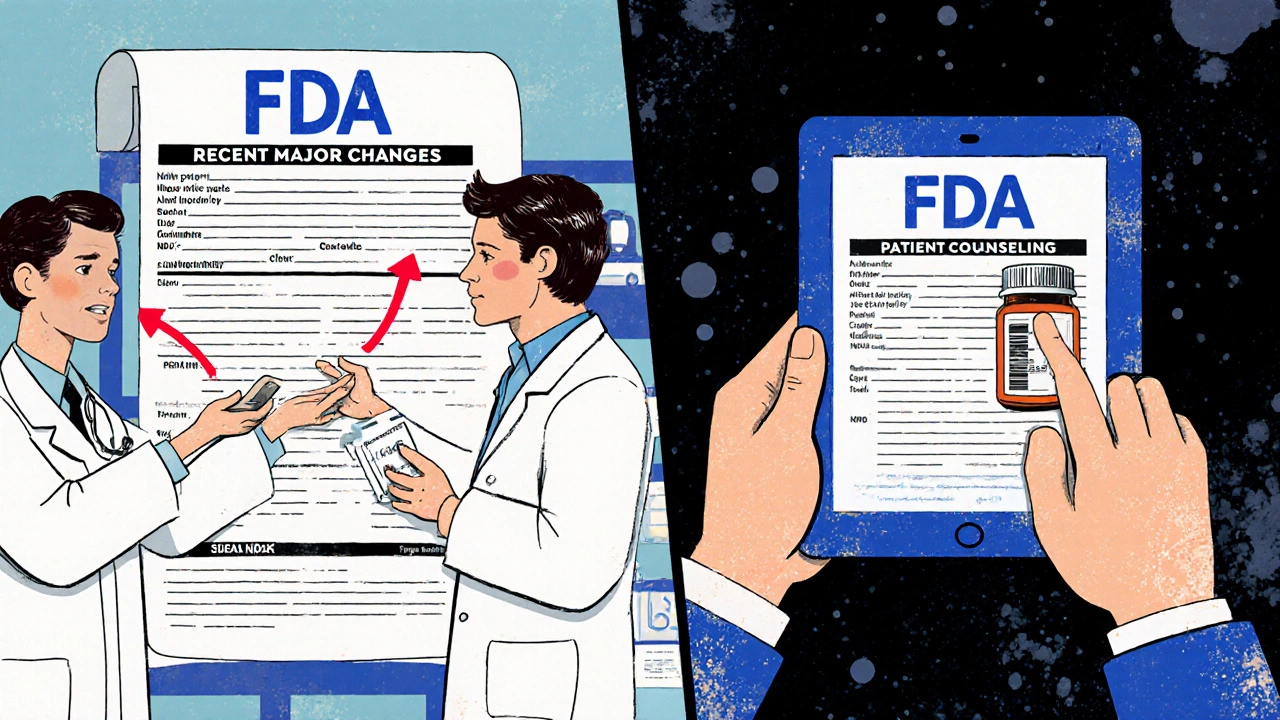
Since 2018, every FDA label must include a Recent Major Changes section. It lists every part of the label that was updated in the last six months. Why? Because drug safety info evolves.
A drug might have been on the market for years, then new data shows it causes a rare liver injury in older adults. The FDA forces the manufacturer to update the label. If your doctor prescribed this drug two years ago and never checked the label since, they might not know about the new warning.
Always check this section before starting a new prescription - even if you’ve taken the drug before. The FDA tracks that labeling updates are missed in 40% of cases. That’s not the patient’s fault - it’s a system flaw.
How Pharmacists and Doctors Use the Label
Doctors don’t read the whole label every time. They focus on Sections 1, 2, 4, 5, and 7 - indications, dosing, contraindications, warnings, and interactions. That’s enough for most decisions.
Pharmacists dig deeper. They check Section 3 (strengths) to avoid mix-ups with similar-looking drugs. They check Section 6 (side effects) to warn you about dizziness or nausea. And they use Section 16 (NDC code) to make sure you get the exact version your insurance covers.
Here’s a real example: A patient got a refill of a blood pressure pill. The pharmacy switched brands. The new brand had the same active ingredient - but a different inactive ingredient. That caused a rare allergic reaction. The NDC code in Section 16 would have flagged the change. The patient didn’t know to check.
What Patients Get Wrong - And How to Avoid It
Most patients never read the full label. They look at the pill bottle. They read the pharmacy printout. They trust their doctor. That’s not enough.
A 2024 study by the Inner Compass Initiative found that 27% of patients relied only on the Highlights section. They missed critical info like: “Do not take with alcohol,” or “This may cause drowsiness - don’t drive.”
Here’s what you should do:
- Ask your doctor or pharmacist: “Can you show me the Boxed Warning and the most common side effects?”
- Check the NDC code on your bottle against the label online. If they don’t match, call your pharmacy.
- Look for the “Recent Major Changes” section. If it’s been updated in the last year, ask if anything affects you.
- Use Section 17 - Patient Counseling Information - as your script. If your provider doesn’t mention the exact advice listed there, ask why.
How the Label Is Built - And Why It Matters
Behind every FDA label is a digital file called Structured Product Labeling (SPL). It’s an XML format that computers can read. That’s why your EHR (electronic health record) can auto-populate drug info - it pulls directly from the FDA’s SPL database.
This system prevents typos. It ensures every pharmacy, hospital, and insurance system sees the same information. But it also means if a manufacturer submits a wrong NDC code or misspells a warning, that error can spread fast.
That’s why the FDA rejects about 12% of first-time SPL submissions. The system is tight. And it’s working - 98% of U.S. electronic health systems use FDA SPL data as their source.
The Future of Drug Labels
The FDA is testing new formats. In 2024, they launched a pilot program with 15 drug companies to try interactive digital labels. Imagine tapping a pill app and seeing a video explaining side effects, or getting a pop-up warning if you’re about to take a dangerous combo.
But the core will stay the same: clear, structured, legally required info. The goal isn’t to make labels shorter - it’s to make them smarter.
By 2027, most new drugs will have digital versions alongside the traditional label. But until then, the paper or PDF version is your best tool. Don’t wait for technology to fix this. Learn how to read it now.
Where to Find FDA Drug Labels
You can access every FDA-approved drug label for free:
- Go to FDA’s Drugs@FDA database
- Search by brand or generic name
- Click on the “Labeling” link
- Download the PDF - it’s the official version
Don’t trust third-party sites like WebMD or MedlinePlus for the full label. They summarize. The FDA site gives you the real thing.
Can I trust the Highlights section alone?
No. The Highlights section is meant to be a quick summary, not a complete guide. It omits important details like rare side effects, dosing for kidney problems, or drug interactions. The FDA requires it to include a disclaimer: "This is not a complete list." Always read the Full Prescribing Information for full context.
What should I do if my drug’s label changed?
Check the "Recent Major Changes" section. If it lists updates to Warnings, Dosage, or Contraindications, talk to your doctor. Even small changes - like adding a new drug interaction - can affect your safety. Don’t assume your old advice still applies.
Why do some drugs have the same name but different labels?
Generic drugs must have the same active ingredient as the brand-name version, but they can differ in inactive ingredients, packaging, or manufacturer. That’s why the NDC code in Section 16 is critical. Two pills with the same name can have different NDCs - and different storage or handling rules. Always verify the NDC on your bottle matches the label.
Are side effects listed in the label guaranteed to happen?
No. The label lists side effects seen in clinical trials - not every possible reaction. "Common" means over 1 in 10 people experienced it. "Rare" means under 1 in 1,000. Most people won’t get the worst ones. But if you notice something new - especially after a dose change - contact your provider. The label helps you recognize what’s unusual.
Can I use the FDA label to question my doctor’s prescription?
Absolutely. If the label says a drug isn’t approved for your condition (Section 1), or warns against use with another medication you’re taking (Section 7), ask your doctor why they’re prescribing it. Off-label use is legal - but you deserve to know the risks. The label gives you the facts to have that conversation.
20 Comments
Michael SegbawuNovember 25, 2025 AT 17:51
Bro the FDA just wants you scared so you dont question your pillsBoxed warnings? Yeah sure but half the time its just to cover their ass
My uncle took that drug for 10 years and never had a problem
Stop reading labels and start living
Aarti RayNovember 26, 2025 AT 12:08
In India we dont even get these labels properlyPharmacist just gives you the pill and says take one daily
But i love that you explain everything so clear
Thank you for sharing this
Alexander RolsenNovember 27, 2025 AT 11:37
This is why America is dying. People think they can self-diagnose with a PDF. The FDA is a bureaucratic nightmare. The drug companies write the labels. The FDA just rubber stamps them. And now you want patients to be doctors? That’s not safety. That’s liability laundering.Leah DoyleNovember 27, 2025 AT 21:46
This was SO helpful!! I just got prescribed something new and I was terrified to ask questions... now I know exactly what to look for! <3Especially the part about the NDC code - I had no idea that was a thing!
Alexis MendozaNovember 28, 2025 AT 01:06
Labels are just words. But people are real. What matters is whether the medicine helps you feel better. Not whether you memorized section 7. Sometimes the best thing you can do is trust your body and your doctor. Not the PDF.Michelle N AllenNovember 28, 2025 AT 05:53
I read the highlights and that’s it honestly like why would I read 20 pages of tiny font when the pharmacist already told me not to drink alcohol with it and that it might make me sleepy like I’m not a medical student and I have a job and kids and honestly I just want to feel better not become an expert on regulatory complianceMadison MaloneNovember 29, 2025 AT 16:34
This is exactly the kind of info we need to share with older relativesMy mom was scared to ask her doctor about her new med and ended up skipping doses because she thought the side effects were 'normal'
Now I print out the label sections and go over them with her
Small things like this save lives
Graham Moyer-StrattonNovember 29, 2025 AT 23:14
Labels are propagandatom charltonNovember 30, 2025 AT 14:54
Thank you for this comprehensive and meticulously structured overview. The inclusion of the Structured Product Labeling (SPL) framework is particularly significant, as it underscores the importance of interoperability and data integrity in modern healthcare systems. This level of transparency is not only commendable but essential for patient safety across the continuum of care.Jacob Hepworth-wainDecember 2, 2025 AT 05:27
I used to ignore labels too until I got a reaction from a generic switchTurns out the new brand had a dye I’m allergic to
Now I always check the NDC
Small step but it saved me from a trip to the ER
Craig HartelDecember 3, 2025 AT 06:06
Love this! I showed my dad this and he’s 72 and now he asks his pharmacist about the boxed warningsHe said he felt like a dummy for never asking before
Thanks for making it feel normal to care
Chris KahanicDecember 4, 2025 AT 14:01
The structured format is useful. But in practice, most patients never access the full label. The system assumes a level of digital literacy and access that doesn’t exist for many. A PDF isn’t a solution if people can’t open it.Geethu EDecember 6, 2025 AT 03:07
I work in a pharmacy and I see this every dayPeople don’t read the label but they blame us when something goes wrong
We try to explain but they’re too busy to listen
This post is a wake up call
Knowledge is power but only if you use it
anant ramDecember 7, 2025 AT 03:21
I just want to say thank you for explaining the Recent Major Changes section - I didn’t even know that existed. My doctor prescribed me this drug last year, and I just checked the label - there’s a new warning about kidney risks that wasn’t there before. I’m calling my doctor tomorrow. You saved me from a mistake.king tekken 6December 8, 2025 AT 21:13
The FDA is just a puppet for Big PharmaThey only update labels when they get sued
That Boxed Warning on Xarelto? Came after 300 dead people
They knew for years
Read the label? Nah
Read the lawsuits
DIVYA YADAVDecember 9, 2025 AT 21:56
You think this is about safety? No. This is about control. The FDA doesn’t want you to understand - they want you to obey. The NDC code? That’s for tracking. The digital labels? That’s for surveillance. They’re building a database of every pill you take. Soon they’ll tell you when to take it. When to stop. Who you can marry. You think you’re reading a label. You’re signing a contract.Kim ClapperDecember 11, 2025 AT 14:06
This article is dangerously misleading. It implies that the FDA is a benevolent guardian of public health. In reality, the agency is underfunded, overburdened, and frequently influenced by corporate lobbying. The ‘structured’ labels are a PR exercise. The real dangers - long-term cumulative effects, interactions with over-the-counter supplements, impacts on mental health - are systematically minimized. This isn’t empowerment. It’s distraction.Bruce HennenDecember 12, 2025 AT 07:47
You misspelled 'contraindications' in section four. Also, 'NDC' is not a 10-digit number - it's 11 digits. And you confused 'adverse reactions' with 'side effects.' This post undermines its own credibility by being sloppy. If you're going to teach people to read labels, at least get the basics right.Jake RuhlDecember 12, 2025 AT 22:37
I read the whole thing and now I’m convinced the government is hiding somethingWhy do they need a digital version? Why the XML? Why the tracking? Why does every label have to be updated? It’s not safety - it’s surveillance
They’re building a pill database
And when you take too many, they’ll come for you
They already know you’re on this med
They’ve been watching
Wake up
Chuckie ParkerDecember 14, 2025 AT 00:46
This is why America is weak. People think they need to read a 50-page PDF to take a pill. Just trust your doctor. If you can’t, don’t take it. Stop overcomplicating everything. The label is for doctors. Not for you.