When you're trying to lose weight, cutting carbs feels like the obvious move. Everyone’s talking about it - keto, Atkins, low-carb this, no-sugar that. But here’s the real question: ketogenic vs. Atkins - which one actually works better for lasting results? It’s not just about dropping pounds fast. It’s about what you can stick with, how your body reacts, and whether you’ll still feel good six months in.
How Keto and Atkins Actually Work
The keto diet was created in the 1920s to treat epilepsy, not weight loss. But doctors noticed something strange: patients lost weight - a lot of it. That’s because keto forces your body into ketosis. That means you stop burning sugar for fuel and start burning fat. To do that, you need to eat almost no carbs. Most people on keto keep carbs under 50 grams a day. That’s about half a banana or one small apple. Fat makes up 75-90% of your calories. Protein? Just enough - too much and your body turns it into sugar, which kicks you out of ketosis.
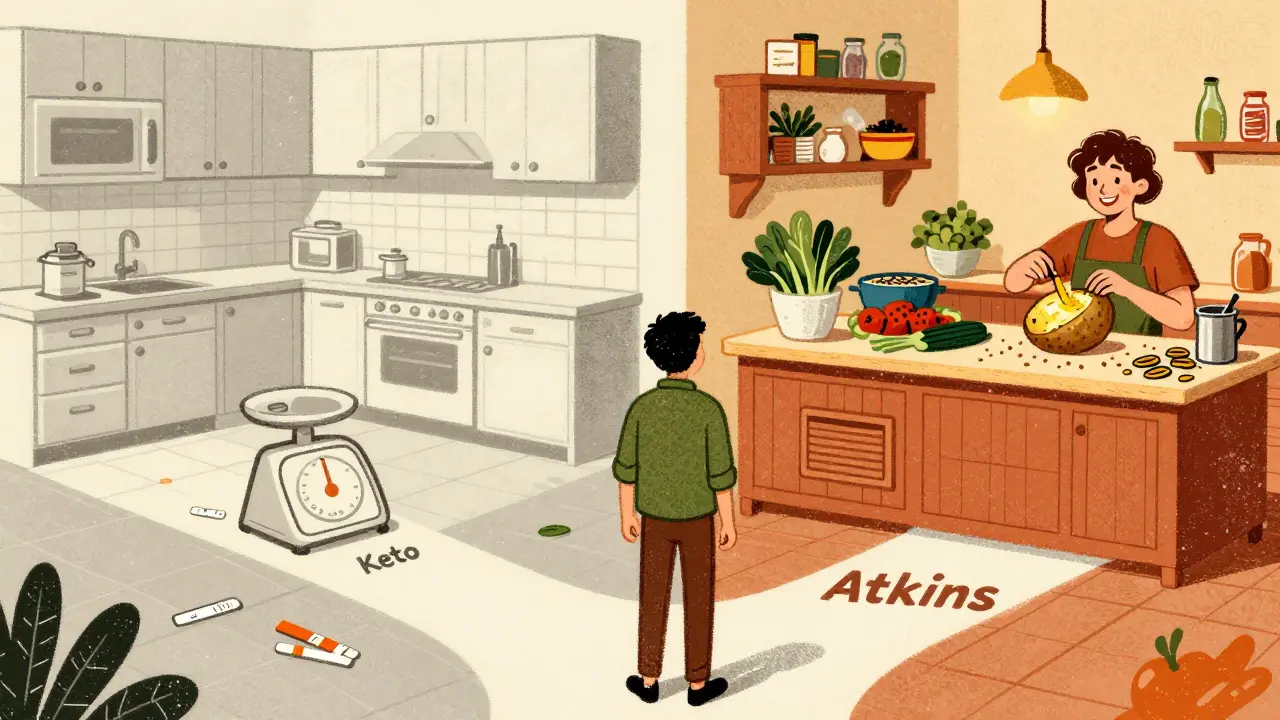
Atkins, on the other hand, was built for weight loss from day one. Dr. Robert Atkins didn’t care about epilepsy. He cared about hunger. His idea? Starve the cravings by cutting carbs, then slowly bring them back. Atkins has four phases. Phase 1 (Induction) is the strictest: 20-25 grams of net carbs a day for two weeks. That’s like keto. But then you move to Phase 2, where you add 5 grams of carbs per week. By Phase 4, you can eat up to 100 grams a day - and still stay lean. That’s the big difference. Keto says “stay here forever.” Atkins says “find your sweet spot.”
What You’re Allowed to Eat
On keto, food has to be clean. Eggs, meat, fish, leafy greens, avocado, olive oil, butter. No processed stuff. No “keto cookies” unless you’re okay with fake sweeteners and soy protein isolate. The goal is to keep your body in ketosis, so even small carb surprises - like a tablespoon of ketchup or a handful of berries - can break it.
Atkins doesn’t care as much. Yes, Phase 1 is strict. But by Phase 2, you can have Greek yogurt, sweet potatoes, and even whole-grain bread - if you track your carbs. And Atkins has its own line of bars, shakes, and frozen meals. You can buy them at Walmart or Amazon. Some people love that convenience. Others hate it because they’re full of additives. You’re not just eating food - you’re eating a product. Keto doesn’t sell you snacks. It just tells you to eat real stuff.
Weight Loss Speed and Results
Both diets drop weight fast in the first 3-6 months. Why? Water. When you cut carbs, your body dumps glycogen - and with it, 2-5 pounds of water. That’s not fat. But it feels amazing. After that, real fat loss kicks in.
A 2014 study showed people on a low-calorie keto diet lost an average of 44 pounds in a year. That’s huge. But here’s the catch: people on a regular low-calorie diet lost 15 pounds. So keto wins on speed. But a 2022 study in the American Journal of Clinical Nutrition found that after two years, the difference vanished. Both groups lost about the same amount. That’s the pattern. Keto gets you there faster. Atkins gets you there slower - but more steadily.
And here’s something most people don’t tell you: keto helps preserve muscle mass during weight loss. Your resting metabolic rate (RMR) doesn’t drop as much. That means your body doesn’t slow down to conserve energy like it does on other diets. Atkins doesn’t have that same edge. But it doesn’t need to. Because it’s designed to last.
The Real Challenge: Sticking With It
Most diets fail because you can’t live on them forever. Keto is brutal for long-term life. No pizza. No pasta. No birthday cake. Even a slice of bread can knock you out of ketosis. And if you slip? You feel awful again - brain fog, fatigue, crankiness. That’s the keto flu, and it hits 70-80% of new dieters. It lasts 1-2 weeks. But if you’re not prepared, you quit.
Atkins doesn’t have that same wall. Phase 4 isn’t a failure. It’s the goal. You don’t have to stay at 20 grams forever. You find your personal carb threshold - the number where you stop gaining weight. For some, it’s 50 grams. For others, it’s 90. You test it. You adjust. You eat real food. You don’t need to measure every gram after Phase 2. That’s why long-term adherence is higher for Atkins. Studies show 48% of people stick with Atkins after a year. For keto? Only 35%.
Who It Works For - And Who It Doesn’t
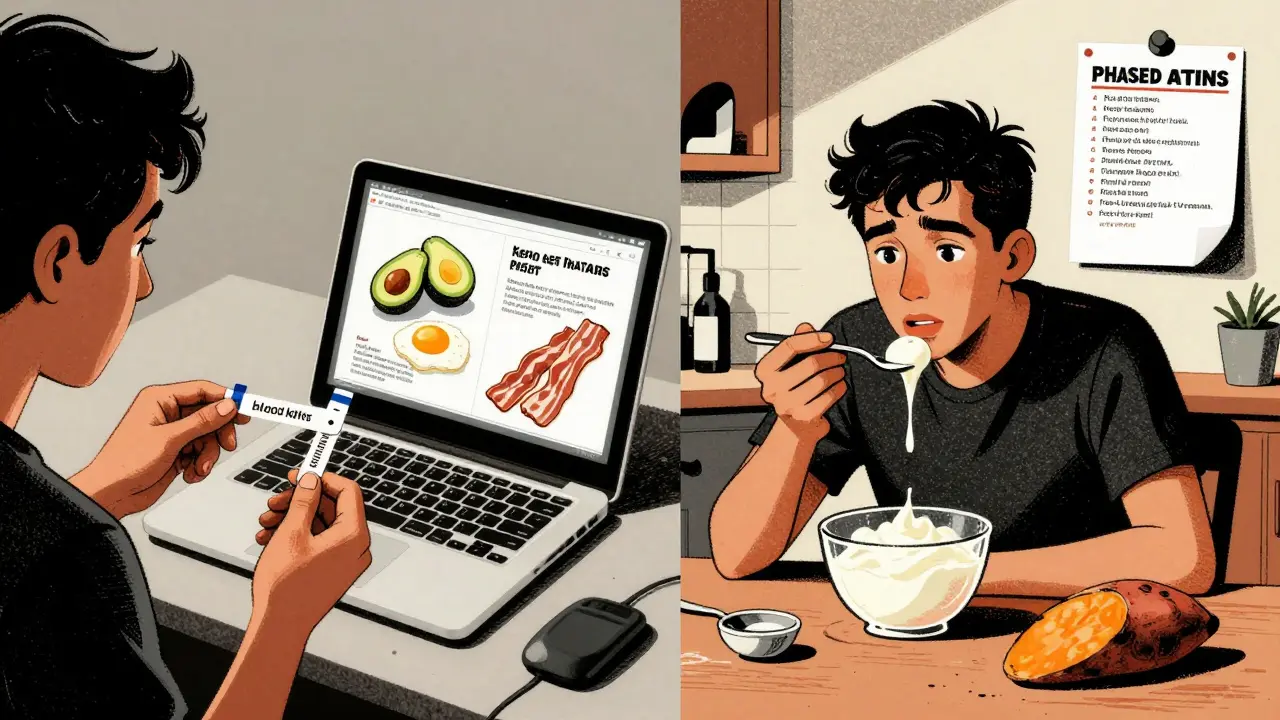
If you’re young, tech-savvy, and love data, keto might click. You’ll track macros with apps like Carb Manager. You’ll test ketones with blood strips. You’ll post your progress on Reddit. You want control. You want precision. Keto gives you that.
If you’re older, busy, or just want to lose weight without becoming a nutrition scientist, Atkins wins. You don’t need to test your blood. You don’t need to avoid all fruit forever. You just follow the phases. You get structure. You get flexibility. You get to eat a baked potato again - someday.
But here’s the truth: neither diet works if you’re eating processed junk. A keto cheeseburger with a sugar-free bun isn’t healthy. An Atkins bar with 20 grams of sugar alcohol isn’t a win. Real food still matters. Both diets can go wrong if you treat them like magic pills.
Health Risks and Expert Warnings
Doctors aren’t all on board. The American Diabetes Association says low-carb diets can help with blood sugar - short term. But long-term safety? Still unclear. The Mayo Clinic says both diets are no better than other diets after a year. And Harvard’s Dr. David Ludwig warns: “The extreme restriction makes long-term adherence challenging for most people.”
There’s also the fat issue. Keto often means lots of butter, bacon, cheese. That’s saturated fat. Some experts - like Dr. Neal Barnard - say that raises heart disease risk. Atkins isn’t much better if you load up on processed meats and cheese. But you can do both diets well. Eat salmon. Eat broccoli. Eat nuts. Eat olive oil. That’s not hard. It just takes effort.

Cost, Tools, and Support
Keto costs more. Blood ketone strips run $40-60 a month. Special keto snacks? Expensive. You’re buying grass-fed butter, organic eggs, wild-caught fish. It adds up.
Atkins has branded products - bars, shakes, frozen meals - that are cheaper than keto alternatives. But they’re still processed. And you’re paying for the brand. Still, you can follow Atkins with regular groceries. No strips needed. No apps required. Just a carb counter and a willingness to learn.
Support? Keto has Reddit, YouTube, and apps like KetoDiet. Thousands of people sharing recipes, struggles, wins. Atkins has official phase guides, customer service, and structured meal plans. If you like organization, Atkins wins. If you like community, keto wins.
Which One Should You Pick?
Here’s the bottom line:
- Choose ketogenic if you want fast results, love structure, don’t mind tracking, and are okay with never eating bread again.
- Choose Atkins if you want to lose weight, then learn how to eat normally without gaining it back. You want flexibility. You want to eat real food - eventually.
Neither is a cure. Neither is perfect. But one might fit your life better.
Try keto for 6 weeks. See how you feel. If you hate it, switch to Atkins Phase 2. If you love it, keep going. But don’t think either one is forever. Weight loss isn’t about diets. It’s about habits. And the best diet is the one you can live with - not the one that sounds the most extreme.
Can you do keto and Atkins together?
Yes - but it’s not necessary. The first phase of Atkins (Induction) is almost identical to keto: under 25 grams of net carbs. Many people start Atkins like keto, then move into higher carb phases. You don’t need to switch diets. Just follow Atkins’ phases and treat Phase 1 as keto. The difference comes later, when you add carbs back in.
Which diet is better for type 2 diabetes?
Both diets improve blood sugar control in the short term. A 2013 study showed Atkins helped reduce HbA1c levels and cut diabetes medication use. Keto does the same - sometimes faster. But long-term, the American Diabetes Association says evidence is still limited. The key isn’t the diet - it’s consistent carb control. Either diet works if you stick with it.
Do you need to count calories on keto or Atkins?
Technically, no - but you should. Both diets reduce hunger naturally by stabilizing blood sugar and increasing fat-burning. But if you eat too much cheese, butter, or Atkins bars, you’ll still gain weight. Calories still matter. Most people lose weight without counting, but tracking for the first few weeks helps you understand portion sizes and hidden carbs.
Can you exercise on keto or Atkins?
Yes - but your performance may dip at first. Keto can cause fatigue in the first 2-4 weeks as your body adapts. After that, many people report better endurance. Atkins doesn’t usually cause that crash because carbs are slowly reintroduced. Weightlifters often prefer Atkins because protein intake stays higher. Both diets work with exercise - just give your body time to adjust.
What happens if you stop either diet?
If you go back to eating sugar, bread, and processed food, you’ll likely regain weight - no matter which diet you were on. The difference is that Atkins teaches you how to find your personal carb tolerance. Keto doesn’t. So if you quit keto cold turkey, you’ll probably binge. If you quit Atkins, you’ve already learned how to eat without gaining. That’s the real advantage.
Final Thought: It’s Not About the Diet - It’s About You
There’s no “best” low-carb diet. There’s only the one that fits your life. Keto is a scalpel. Atkins is a toolbox. One cuts deep and fast. The other lets you build something that lasts.
Don’t pick based on what’s trending. Pick based on what you can actually do for the next five years. Because weight loss isn’t a sprint. It’s a lifestyle. And the only diet that works forever is the one you don’t hate.
14 Comments
Charles BarryDecember 21, 2025 AT 20:29
The keto diet is just Big Pharma’s way of keeping you hooked on blood strips and expensive butter. They don’t want you to eat real food-they want you to buy their ketone monitors and ‘keto’ snacks that are 80% soy isolate. This isn’t nutrition, it’s surveillance capitalism dressed in avocado toast.
Atkins? Even worse. Those ‘Phase 4’ meal plans? Designed by corporate diet engineers who’ve never held a potato in their life. They’re selling you a ladder to climb out of a hole they dug.
And don’t get me started on ‘carb tolerance.’ That’s just a fancy term for ‘I’m addicted to sugar but I need to feel in control.’ You’re not a scientist. You’re a snack addict with a spreadsheet.
Rosemary O'SheaDecember 23, 2025 AT 09:50
Oh please. Keto is the only diet for people who understand that food is chemistry, not comfort. Anyone who thinks they can ‘find their sweet spot’ with Atkins is deluding themselves-carbs rewire your dopamine receptors. You think you’re ‘in control’? You’re just one croissant away from a 10-pound rebound.
And let’s be honest: if you need Walmart frozen meals to survive, you shouldn’t be dieting at all. You need therapy. Or a better life. Or both.
Kathryn WeymouthDecember 24, 2025 AT 05:21
I appreciate the detailed breakdown, but I’m concerned about the oversimplification of long-term health outcomes. The 2022 study cited did show equivalent weight loss after two years, but it didn’t measure lipid profiles, insulin sensitivity, or gut microbiome diversity-factors that differ significantly between sustained keto and moderate low-carb approaches. Also, the muscle preservation benefit of keto is well-documented in resistance-trained populations, which the post mentions but doesn’t contextualize for non-athletes. Real food quality matters more than the diet label-whether you’re on keto or Atkins, if you’re eating processed ‘keto’ bars, you’re losing the war before you start.
Nader BsyouniDecember 25, 2025 AT 03:46
Everyone’s obsessed with diets like they’re religious texts but no one asks why we’re all so damn hungry in the first place
Maybe the problem isn’t carbs maybe it’s the 14 hour workdays and the 3am scrolling and the fact that we’ve turned eating into a performance art for Instagram
Also who the hell decided butter is the new holy water
Also also I think the FDA is hiding the truth about soybean oil
Julie ChavassieuxDecember 26, 2025 AT 21:24
Ugh. I tried keto. It was like being punished by a nutrition cult. I cried over a single blueberry. I had to measure my olive oil. I missed my toast. I missed my life.
Atkins let me eat a baked potato in month 4. And I didn’t die. I didn’t explode. I just… ate. And I kept the weight off.
So yeah. I’m done with extreme. I’m done with guilt. I’m done with ketone strips. I’m just done.
Herman RousseauDecember 28, 2025 AT 03:00
Hey everyone - just wanted to say this post is actually super helpful. I’ve been stuck in the ‘diet loop’ for years, and this is the first time I’ve read something that didn’t make me feel guilty. If you’re new to low-carb, start with Atkins Phase 2 - not keto. You don’t need to go nuclear on day one. And yes, you can still eat berries, Greek yogurt, and even a slice of sourdough if you track it. I lost 32 lbs in 6 months without buying a single ‘keto’ snack. Real food. Real life. No strips. No apps. Just me and my hunger. You got this 💪
P.S. If you’re feeling the keto flu, drink more water and add salt. Seriously. It’s not magic. It’s electrolytes.
Ajay BrahmandamDecember 30, 2025 AT 02:01
Bro I tried keto for 2 weeks and I was so tired I couldnt even walk to the fridge
Atkins phase 2? I ate sweet potato with butter and felt like a king
no strips no apps no drama
just eat real food and dont stress
also indian food is low carb if you skip the rice and roti
chicken curry with cauliflower rice = win
Aliyu SaniDecember 30, 2025 AT 23:12
Look i been in the west for 8 years and i see this pattern over and over again
people think diet is about food but its about control
keto is for people who need to micromanage their existence
atkins is for people who want to eat but still feel like theyre doing something right
but honestly the real problem is we live in a system that makes us hungry and then sells us solutions to be less hungry
you dont need a diet
you need to stop being exploited by the food industrial complex
and yes i know this sounds like a lecture
but i lived it
Johnnie R. BaileyDecember 31, 2025 AT 12:27
Here’s the thing nobody says out loud: both diets are just variations of the same old lie - that you can out-eat your environment.
Keto is the Silicon Valley version: quantified, optimized, biohacked.
Atkins is the suburban version: structured, branded, convenient.
But the truth? You’re still eating in a world designed to make you fat. The real rebellion isn’t cutting carbs - it’s growing your own food, cooking from scratch, and refusing to let corporations define your hunger.
Also - if you’re measuring your ketones, you’re not healing. You’re performing.
Art Van GelderJanuary 1, 2026 AT 03:05
I’ve been on both diets, alternated them, cycled them, and honestly I think the whole conversation is missing the forest for the trees. The reason keto feels so extreme isn’t because of the carbs - it’s because you’re suddenly forced to face how much of your life was built around emotional eating, social rituals, and cultural conditioning around food. When you cut carbs, you’re not just cutting glucose - you’re cutting comfort, connection, celebration. Atkins doesn’t ask you to abandon those things. It asks you to negotiate them. That’s why it lasts. That’s why it’s not a diet - it’s a negotiation with yourself. And maybe that’s the only kind of change that ever sticks. The rest? Just temporary rebellion dressed in avocado oil.
Jim BrownJanuary 1, 2026 AT 18:02
It is imperative to underscore that the prevailing discourse surrounding low-carbohydrate dietary regimens frequently obfuscates the fundamental biological principle that caloric balance remains the sine qua non of weight regulation. While ketosis may engender a transient elevation in metabolic efficiency, the long-term physiological adaptations - including downregulation of leptin and thyroid hormones - ultimately attenuate the initial advantages. Furthermore, the assertion that Atkins permits greater adherence is predicated upon the assumption that human behavior is rational, which empirical evidence from behavioral economics categorically refutes. One cannot merely ‘find one’s carb threshold’; one must confront the neurobiological architecture of craving, habituation, and reward. Thus, the most efficacious intervention is not dietary prescription, but psychological reconditioning.
Cara HritzJanuary 3, 2026 AT 09:14
Wait so keto is 50g carbs a day but then you said half a banana? That’s like 20g so like… what? And what about fiber? Do you count it? I’m so confused now I think I’m gonna eat a donut just to feel something
also why is everyone so mad about butter??
Sai Keerthan Reddy ProddatooriJanuary 4, 2026 AT 16:54
Atkins is a liberal scam. Keto is the only real diet. America is weak because we eat bread and sugar. We used to be strong. Now we are fat. China eats rice. India eats carbs. Look where they are. We need to go back to real food. No soy. No fake sweeteners. No Walmart. Just meat. Butter. Eggs. That’s it. God made man to eat fat. Not sugar. Not bread. Not carbs. This is the truth.
Gabriella da Silva MendesJanuary 6, 2026 AT 14:41
Ok but like… why are we even talking about this? I lost 40 lbs on Weight Watchers. I eat pizza. I eat ice cream. I eat carbs. I just don’t eat a whole damn pizza. I eat one slice. And I walk. And I sleep. And I drink water. And I don’t check my ketones. And I don’t cry over berries. And I’m not a scientist. I’m just a person who wanted to feel better. So maybe… the real answer is… none of this? 🤷♀️