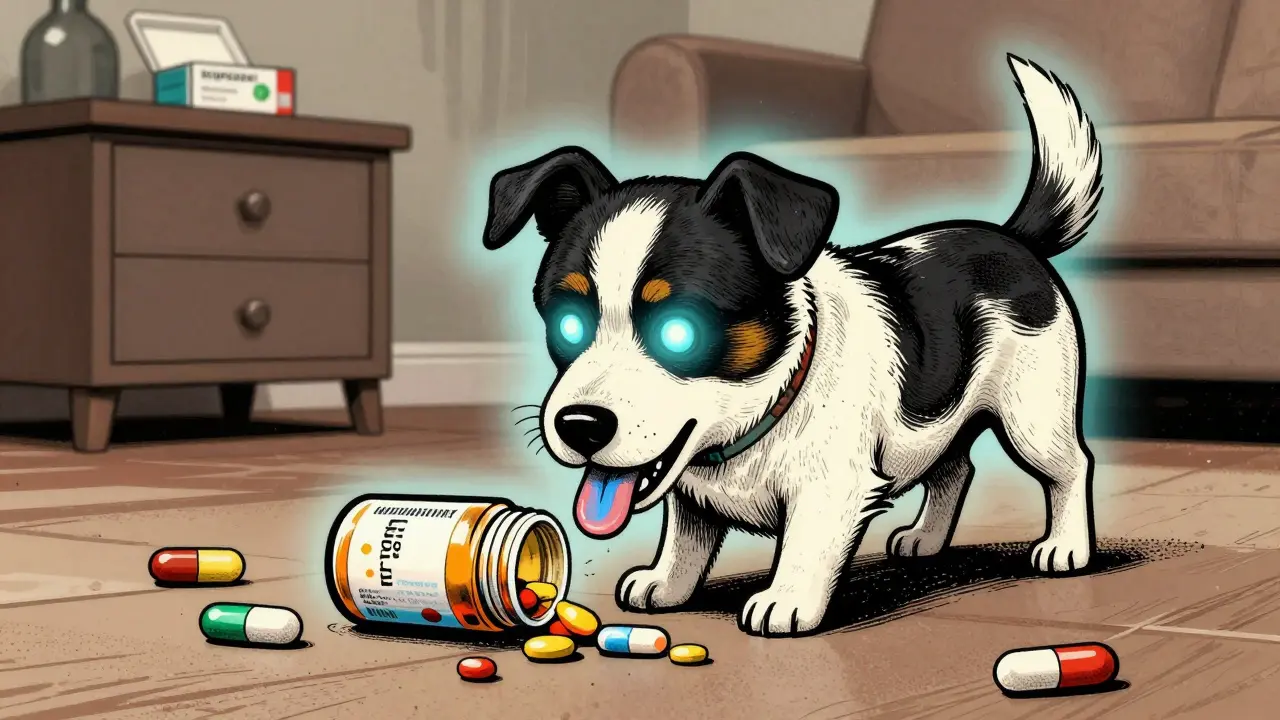
Every year, over 150,000 pets in the U.S. end up in emergency vet clinics because they swallowed something they shouldn’t have-and most of those cases involve human medications. Dogs, especially, are notorious for chewing through pill bottles, but cats aren’t safe either. The problem isn’t just that pets are curious. It’s that the medicines we take every day-antidepressants, painkillers, ADHD meds-are deadly to them in tiny amounts. And the symptoms? They don’t always look like what you’d expect. You might think your dog is just hyper or your cat is acting weird, but it could be a life-or-death emergency.
What Happens When Pets Ingest Human Medications?
It’s not just about the pill. It’s about what that pill does inside your pet’s body. Humans and pets process drugs differently. Cats, for example, can’t break down acetaminophen (Tylenol) at all. Even one tablet can poison them. Dogs handle it better, but still can’t process NSAIDs like ibuprofen (Advil) or naproxen (Aleve) safely. A single 200mg ibuprofen tablet can cause stomach ulcers and kidney failure in a 20-pound dog. For a cat? Half that dose is dangerous.
Antidepressants like Prozac, Lexapro, or Effexor are among the most common culprits. These drugs affect serotonin levels in the brain. In pets, too much serotonin causes a dangerous condition called serotonin syndrome. Symptoms include high fever (103°F or higher), tremors, rapid heart rate, and seizures. One case from Oregon showed a cat that ate just one extended-release Effexor capsule-something meant for a human-ended up with liver enzyme levels over 1,200 U/L. Normal? Around 50. That’s not a coincidence. That’s a medical emergency.
Key Symptoms by Medication Type
Not all overdoses look the same. The signs depend on what your pet ate. Here’s what to watch for:
- Antidepressants (SSRIs, SNRIs): Agitation, pacing, vocalizing, drooling, tremors, fever, seizures. Symptoms can start within 30 minutes and peak in 2-6 hours.
- ADHD meds (Adderall, Concerta, Ritalin): Extreme hyperactivity, panting, rapid heartbeat (over 220 bpm), high body temperature (up to 107°F), tremors, dilated pupils. Dogs can crash within an hour. Cats are less commonly affected, but when they are, it’s worse.
- NSAIDs (ibuprofen, naproxen): Vomiting (92% of cases), black tarry stools (sign of internal bleeding), loss of appetite, lethargy, increased thirst, urination changes. Kidney damage can show up in 24-72 hours.
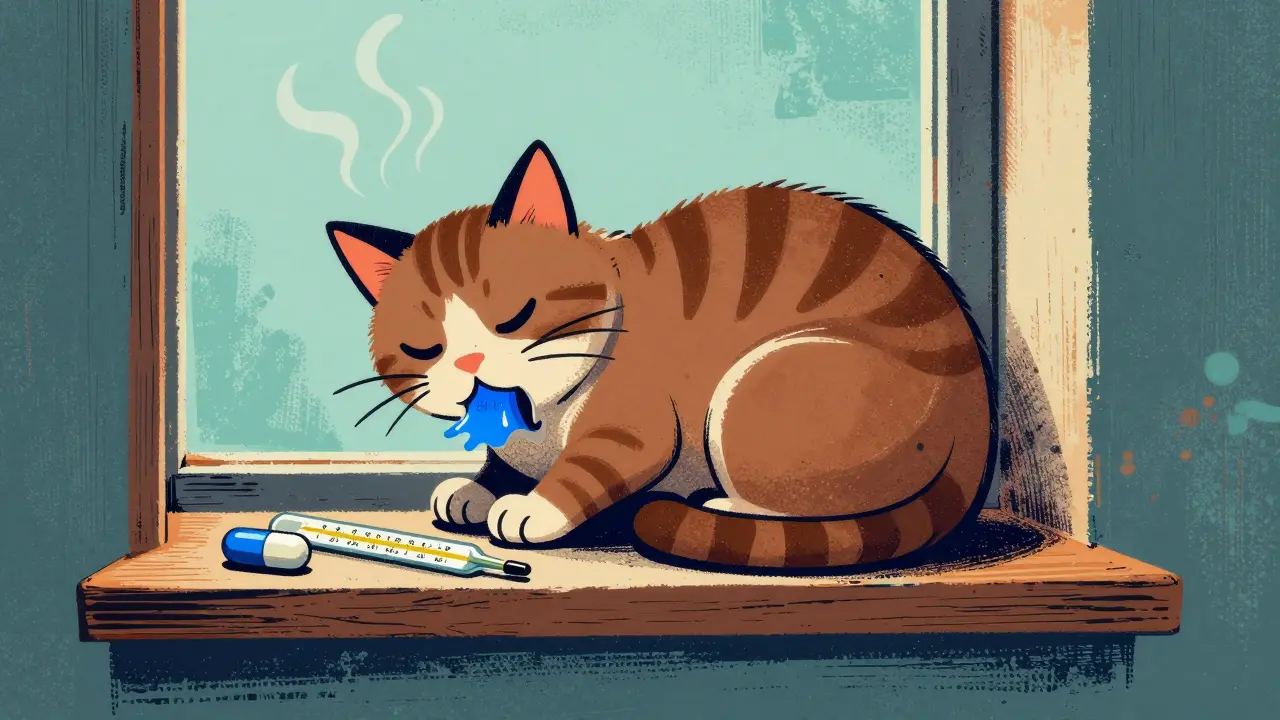
- Acetaminophen (Tylenol): In cats, gums turn brown or blue (methemoglobinemia), breathing becomes labored, swelling in face or paws, vomiting. In dogs, liver damage appears 24-72 hours later with jaundice, vomiting, and weakness.
- Benzodiazepines (Xanax, Ambien): Paradoxical reactions are common in dogs-instead of calming down, they become aggressive, hyper, or disoriented. Cats often develop liver failure, even from small doses.
One big mistake owners make? Mistaking these signs for something else. A dog shaking from Adderall toxicity? Looks like shivering from cold. A cat acting strange after eating Effexor? Feels like a behavioral issue. But these aren’t random. They’re textbook reactions to specific drugs.
Species Differences Matter
Cats and dogs don’t react the same way. That’s not a myth-it’s biology. Cats lack a key liver enzyme (glucuronyl transferase) that helps break down certain drugs. That’s why acetaminophen is so deadly to them. Just 10mg per kg of body weight can be fatal. For a 10-pound cat? That’s less than half a 325mg tablet.
Dogs, on the other hand, can handle acetaminophen better-but they’re far more sensitive to NSAIDs. A 50-pound dog might survive a single 200mg ibuprofen tablet, but two could kill it. And extended-release pills? Even worse. They keep releasing poison over hours instead of minutes, making treatment harder.
Effexor XR, for example, is designed to last 24 hours in humans. In a cat, it can cause toxicity for over 12 hours straight. Owners often think, “It’s just one pill,” but the slow release means the poison keeps working. By the time they get to the vet, it’s too late.
What to Do Immediately
Time is everything. A Merck Veterinary Manual study found 93% of pets survive if treated within two hours of ingestion. After that, the odds drop fast. So here’s what you do-right now:
- Don’t wait for symptoms. If you see your pet swallow a pill, or find an empty bottle, act immediately.
- Check for clues. Look for pill fragments, spilled powder, or chewed packaging. Note the name, strength, and how many were missing.
- Measure temperature. Use a rectal thermometer. If it’s over 103.5°F, it’s likely a stimulant or antidepressant overdose.
- Check gums. Are they pink? Normal. Blue or brown? Acetaminophen poisoning. That’s a red flag.
- Call for help. Don’t Google. Don’t wait. Call the Pet Poison Helpline (1-800-213-6680) or the ASPCA Poison Control App. They’re staffed 24/7 by veterinary toxicologists. Response time? Under a minute.
Do NOT try to make your pet vomit unless a vet tells you to. Some drugs, like benzodiazepines, can cause aspiration if vomited. Others, like iron supplements or large pills, can damage the esophagus on the way back up. Let the experts guide you.
Common Mistakes and How to Avoid Them
Most owners don’t realize how quickly things go wrong. Here are the top errors-and how to dodge them:
- Mistake: Thinking “my pet is fine because they’re still awake.” Fix: Many drugs cause delayed organ damage. A dog might seem fine for 6 hours after eating ibuprofen, then collapse from kidney failure.
- Mistake: Assuming “it’s just one pill.” Fix: One 10mg Effexor capsule can poison a 15-pound cat. One 200mg ibuprofen can kill a 30-pound dog.
- Mistake: Confusing tremors with cold or anxiety. Fix: Medication tremors are rhythmic, fast (8-10Hz), and accompanied by other signs like dilated pupils or fever. Cold shivers are irregular and don’t come with those.
- Mistake: Waiting to see if symptoms get worse. Fix: If you suspect ingestion, treat it like an emergency. Every minute counts.
There’s also a dangerous myth: “My pet ate it before, and they were fine.” That’s luck, not safety. One time doesn’t mean it’s safe. Dose matters. Weight matters. Time matters. And your pet’s metabolism? It’s not the same as last time.
How to Prevent This From Happening
Prevention is the best treatment. Here’s how to keep your home safe:
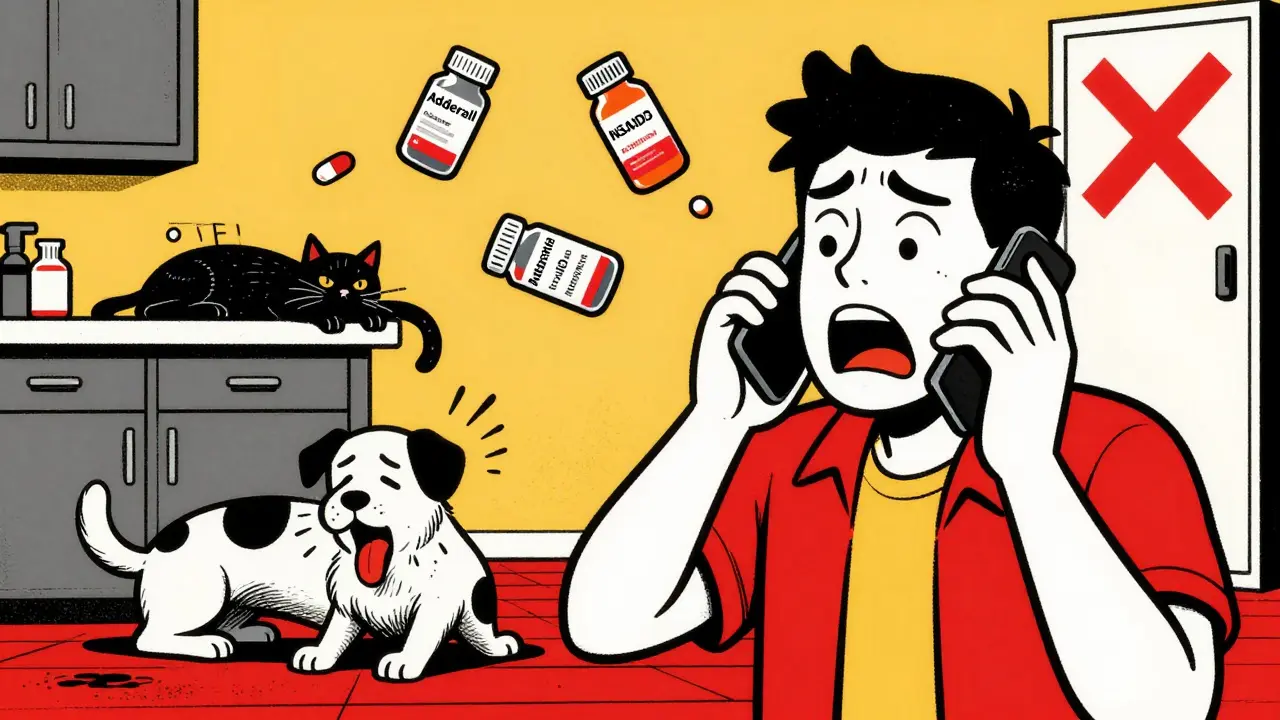
- Lock up all meds. Use childproof containers or lockboxes. Don’t leave pills on nightstands, countertops, or purses.
- Don’t share meds. Never give your dog aspirin or your cat Tylenol-even if you think it’s “just a little.”
- Dispose of pills properly. Don’t flush them. Use a drug take-back program or mix them with coffee grounds or cat litter before throwing them away.
- Be extra careful with elderly pets. Older pets are more sensitive to toxins. A dose that’s safe for a young dog could kill an older one.
- Know your pet’s weight. If you ever need to call poison control, they’ll ask for it. Keep it handy.
Some companies are starting to add bitter-tasting coatings to pills to deter pets, but it’s not required. So don’t rely on it. Your vigilance is the only real shield.
What Happens at the Vet?
If you get your pet to the clinic quickly, treatment can be straightforward. For recent ingestions (under 2 hours), they’ll likely give activated charcoal to absorb the poison. IV fluids help flush toxins from the kidneys. For stimulant overdoses, they’ll use medications to slow the heart rate and cool the body. For acetaminophen, they’ll give N-acetylcysteine (NAC), a life-saving antidote. For antidepressants, they’ll manage seizures and temperature.
But if you wait? Things get ugly. Kidneys fail. Livers shut down. Blood can’t carry oxygen. The cost? Up to $5,000 for a single case. The risk? Death. And it’s preventable.
One success story: a Labrador that ate ibuprofen. His owner noticed vomiting and black stools within 90 minutes. Called poison control, rushed to the ER, got charcoal and fluids. He went home the next day. Another case: a cat that ate Effexor. The owner thought it was “just acting odd.” Waited 4 hours. By the time they got there, the cat had liver failure. It didn’t survive.
Can a small amount of human medication really kill my pet?
Yes. Even one pill can be fatal. For example, a single 200mg ibuprofen tablet can cause stomach ulcers and kidney failure in a small dog. A single 10mg acetaminophen tablet can kill a cat. Pets are much more sensitive than humans, and their bodies can’t process many human drugs safely.
What should I do if I think my pet swallowed medication?
Don’t wait. Call the Pet Poison Helpline at 1-800-213-6680 or use the ASPCA Poison Control App immediately. Have the medication name, strength, and estimated amount ready. Do not try to induce vomiting unless instructed by a professional. Time is critical-treatment within two hours greatly improves survival.
Are cats more at risk than dogs?
Yes, in some cases. Cats are especially vulnerable to acetaminophen and certain antidepressants like Effexor because they lack the liver enzymes needed to break them down. Even tiny doses can cause fatal liver damage or methemoglobinemia. While dogs are more likely to ingest pills, cats face higher mortality rates from the same exposures.
What are the signs of serotonin syndrome in pets?
Serotonin syndrome from antidepressants includes fever (103-106°F), rapid heart rate, tremors, agitation, vocalization, dilated pupils, and seizures. Symptoms can appear within 30 minutes to 12 hours. If your pet is unusually hyper, shaking, or seems confused after eating medication, treat it as an emergency.
Can I use home remedies to treat pet overdose?
No. Home remedies like hydrogen peroxide, milk, or salt can make things worse. Some drugs cause internal damage if vomited. Others need specific antidotes only available at a vet. Calling poison control or heading to an emergency clinic is the only safe option.
Final Thought: Be the First Line of Defense
You don’t need to be a vet to save your pet’s life. You just need to know the risks and act fast. Human medications are everywhere-on nightstands, in purses, in bathroom cabinets. Your pet doesn’t know the difference between your medicine and their treats. But you do. Keep pills locked up. Know the signs. Call for help immediately. One quick call could mean the difference between a full recovery and a funeral.
8 Comments
Joy FJanuary 2, 2026 AT 18:30
Okay, but let’s be real-this isn’t just about pet owners being careless. It’s about how we’ve turned our homes into pharmaceutical free-for-alls. Pill bottles on nightstands like they’re decorative objects? That’s not negligence, that’s cultural decay. We treat medicine like candy, then act shocked when Fido gets a serotonin overdose from a single Effexor capsule. We’re not just bad at storage-we’re bad at thinking. Our entire relationship with pharmaceuticals is performative. We pop pills like they’re M&Ms, then wonder why our pets are dying from the same ritual.
And don’t even get me started on the myth that ‘it’s just one pill.’ One pill is a death sentence when your pet’s liver doesn’t have the enzymes to detox it. Cats don’t metabolize acetaminophen. They don’t have the option. It’s not a choice. It’s biological erasure. And we act like it’s a coincidence when they die.
We need systemic change, not just ‘lock up your meds.’ We need regulation on pill packaging. We need bitter coatings mandated by law. We need pharmaceutical companies to stop designing drugs that are literally poison to 90% of mammals. This isn’t pet care. This is bioethics on a household level.
And yet, the vet bills keep piling up. Because people still think ‘I didn’t mean to’ excuses death. But intent doesn’t matter when your cat’s gums are turning blue.
I’ve seen it. I’ve held a 12-pound cat that ate half a Tylenol. She didn’t even know she was dying. Neither did I, until it was too late. So now? I keep my meds in a biometric safe. Because love isn’t enough. Responsibility is the only antidote left.
Haley ParizoJanuary 4, 2026 AT 05:29
You people are so obsessed with blaming pet owners when the real villain is Big Pharma. They design drugs for humans, then don’t test them on animals because ‘it’s too expensive.’ But when a cat dies from a single tablet? Suddenly it’s ‘oh no, your negligence!’ No. It’s corporate malice. They know cats can’t process acetaminophen. They know dogs are sensitive to NSAIDs. And yet they still sell these pills in blister packs that look like candy. They don’t care. They profit. You think locking up meds fixes anything? That’s like putting a Band-Aid on a bullet wound.
They should be required to print ‘DANGEROUS TO PETS’ in neon red on every bottle. They should be fined millions per incident. But no-because the FDA is a revolving door for pharma lobbyists. And we’re the ones cleaning up the corpses.
I’ve worked in ER vet clinics for 17 years. I’ve seen 142 cats die from Tylenol. Every. Single. One. Could’ve been prevented. But the system won’t change. So now we’re just sad little humans yelling into the void while the corporations cash in.
And you know what? I’m not just mad. I’m done. I won’t buy another pill that doesn’t have a pet-safe warning label. And if you do? You’re complicit.
Ian DetrickJanuary 4, 2026 AT 12:15
Look, I get it-this is terrifying. But let’s not turn this into a doom spiral. The fact that we’re talking about this at all? That’s progress. Five years ago, nobody knew what serotonin syndrome meant for dogs. Now? We’ve got poison control hotlines, apps, vet techs trained to spot the signs. That’s huge.
I used to leave my Adderall on the dresser. My border collie once chewed through the bottle. I panicked, called the helpline, and they walked me through checking his gums, temp, heart rate. We got him in within 45 minutes. He’s fine. No long-term damage. Because I acted fast. Not because I’m a genius. Because I had the info.
So yeah, lock up your meds. Know your pet’s weight. Don’t Google. Call the helpline. It’s not magic. It’s just basic prep. And honestly? If you’re reading this, you’re already ahead of 80% of pet owners. We’re not doomed. We’re learning.
And if you’re still scared? Get a lockbox. $15 at Target. One hour of your time. That’s all it takes to save a life. No drama. No guilt. Just action.
My dog’s alive because I didn’t wait for symptoms. I acted. And you can too.
Angela FisherJanuary 4, 2026 AT 15:33
Okay but… what if the meds are being planted? 🤔 I mean, I’ve been noticing weird stuff. Like, my neighbor’s cat died after eating a pill… and then my ex’s dog died from ‘ibuprofen’ the week after. Coincidence? Or is someone targeting pets to get back at people? 🤨
I’m not crazy. I’ve seen the patterns. People leave pills out on purpose. It’s like a quiet war. And nobody’s talking about it. Why? Because the government doesn’t want you to know that your meds could be weaponized. 🚨
Also, did you know that some vets are on payroll with pharma companies? They tell you to ‘call poison control’ because they don’t want you to know the real truth-that they’re profiting off the deaths. 😔
My cat’s been acting weird since I started taking my antidepressants. I’m not saying it’s me… but… 🤔
Lock your meds? Nah. I’m locking my whole house. And I’m installing cameras. Because someone’s out there. And they’re using your medicine to kill your family. 🕵️♀️💔
Send help. Or at least, send this to 10 people. Before it’s too late. 🙏
Lori JacksonJanuary 5, 2026 AT 12:41
Let’s be honest-this entire post is just performative guilt for middle-class Americans who think they’re doing enough by ‘locking up meds.’
You don’t need a lockbox. You need to stop taking antidepressants in the first place. You don’t need to know your pet’s weight-you need to stop medicating your emotional void with SSRIs. You think a 200mg ibuprofen is dangerous? Try living with chronic pain and being told ‘just exercise more.’
Meanwhile, the real crisis is that we’ve outsourced care to corporations. You don’t need a vet. You need a therapist. You don’t need a poison helpline. You need a society that doesn’t make people feel so broken they need pills to function.
And don’t even get me started on the fact that you’re all okay with feeding your pets kibble full of preservatives and corn syrup, but suddenly you’re horrified by a single Tylenol? Hypocrisy is a disease. And it’s contagious.
Fix your life. Not your pill bottles.
Also, cats don’t die because of your meds-they die because you’re too self-absorbed to notice they’re suffering in silence. Just like you.
Just saying.
Wren HamleyJanuary 6, 2026 AT 09:05
Wild how we treat pets like furry little lab rats and then act surprised when they react badly to our chemical experiments. Seriously-cats are basically walking biochemistry puzzles. Their livers are like ancient Unix systems: no updates, no patches, just… hope it doesn’t crash.
And dogs? They’re the ultimate optimists. They’ll eat your entire prescription bottle because it smells like ‘human.’ They don’t know it’s poison. They just know it’s tasty. And we act like it’s their fault? Nah. It’s ours.
But here’s the kicker: we’re the only species that makes drugs designed for our neurochemistry and then expects other mammals to survive them. That’s not science. That’s arrogance wrapped in a white coat.
And yet… we’re the ones who cry when they die. Like it’s a tragedy. But we still leave the bottle open. Why? Because we don’t want to feel responsible. We want to believe it’s an accident.
It’s not. It’s negligence dressed up as love.
So yeah-lock the meds. But also… maybe ask why you need them in the first place. 🤷♂️
Ian RingJanuary 6, 2026 AT 16:01
Well, this is a sobering piece-thank you for sharing. I’ve had two cats in my life, both passed away from unrelated causes, but reading this made me reflect on how careless I was with my own medications back then. I did leave pills on the windowsill once-didn’t think twice. Now? Locked away in a drawer with a childproof cap. Simple, yes-but necessary.
Also, the bit about not inducing vomiting? Crucial. I’d have done it without thinking, assuming it was ‘common sense.’ Turns out, it’s not. Good to know.
Appreciate the clarity on symptoms too. I’ll be keeping this bookmarked. My current cat is 11, and I’d hate to lose her over something preventable.
Small steps, but they matter. 🙏
Tru VistaJanuary 7, 2026 AT 02:50
One pill can kill? Wow. Didn't know that. Guess I'm dumb. 😅