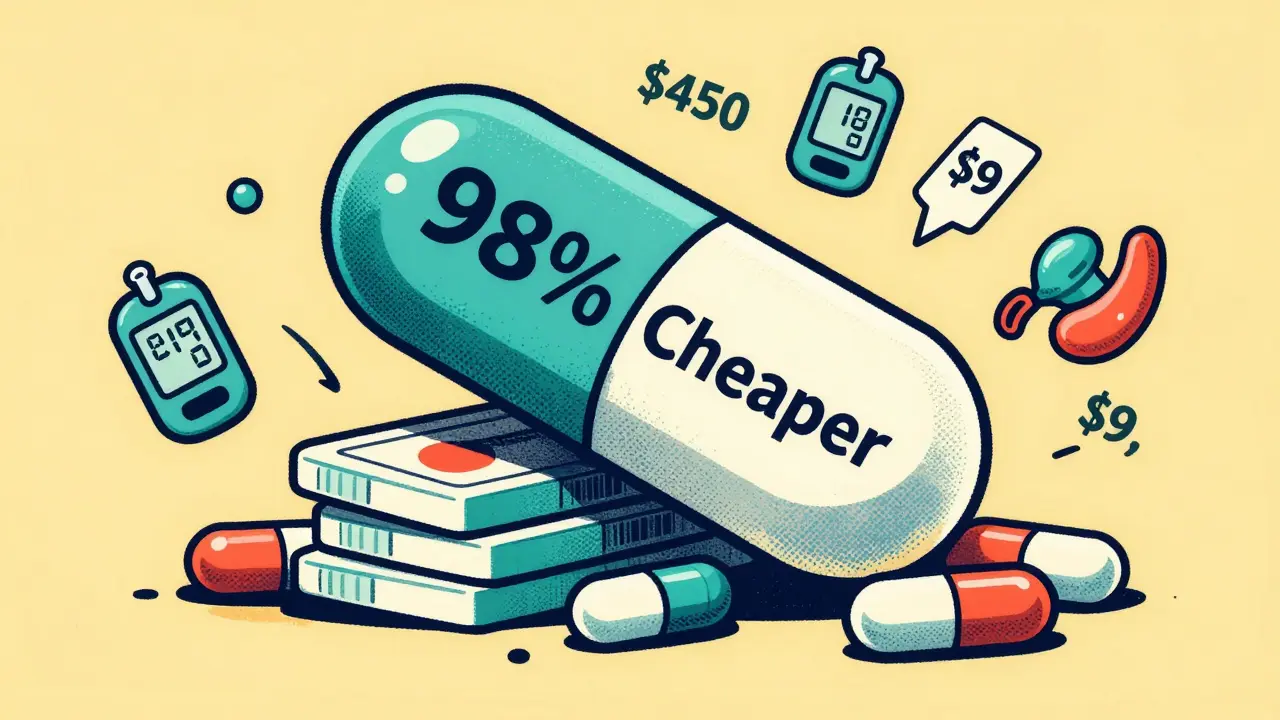
Every year, Americans spend over $600 billion on prescription drugs. But here’s the surprising part: generic medications make up 90% of all prescriptions filled, yet they account for just 1.5% of total drug spending. That’s not a typo. For every dollar spent on brand-name pills, you’re spending less than two cents on the generic version that does the exact same job.
Why Generics Cost So Much Less
Generic drugs aren’t cheap because they’re low quality. They’re cheap because they don’t need to repeat the $1 billion+ research, clinical trials, and marketing campaigns that brand-name drugs do. Once a patent expires-usually after 10 to 12 years-other manufacturers can step in and produce the same medicine. The FDA requires them to prove they’re bioequivalent: meaning they deliver the same active ingredient, in the same amount, at the same rate as the brand. That’s it. No extra bells. No fancy packaging. No TV ads.Take sertraline, the generic version of Zoloft. A 30-day supply of the brand can cost $450 out-of-pocket. The generic? Around $9. That’s a 98% drop. The same pattern shows up across the board: for common medications like metformin (for diabetes), atorvastatin (for cholesterol), or levothyroxine (for thyroid), the generic is often 80-90% cheaper.
The Real Numbers Behind the Savings
In 2022 alone, generic and biosimilar drugs saved the U.S. healthcare system $408 billion. That’s more than the entire annual budget of the Department of Education. Over the last decade, those savings have added up to $2.9 trillion. Think about that: nearly $3 trillion in money that didn’t go to drug companies, insurers, or patients’ pockets.Here’s how it breaks down:
- Medicare saved $130 billion in 2022 thanks to generics.
- Private insurers saved $194 billion.
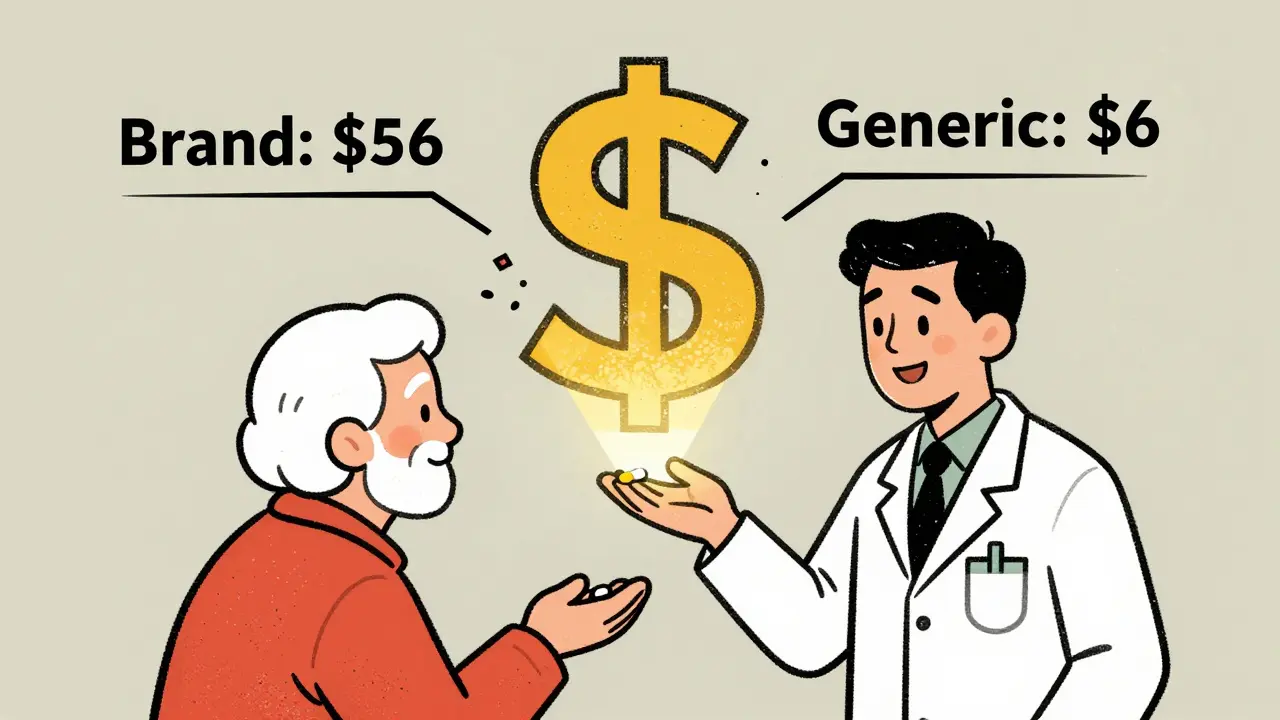
- The average generic copay is $6.16. The average brand-name copay? $56.12.
- 93% of generic prescriptions cost less than $20. Only 59% of brand-name prescriptions do.
And yet, brand-name drugs still make up 82% of total drug spending-even though they’re prescribed only 10% of the time. That’s because the price per pill is so high. Generics flip the script: more prescriptions, far less cost.
Therapeutic Substitution: The Hidden Savings
Most people think savings come from swapping a brand for its generic. But the biggest savings often come from switching between two generics.A 2022 study in Colorado looked at the top 1,000 generic drugs and found that 45 of them were priced way higher than other options that worked just as well. One example: a high-cost generic version of a blood pressure drug cost $1,200 a month. A different generic, with the same active ingredient and dosage, cost $18. That’s a 98.5% discount.
Doctors and pharmacists call this “therapeutic substitution.” It’s not about switching drugs-it’s about switching to a cheaper version of the same drug class. In 62% of these cases, the cheaper option was just a different strength or form-like a tablet instead of a capsule. The average savings? 94.9%.
Why Some People Still Pay Too Much
You’d think with all these savings, patients would be paying less. But here’s the catch: copays haven’t kept up with falling drug prices. A pharmacy might pay $2 for a generic pill, but your copay is still $20 because your insurance plan hasn’t updated its formulary. Or worse-you’re on a high-deductible plan and get hit with the full list price before your deductible kicks in.A 2022 Medicare survey found that 41% of beneficiaries still struggled to afford their meds-even though 91% of their prescriptions were generics. Why? Because even $10 or $15 a month adds up. If you’re taking five different generics, that’s $75 a month. That’s $900 a year. For someone on a fixed income, that’s real pain.
Are Generics Always Safe?
Yes. The FDA holds generics to the same strict standards as brand-name drugs. Every batch is tested for purity, potency, and shelf life. The manufacturing facilities are inspected just like brand-name ones.There are rare exceptions-mainly with drugs that have a narrow therapeutic index (NTI), like levothyroxine, warfarin, or some epilepsy meds. Tiny changes in blood levels can cause big problems. That’s why some doctors are cautious. But even here, the FDA has found that 98% of generic NTI drugs are rated “AB,” meaning they’re therapeutically equivalent.
One 2023 Drugs.com survey found that 15% of users reported issues after switching to a generic for levothyroxine. But when researchers checked their blood levels, most were within normal range. The real problem? Patients didn’t tell their doctor they felt different. They just assumed the generic was “weak.” Education helps: a Harvard study showed that when doctors explained FDA bioequivalence rules, patient concerns dropped by 87%.
How to Get the Best Generic Deal
You don’t have to guess which generic is cheapest. Here’s how to save:- Ask your doctor: “Is there a generic version?” Always. Even if you think there isn’t, new ones come out every month.
- Ask your pharmacist: “Is there a cheaper generic alternative?” They know which ones are priced lower-even if they’re not the first one listed.
- Use GoodRx or SingleCare. These apps show real-time prices at nearby pharmacies. Sometimes the same generic costs $3 at Walmart and $15 at CVS.
- Ask about 90-day supplies. Many generics are cheaper per pill when bought in bulk.
- Check your plan’s formulary. If your drug isn’t covered, ask for a prior authorization or exception.
And don’t assume your insurance will automatically choose the cheapest option. You have to ask.
What’s Changing in 2025?
The Inflation Reduction Act, passed in 2022, is starting to have real impact. Starting in 2025, Medicare Part D will cap out-of-pocket drug costs at $2,000 per year. That means more people will be able to afford their meds-especially if they’re on multiple generics.At the same time, more biosimilars (generic versions of complex biologic drugs) are hitting the market. In 2023, there were 41 FDA-approved biosimilars, up from just 5 in 2015. They’re still expensive compared to small-molecule generics, but they’re already saving billions on drugs like Humira and Enbrel.
Still, challenges remain. Drug shortages are rising-78% of the 312 active shortages in late 2023 were for generic drugs. That’s because many generics are made overseas, and supply chains are fragile. And brand companies still use legal tricks-like filing dozens of weak patents-to delay generic entry. The FTC found that on average, a brand-name drug gets hit with 17.5 patents to block competition.
Bottom Line: Generics Are the Quiet Hero of American Healthcare
They’re not flashy. They don’t have commercials. They don’t have celebrity endorsements. But without generics, millions of Americans couldn’t afford their prescriptions. They’ve kept heart disease, diabetes, and depression treatable for people who otherwise would have skipped doses or gone without.The data is clear: generics save lives and money. The real problem isn’t the drugs-it’s the system that still lets prices stay high even when competition exists. If you’re paying more than $20 for a common generic, you’re probably overpaying. Ask questions. Shop around. Demand the lowest price. Your wallet-and your health-will thank you.
12 Comments
Stewart SmithJanuary 1, 2026 AT 02:09
So basically, we’re paying $450 for a pill that costs $9 to make, and the system calls this ‘innovation’? 🤡
Aaron BalesJanuary 2, 2026 AT 03:41
Always ask your pharmacist. They know which generic is cheapest - not the first one listed, but the one that actually saves you money. It’s not magic, it’s just knowledge.
Brandon BoydJanuary 2, 2026 AT 22:21
If you’re taking five generics and paying $20 each, you’re bleeding $100 a month. That’s $1,200 a year. You can buy a new phone with that. Or food. Or rent. Don’t just accept it - ask for the $3 version at Walmart. Your body deserves better than corporate greed.
Branden TemewJanuary 3, 2026 AT 07:49
Generics are the quiet revolution no one talks about - like the unsung hero who shows up every day, does the job perfectly, and never gets a parade. Meanwhile, the brand names are the loud guy in the suit who got a $200M ad budget and still charges you $500 for a sugar pill.
Sara StinnettJanuary 3, 2026 AT 12:13
Let’s be honest - the real villain isn’t Big Pharma. It’s the American obsession with branding. We’d rather pay $100 for a bottle labeled ‘Zoloft’ than $9 labeled ‘sertraline’ because we’ve been conditioned to equate name with quality. It’s not medical - it’s psychological manipulation dressed as healthcare.
Frank SSSJanuary 4, 2026 AT 17:09
I switched to generic levothyroxine and felt like a zombie for three weeks. My doctor said it’s ‘bioequivalent’ - but my body didn’t get the memo. Now I’m back on brand. Maybe the FDA tests it in a lab, but my thyroid doesn’t live in a lab. So yeah, I’m not buying the ‘same thing’ myth anymore.
Darren PearsonJanuary 5, 2026 AT 02:04
While the economic argument for generics is compelling, one must not overlook the nuanced pharmacokinetic variances that, though statistically insignificant in population studies, can manifest clinically in individuals with complex comorbidities. The FDA’s AB rating system, while rigorous, does not account for inter-patient variability in absorption kinetics - particularly in geriatric populations with altered hepatic metabolism. Thus, blanket substitution without clinical monitoring constitutes a form of utilitarian healthcare rationing masquerading as fiscal prudence.
Jenny SalmingoJanuary 5, 2026 AT 12:58
I’m from a small town in Texas. My grandma takes three generics. She pays $4 for each at the grocery store pharmacy. She says, ‘If it keeps me walking, I don’t care what it’s called.’ That’s all that matters.
linda permata sariJanuary 6, 2026 AT 11:33
My mom in Indonesia takes the same generic for blood pressure as people here - but she pays $0.50 a pill. The same medicine, same factory, same FDA rules. We’re not paying for quality. We’re paying for marketing. And it’s wrong.
Paul HuppertJanuary 6, 2026 AT 13:12
GoodRx saved me $180 last month on my diabetes meds. Just typed in the name, picked the nearest pharmacy with the lowest price. Took 2 minutes. Why didn’t I do this sooner?
Retha DunggaJanuary 6, 2026 AT 20:53
life is just a big pharmacy and we're all just trying to find the cheapest pill that doesn't make us cry 🤷♀️💊 #genericsareheroes
Lawver StantonJanuary 8, 2026 AT 03:34
Let me tell you about my cousin who took the generic version of his antidepressant and started crying uncontrollably in the middle of a Target aisle. He thought it was ‘just a pill’ - until his brain decided to go on strike. Now he pays $200 a month for the brand because he doesn’t want to risk his mental health on a chemical that’s ‘close enough.’ And honestly? I get it. You think you’re saving money, but what if you lose your ability to function? What’s the real cost then? The system isn’t broken - it’s designed to make you feel guilty for needing help, then charge you extra for the privilege of not dying.