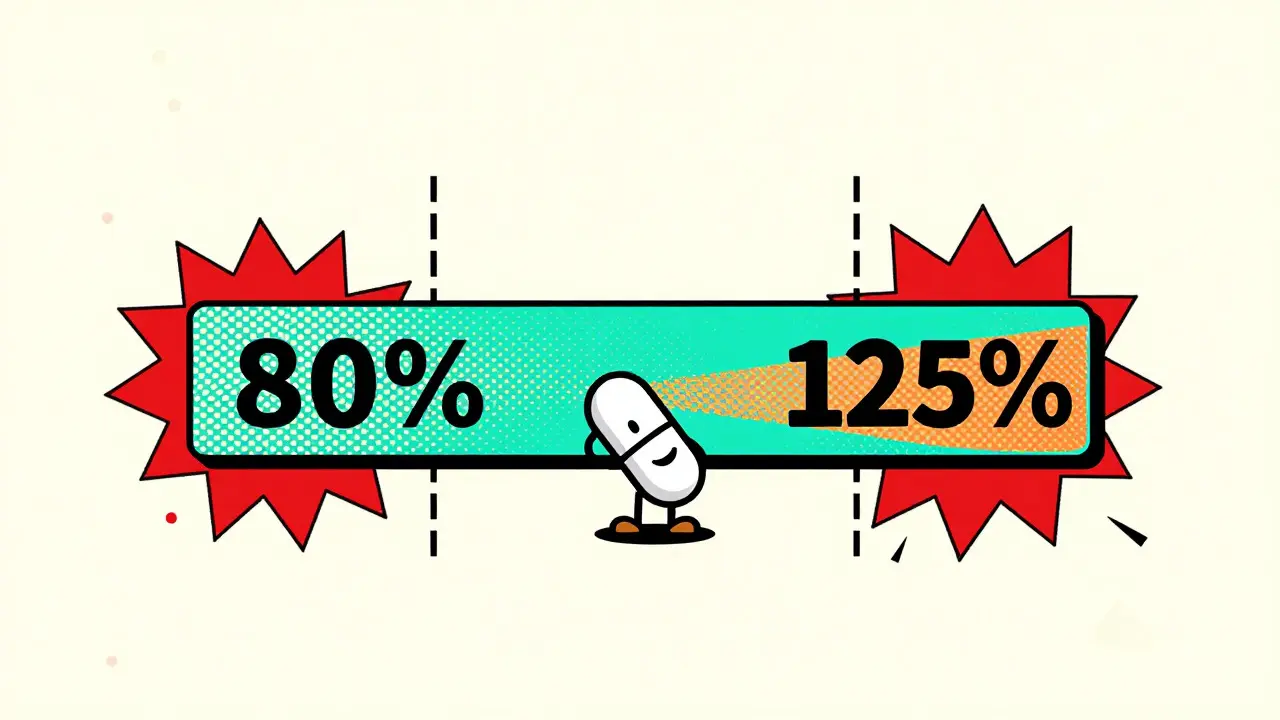
Ever wondered why your doctor switched you from a brand-name drug to a generic and you felt nothing different? Or maybe you’ve heard the scary rumor that generics are only "80% as strong"? That fear usually stems from a misunderstanding of the 80-125% rule, the global standard used to prove that a generic drug works just like its original counterpart. This isn't about the amount of active ingredient in the pill; it’s about how your body absorbs and processes it. If you’re a healthcare professional, a patient, or someone curious about how medicines get approved, understanding this statistical benchmark is key to trusting the supply chain.
The core idea is simple but statistically tricky. Regulatory agencies don’t just compare average blood levels. They look at the range of variability. For two drugs to be considered bioequivalent, the 90% confidence interval (CI) of the ratio between the test product (generic) and the reference product (brand) must fall entirely within 80% to 125%. If that range stays inside those bounds, the drugs are legally and clinically equivalent. It sounds technical, but the goal is practical: ensuring that swapping one for the other won’t change your treatment outcome.
What Actually Happens Inside the 80-125% Range
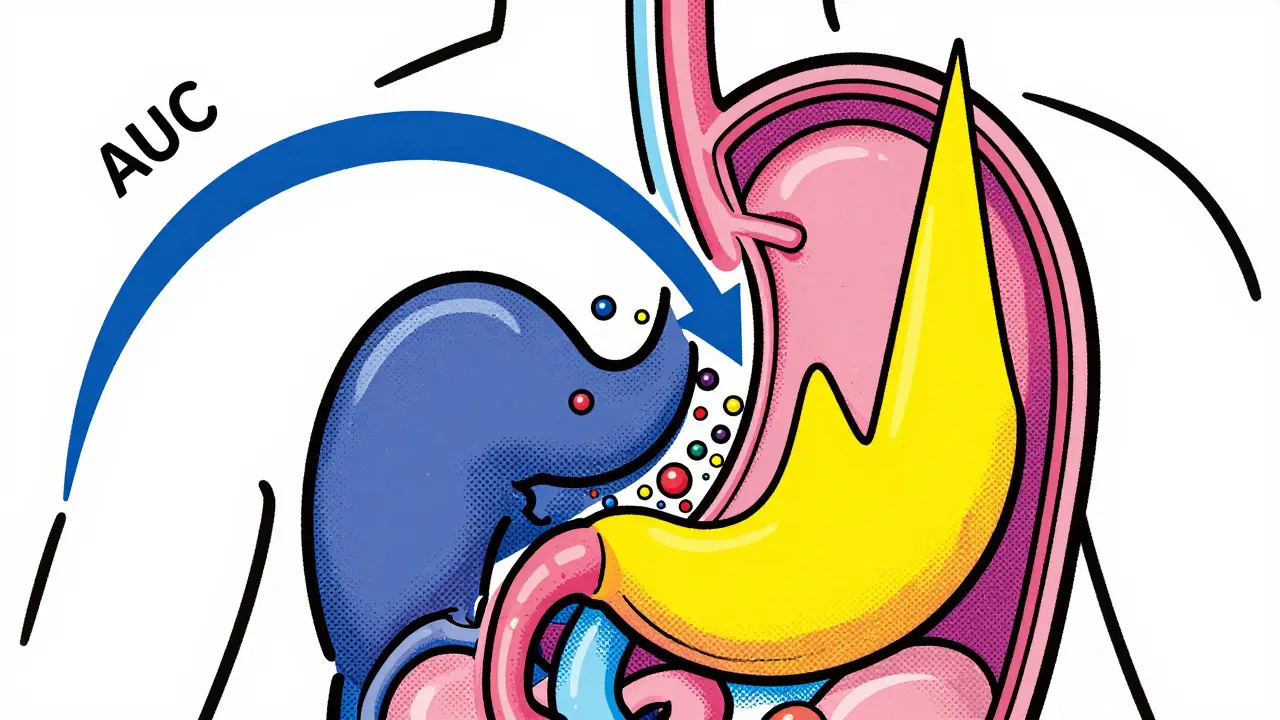
To grasp why these specific numbers matter, we have to look at pharmacokinetics. When you take a pill, your body doesn't absorb it instantly or uniformly. Two key metrics track this process:
- Area Under the Curve (AUC): This measures the total exposure to the drug over time. Think of it as the total amount of drug your system sees.
- Maximum Concentration (Cmax): This is the peak level of the drug in your blood. It tells us how fast the drug was absorbed.
Here’s where the math gets interesting. Drug concentrations in the body typically follow a log-normal distribution, not a standard bell curve. Because of this, scientists transform the data logarithmically before analyzing it. On this log scale, the 80-125% range becomes symmetrical around zero. Specifically, -0.2231 on the log scale equals 80%, and +0.2231 equals 125%. This symmetry makes the statistical comparison fairer and more robust than older methods that used additive percentages.
Why a 90% confidence interval instead of the usual 95%? In most medical trials, we use 95% CIs because we want to be very sure there's no difference. But in bioequivalence, we are proving *similarity*, not difference. A 90% CI allows for a 5% error margin at both the upper and lower limits. This creates a tighter, more practical window that accounts for natural biological variation without being so strict that almost no generic could ever pass.
Common Misconceptions About Generic Strength
Let’s bust the biggest myth right now: the 80-125% rule does not mean your generic contains only 80% of the active ingredient. If that were true, you’d feel weaker effects immediately. In reality, generic manufacturers must match the label claim of the brand-name drug with high precision, usually within 95-105% of the stated dose. The 80-125% rule applies to the pharmacokinetic parameters measured in human studies, not the raw ingredient weight.
A 2022 survey by the American Pharmacists Association found that 63% of community pharmacists still held onto the misconception that the rule referred to ingredient content. This confusion fuels patient anxiety. Online forums often reflect this worry, with patients citing the "80% rule" as their primary reason for hesitating to switch medications. However, post-marketing surveillance data tells a different story. An FDA analysis of over 2,000 generic drugs approved between 2003 and 2016 showed that only 0.34% required label changes due to bioequivalence concerns after they hit the market. That’s a remarkably low failure rate for a system handling thousands of products annually.
How Studies Prove Bioequivalence
Getting a generic approved isn't a paperwork exercise; it requires rigorous clinical testing. These studies typically follow a randomized, crossover design. Here’s what that looks like in practice:
- Participants: Usually 24 to 36 healthy volunteers are recruited. They act as their own controls, which reduces noise in the data.
- Design: Each participant takes the brand-name drug, washes out, then takes the generic (or vice versa). Blood samples are collected at precise intervals.
- Analysis: Researchers calculate the geometric mean ratios for AUC and Cmax. They then construct the 90% confidence interval for these ratios.
If the entire 90% CI falls within 80-125% for both AUC and Cmax, the drug passes. It’s an all-or-nothing scenario for the main parameters. If AUC passes but Cmax fails, the generic might need reformulation or further study. This process adds 18-24 months and $2-5 million to the development timeline, representing 15-20% of total generic drug development costs. Yet, this investment ensures that when you pick up a generic at the pharmacy, it has survived one of the most scrutinized statistical hurdles in pharmaceutical science.
Exceptions: When One Size Doesn’t Fit All
The 80-125% rule is a "one-size-fits-all" standard, which is its greatest strength for simplicity but also its main criticism. Not every drug behaves the same way. Some categories require stricter or looser criteria:
| Drug Category | Standard Range | Reason for Adjustment |
|---|---|---|
| Most Small Molecule Generics | 80-125% | Standard regulatory harmonization |
| Narrow Therapeutic Index (NTI) Drugs | 90-111% | Small changes can cause toxicity or loss of efficacy (e.g., Warfarin, Levothyroxine) |
| High-Variability Drugs | Scaled Average Bioequivalence (SABE) | Natural variability is high; fixed ranges are too strict |
Narrow Therapeutic Index (NTI) drugs are the big exception. These are medicines where the gap between a therapeutic dose and a toxic dose is tiny. For drugs like warfarin (a blood thinner) or levothyroxine (for thyroid issues), a 20% difference in absorption could lead to serious side effects or treatment failure. Consequently, the FDA and EMA have tightened the acceptance range for these specific products to 90-111%. This means generics for NTI drugs face a much harder statistical hurdle than the average antibiotic or painkiller.
On the other end of the spectrum are highly variable drugs, where individual bodies react very differently to the same dose. For these, regulators use Scaled Average Bioequivalence (SABE). This approach adjusts the acceptance range based on the inherent variability of the reference product. If the brand-name drug itself varies wildly between people, the generic is allowed a wider margin, potentially expanding the range up to 69.84-143.19% for Cmax under specific conditions. This flexibility prevents good generics from being rejected simply because the human body is unpredictable.

Global Harmonization and Industry Impact
You might think the US has its own unique rules, but the 80-125% standard is a global language. The FDA, European Medicines Agency (EMA), World Health Organization (WHO), and Health Canada all use nearly identical criteria. This harmonization, driven largely by the International Council for Harmonisation (ICH), means a generic developed in Europe can often be submitted in the US with minimal rework. As of 2022, 52 countries use identical or substantially similar standards.
This standardization powers the $227 billion global generic pharmaceuticals market. Since the Hatch-Waxman Act of 1984, over 14,000 generic drug products have been approved in the US alone. Today, generics account for 90% of all prescriptions filled in the US, yet they represent only 23% of total drug spending. Without the clear, predictable framework of the 80-125% rule, this cost-saving mechanism would be far less efficient. The industry invests approximately $2.1 billion annually in bioequivalence studies, with contract research organizations conducting over 1,200 such studies each year. It’s a massive, well-oiled machine built on this single statistical principle.
Future Directions and Emerging Challenges
While the rule has proven remarkably robust, it isn't static. The FDA’s 2023-2027 Strategic Plan includes "modernizing bioequivalence tools" as a key objective, with $15 million allocated for research into model-informed approaches. One area of focus is complex generics-things like inhalers, topical creams, and modified-release formulations. These products don't always fit neatly into standard oral tablet studies. The FDA established the Complex Generics Initiative in 2018 specifically to tackle these challenges, recognizing that traditional AUC/Cmax measurements might not capture the full picture for non-oral routes.
Another frontier is pharmacogenomics. As we learn more about how genetic variations affect drug metabolism, experts suggest that future bioequivalence standards might need to be personalized. By 2030, we could see criteria that account for specific genetic markers, moving away from population averages toward individualized equivalence. For now, though, the 80-125% rule remains the gold standard, backed by decades of data showing that products meeting this criterion show no clinically meaningful differences in therapeutic outcomes across dozens of drug classes.
Does the 80-125% rule mean my generic has less medicine?
No. The rule refers to the 90% confidence interval of pharmacokinetic parameters (how the body handles the drug), not the amount of active ingredient in the pill. Generics must contain the same labeled amount of active ingredient as the brand-name drug, typically within 95-105% accuracy.
Why is it a 90% confidence interval instead of 95%?
Bioequivalence studies aim to prove similarity, not difference. A 90% confidence interval allows for a 5% error margin at both the upper and lower limits. This creates a practical window that accounts for natural biological variation without being so strict that most generics would fail to meet the criteria.
Are there drugs that do not follow the 80-125% rule?
Yes. Narrow Therapeutic Index (NTI) drugs, such as warfarin and levothyroxine, often require tighter limits, typically 90-111%. Highly variable drugs may use Scaled Average Bioequivalence (SABE), which adjusts the range based on the reference product's natural variability.
How long does it take to complete a bioequivalence study?
A typical bioequivalence study involves 24-36 healthy volunteers and takes 8-12 weeks to conduct. Following data collection, statistical analysis usually requires another 4-6 weeks. The entire process adds significant time and cost to generic drug development.
Which regulatory agencies use this standard?
The standard is globally harmonized. Major agencies including the US FDA, European Medicines Agency (EMA), World Health Organization (WHO), and Health Canada all require the 90% confidence interval of the geometric mean ratio to fall within 80-125% for AUC and Cmax.