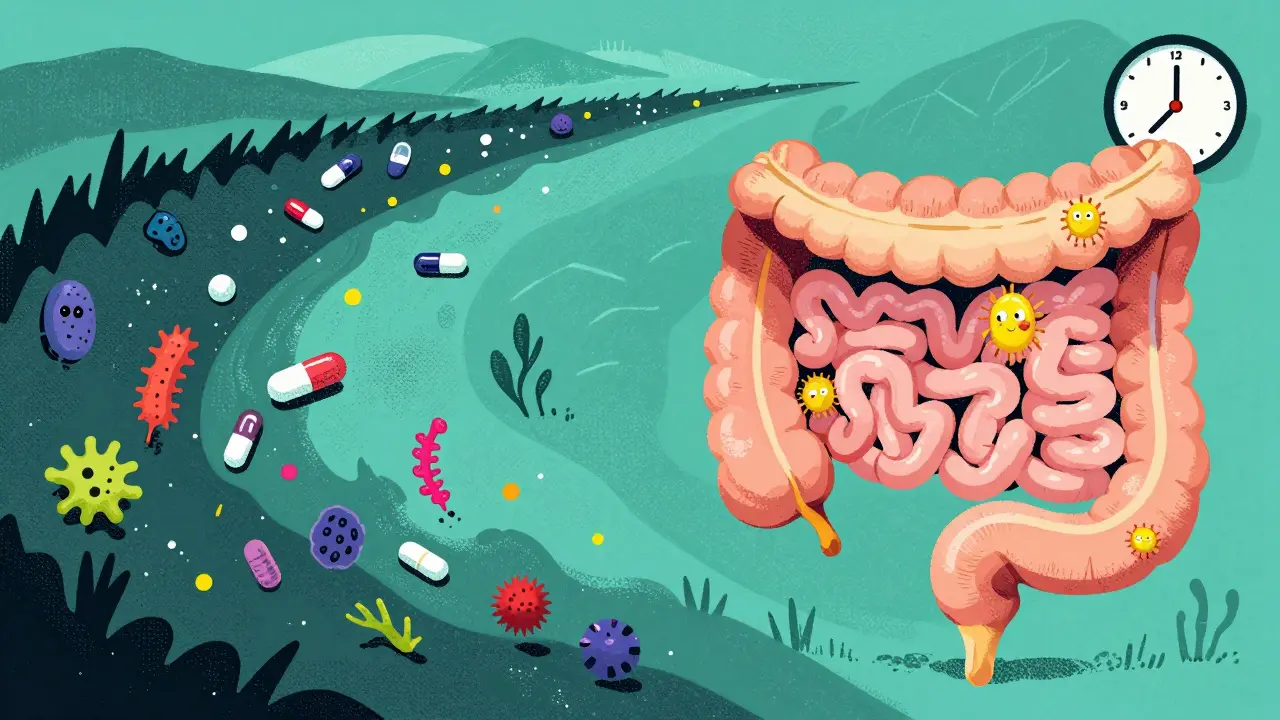
When you’re on antibiotics, your gut knows it. The good bacteria that help with digestion, immunity, and even mood? They’re getting wiped out along with the bad bugs. That’s why so many people end up with bloating, diarrhea, or yeast infections after a course of antibiotics. But here’s the thing: taking probiotics at the same time doesn’t always help. In fact, if you take them too close together, you’re just feeding the antibiotics more targets. The real solution? Spacing your doses properly.
Why Timing Matters More Than You Think
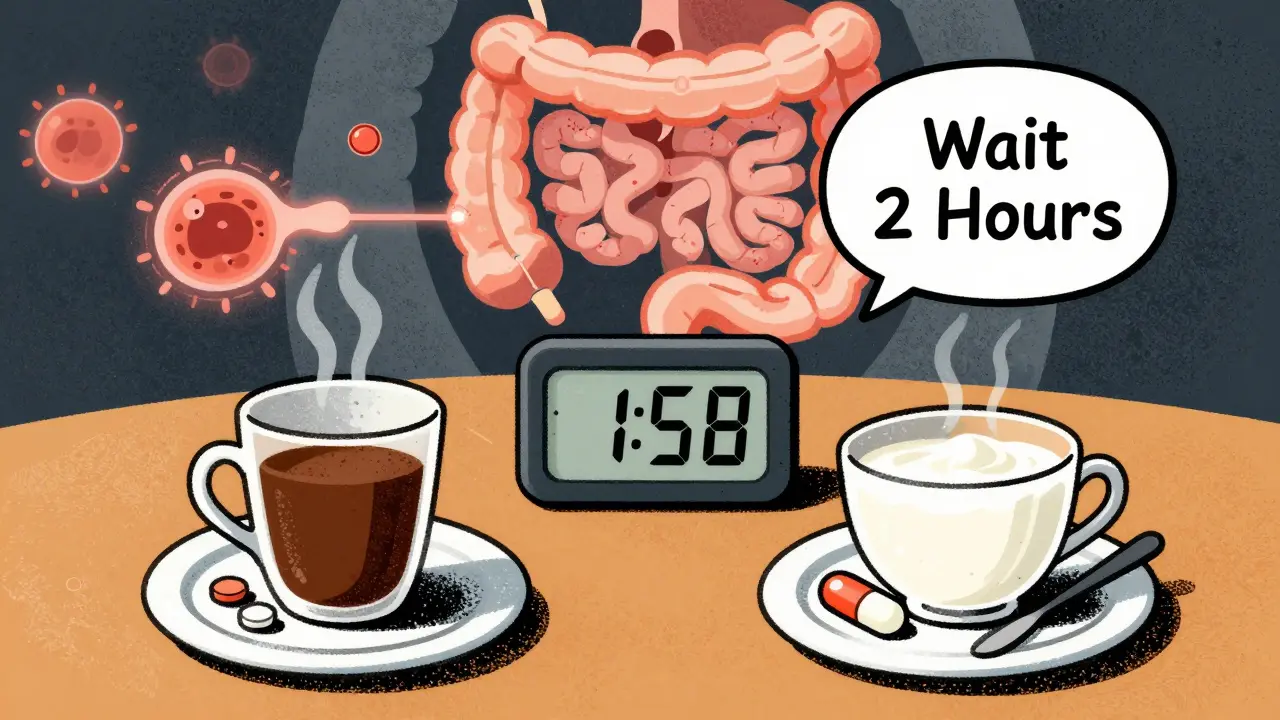
Antibiotics don’t pick and choose. They hit everything in their path-good bacteria, bad bacteria, and everything in between. Probiotics are live microbes, and if you swallow them right after an antibiotic pill, chances are they’re dead before they even reach your colon. Studies show that taking probiotics within 30 minutes of an antibiotic reduces their survival rate by 78% to 92%. That’s not just ineffective-it’s a waste of money. The goal isn’t just to take probiotics. It’s to get them to survive long enough to colonize your gut and start doing their job. And that means giving antibiotics time to clear out before the probiotics show up. The science is clear: you need at least two hours between doses.How Far Apart Should You Take Them?
Two hours is the minimum. But here’s where it gets practical. If you take your antibiotic at 8 a.m. and again at 8 p.m., your probiotic should be taken at 6 a.m. and 6 p.m. Or, if that’s too hard to remember, shoot for 10 a.m. and 10 p.m. The key is consistency. Skipping doses cuts effectiveness by 37%, according to a 2023 study tracking 217 people on antibiotics. Some doctors even recommend spacing them 4 to 6 hours apart if you’re on a strong, broad-spectrum antibiotic like ciprofloxacin or clindamycin. Why? Because those drugs stick around longer in your system. The longer the antibiotic stays active, the longer you should wait before introducing probiotics.Not All Probiotics Are Created Equal
Here’s where most people get confused. Not all probiotics need the same spacing. There’s a big difference between bacterial strains like Lactobacillus and Bifidobacterium, and a yeast called Saccharomyces boulardii. Saccharomyces boulardii is not a bacterium-it’s a yeast. Antibiotics don’t touch yeast. That means you can take it at the same time as your antibiotic. No waiting. No guesswork. It’s one of the few probiotics that actually works alongside antibiotics without being killed off. Clinical trials show it reduces antibiotic-associated diarrhea by 52% when taken at 20 billion CFUs per day. On the other hand, strains like Lactobacillus rhamnosus GG (LGG) are highly sensitive to antibiotics. You need the full two-hour gap. But they’re also one of the most studied. LGG at 10-20 billion CFUs cuts diarrhea risk by 47%. That’s why it’s the most common strain in clinical guidelines.How Much Should You Take?
Dose matters. Too little, and you’re not doing anything. Too much, and you’re just spending extra cash. Here’s what the data says:- Mild cases (short antibiotic course, no prior gut issues): 5-10 billion CFUs per day
- Diarrhea or moderate disruption: 10-20 billion CFUs per day
- Long courses (over 14 days) or existing gut problems: 20-40 billion CFUs per day

How Long Should You Keep Taking Them?
Don’t stop when the antibiotics run out. That’s when your gut needs the most help. Antibiotics can wipe out 25-40% of your gut’s bacterial diversity. It doesn’t bounce back overnight. Experts recommend continuing probiotics for 7 to 14 days after your last antibiotic dose. The International Scientific Association for Probiotics and Prebiotics (ISAPP) says 87% of effective studies kept probiotics going for 14 days after treatment. Why? Because that’s how long it takes for your microbiome to start rebuilding. A 2024 study tracking 1,000 people found that those who stuck with probiotics for 14 days after antibiotics had 89% microbiome recovery. Those who stopped early? Only 63%.What About Multi-Strain Probiotics?
You’ve probably seen bottles with 10, 15, even 20 different strains. The marketing says “more is better.” But science says otherwise. A 2022 Cochrane Review analyzed 31 trials and found no significant advantage to multi-strain formulas over single-strain ones for preventing antibiotic-associated diarrhea. The odds ratio was 0.91-basically, no difference. What matters isn’t the number of strains. It’s the strain itself and whether it’s been proven to survive and work with antibiotics. Stick with strains that have solid evidence: Lactobacillus rhamnosus GG, Saccharomyces boulardii, and Bifidobacterium lactis. Don’t get distracted by fancy labels.Common Mistakes and How to Avoid Them
Most people mess this up in three ways:- Taking probiotics with antibiotics-no gap. Result: 90% of the probiotics die before they do anything.
- Stopping too soon-quit after finishing antibiotics. Result: gut doesn’t recover properly.
- Choosing the wrong strain-picking a probiotic with no proven data for antibiotic use. Result: wasted money, no benefit.
What If You’re on a Special Antibiotic?
Some antibiotics, like vancomycin, target only certain types of bacteria (gram-positive ones). That means they’re less likely to kill all your gut microbes. In theory, you might not need as strict a gap. But here’s the catch: there’s no solid clinical data to back this up. So even if your doctor says it’s “fine,” stick with the two-hour rule. It’s safer. Also, if you’re on multiple antibiotics or have a history of C. difficile infection, talk to your doctor. You might need a higher dose or a specific strain like Saccharomyces boulardii, which has been shown to reduce C. diff recurrence by 64%.What’s Next? The Future of Probiotic Timing
New tech is coming. Companies like Seed and Pendulum are developing time-release capsules that protect probiotics from stomach acid and antibiotics. Some even have coatings that only release the probiotic after the antibiotic has cleared. But as of late 2024, none of these are widely available or proven in large trials. Right now, the gold standard is still simple: wait two hours. Take the right strain. Don’t quit early. And if you’re using Saccharomyces boulardii, you can take it with your antibiotic-no waiting needed.Final Checklist: Your Simple Guide
- Choose the right strain: LGG or Saccharomyces boulardii are your best bets.
- Check the label: Must list strain name and CFU count (aim for 10-40 billion).
- Space doses: Wait at least 2 hours after your antibiotic. For Saccharomyces boulardii, no wait needed.
- Don’t skip doses: Daily use is critical. Missing doses cuts effectiveness by 37%.
- Keep going: Continue for 7-14 days after your last antibiotic.
Can I take probiotics at the same time as antibiotics?
Only if you’re taking Saccharomyces boulardii, a yeast-based probiotic. Antibiotics don’t kill yeast, so it survives and works even when taken together. For bacterial probiotics like Lactobacillus or Bifidobacterium, taking them at the same time as antibiotics kills 78-92% of the beneficial bacteria before they can do anything. Always wait at least two hours.
How long should I wait after an antibiotic before taking a probiotic?
Wait at least two hours. This gives the antibiotic time to move through your digestive system and lose its active concentration in the gut. If you’re on a high-dose or long-term antibiotic, some experts recommend waiting 4-6 hours for maximum probiotic survival. Consistency matters more than perfection-stick to the same schedule every day.
Do I need to keep taking probiotics after I finish my antibiotics?
Yes. Antibiotics can reduce your gut bacteria by 25-40%, and recovery takes time. Continuing probiotics for 7-14 days after your last dose helps your microbiome rebuild. Studies show people who do this have nearly 30% better gut recovery than those who stop early. Don’t quit just because the antibiotic course is done.
What’s the best probiotic strain for antibiotic use?
Lactobacillus rhamnosus GG (LGG) and Saccharomyces boulardii are the two most proven strains. LGG reduces antibiotic-associated diarrhea by 47% at 10-20 billion CFUs per day. Saccharomyces boulardii cuts it by 52% and can be taken with antibiotics. Avoid products that don’t list these strains clearly on the label.
Does taking more strains mean better results?
No. A 2022 Cochrane Review of 31 studies found no benefit to multi-strain probiotics over single-strain ones for preventing diarrhea during antibiotic use. More strains don’t mean better outcomes. What matters is whether the strain has been clinically tested and proven effective for this specific purpose.
11 Comments
Hugh BreenMarch 12, 2026 AT 07:23
OMG this is LIFE-CHANGING 💥 I literally took probiotics with my antibiotics last time and ended up in the bathroom for a week 😭 But now?? Two-hour gap? YES. I’m switching to Saccharomyces boulardii ASAP - no more guessing, no more suffering. My gut is gonna thank me 🙌
mir yasirMarch 13, 2026 AT 04:57
While the empirical data presented is commendable, one must acknowledge the inherent reductionism in conflating microbial colonization with therapeutic efficacy. The gut microbiota is not a binary ecosystem of 'good' and 'bad' bacteria, but a dynamic, context-dependent network. To prescribe rigid temporal intervals as a panacea is to misunderstand the complexity of host-microbe coevolution. One wonders whether the observed clinical outcomes are attributable to probiotic intervention or merely placebo-driven adherence.
Byron BororMarch 13, 2026 AT 12:57
Look, I don’t care what some fancy study says - if you’re taking probiotics in America, you’re already ahead of the game. We don’t need Europeans telling us how to do this. Two hours? Nah. I take mine with my coffee, right after my antibiotic. My gut’s been fine for 12 years. Stop overcomplicating things. American ingenuity > European overanalysis.
Lorna BrownMarch 14, 2026 AT 02:58
I’ve been thinking about this a lot - not just the timing, but why we even assume probiotics are meant to 'fix' what antibiotics break. Maybe the real issue is that we’re overusing antibiotics in the first place. If we treated infections more selectively, would we even need to space out supplements? Is this just another band-aid on a systemic problem? I’m not saying skip probiotics - I’m asking what we’re avoiding by focusing on this fix instead of the root.
Rex RegumMarch 14, 2026 AT 18:31
Oh wow, so now we’re supposed to trust science? When did that become a thing? I read a Reddit thread that said probiotics are just sugar-coated snake oil. And now you’re telling me to wait 2 hours? That’s 120 minutes of pure corporate propaganda. I’m taking mine together. My microbiome doesn’t care about your graphs. I’m not your lab rat.
Kelsey VonkMarch 15, 2026 AT 08:32
I’ve been taking LGG for a month now after my last round of amoxicillin… and honestly? My digestion feels way better. Not perfect, but better. I didn’t know about the yeast one (Saccharomyces) until now - I’m switching next time. Also, I always forget to take them at the same time every day… I feel guilty lol. But I’m trying. 🙏
Emma NicollsMarch 16, 2026 AT 05:12
soooo i just took my probiotic like 30 mins after my abx and now im scared 😅 but i read this and im gonna start spacing it out next time!! also saccharomyces boulardii sounds like a dragon but i love it. thanks for the clarity!!
Jimmy VMarch 17, 2026 AT 04:12
Stop overthinking. Two hours. LGG or S. boulardii. 10-20B CFUs. Daily. 7-14 days post. Label check. Done. No fluff. No drama. Just do it. Your gut doesn’t need a PhD - it needs consistency.
Richard HarrisMarch 18, 2026 AT 15:07
Interesting stuff. I’ve been using a multi-strain one for ages, but now I’m wondering if I’ve been wasting my money… I’ll switch to just LGG next time. Also, I think I misread the timing - I thought it was two hours before, not after. Oops. 😅
Kandace BennettMarch 19, 2026 AT 07:45
OMG I knew it!! 🙌 I told my cousin last year she was doing it wrong and she ignored me. Now she has chronic bloating. 🤦♀️ Look - if you’re not using LGG or Saccharomyces boulardii, you’re just throwing money at a fancy bottle. And if you don’t check the CFUs? Honey, you’re not even in the game. 🧪✨
Tim SchulzMarch 20, 2026 AT 06:15
Wow. A whole 1,200-word essay on how to not die from antibiotics. And the punchline? Wait two hours. 🤡 I mean… congrats? You just turned a 1998 clinical note into a viral blog. Next up: 'How to breathe: the science of inhaling and exhaling.' 🎩