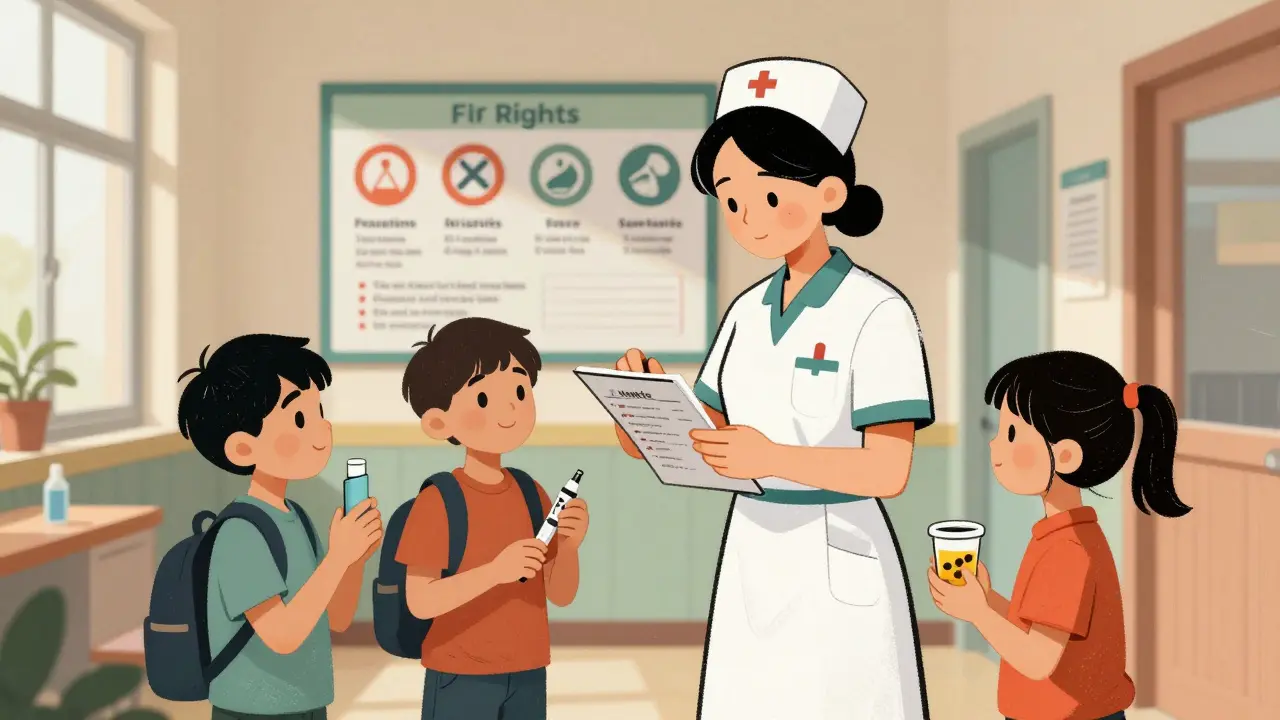
Every morning, hundreds of thousands of children across the U.S. swallow pills, use inhalers, or get insulin injections right before class. These aren’t random acts-they’re carefully planned, legally required, and life-saving procedures managed by school nurses. But coordinating this isn’t just about handing out medicine. It’s a complex system built on rules, training, documentation, and trust. If done wrong, it puts kids at risk. If done right, it keeps them in class, healthy, and safe.
Why Coordination Matters More Than You Think
Think about a child with asthma. They need their inhaler every morning before recess. One missed dose could mean a trip to the ER-or worse. Now multiply that by dozens of students with diabetes, epilepsy, allergies, ADHD, or other chronic conditions. In 2023, 14.7% of all U.S. public school students required daily medication during school hours. That’s nearly one in seven kids. Without proper coordination, schools can’t meet their legal obligations under Section 504 of the Rehabilitation Act or IDEA. And when they fail, districts face fines, lawsuits, or even loss of federal funding. In 2022, Houston ISD was fined $2.3 million for medication administration failures. This isn’t hypothetical. It’s happening.
The core of this system? The Five Rights: right student, right medication, right dose, right route, right time. Sounds simple. But in a busy school with 1,200 students and one nurse? It’s a daily puzzle. The American Academy of Pediatrics (AAP) and the National Association of School Nurses (NASN) both say: if you skip even one of these, you’re risking harm. And errors happen. About 1.2% of all school-based doses are given incorrectly. That’s not a small number when you’re talking about thousands of doses every day.
Step 1: Build a District-Wide Policy
You can’t wing this. Every district needs a written policy approved by the school board. This isn’t just paperwork-it’s your legal shield. The NASN’s 2022 Clinical Practice Guideline is the gold standard. It tells you exactly what to include: who can administer, how to store meds, how to document, and what to do in emergencies. Don’t make up your own rules. Use the sample templates from NASN’s Implementation Toolkit. They’ve been tested in hundreds of districts. Skipping this step means you’re flying blind. And in a lawsuit? You’ll lose.
It takes 8 to 12 weeks to get a policy approved. Start early. Involve your legal team, your school board, and your district nurse. This isn’t a task for one person. It’s a team effort.
Step 2: Train the Nurse First
The school nurse isn’t just the person handing out pills. They’re the coordinator, the trainer, the auditor, and the legal gatekeeper. They must complete a 16-hour certification course on delegation protocols before they can train anyone else. Why? Because they’re the only ones legally allowed to assess whether a student needs help-and whether a staff member is ready to give the medicine.
They need to know state laws inside and out. In Virginia, the nurse must personally observe the first dose of any new medication. In Texas, some districts treat it like an administrative task, letting aides give meds without nurse oversight. That’s risky. A 2022 analysis found districts using this model had 14% higher liability risk. The nurse’s job isn’t to be a dispenser. It’s to be the safety net.
Step 3: Screen Every Student
Not all students need the same level of help. The New York State Education Department (NYSED) model breaks students into three categories:
- Nurse Dependent: Requires a nurse to give the med (e.g., IV insulin, complex infusions).
- Supervised: Can take the med themselves but need an adult nearby (e.g., a child with asthma using an inhaler).
- Self-Administered: Can handle it alone, with written permission from parent and doctor (e.g., a teen with ADHD taking a pill).
Screening happens at the start of each school year. It’s not optional. Skipping this means you don’t know who needs what-and that’s how mistakes happen.
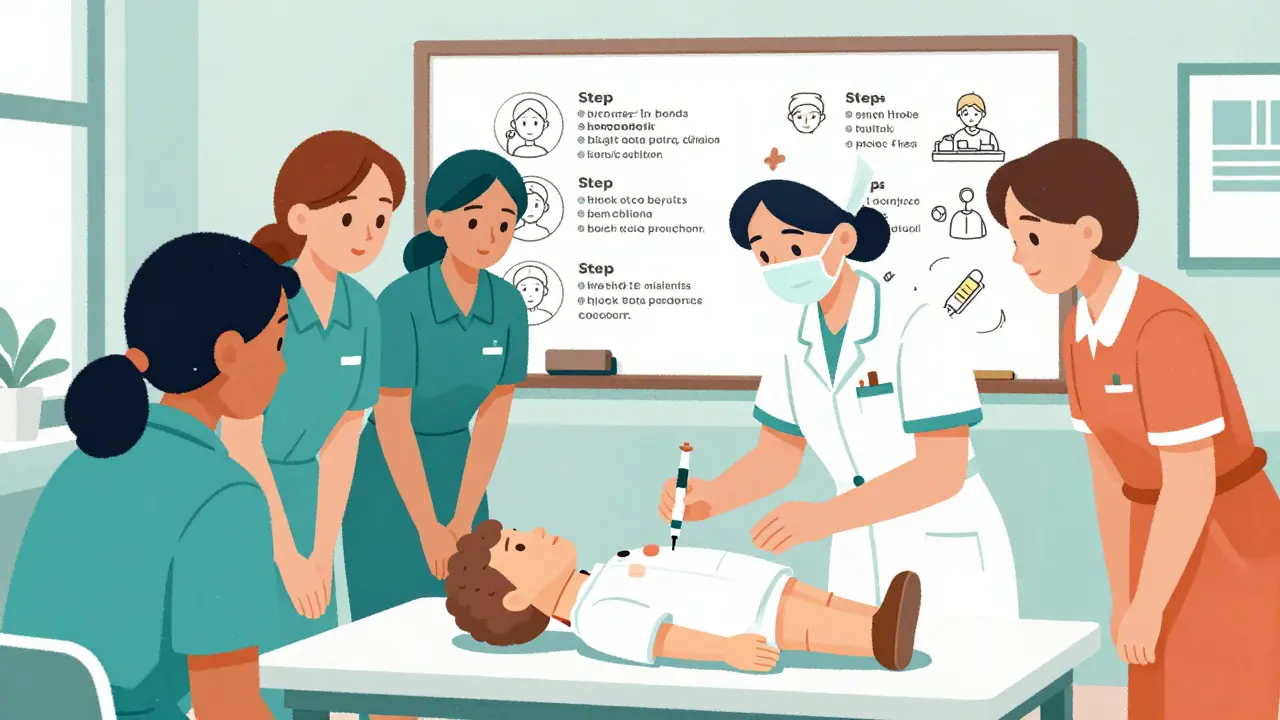
Step 4: Create Individualized Healthcare Plans (IHPs)
For every student who needs help, you need an IHP. This isn’t a form. It’s a living plan. It includes:
- Exact medication name, dose, and schedule
- Side effects to watch for
- Emergency steps (e.g., when to use an EpiPen)
- Parent and provider contact info
- Who is authorized to give the med
Each IHP takes 2 to 4 hours to build. But here’s the payoff: schools using IHPs see a 28% improvement in medication adherence compared to those just using checklists. Why? Because it’s personalized. It connects the dots between home, school, and doctor.
Step 5: Train Unlicensed Personnel
Most schools don’t have enough nurses. The national average is 1 nurse for every 1,102 students. The recommended ratio? 1:750. So nurses train others-teachers, aides, cafeteria workers. But only if they’re qualified.
Training varies by medication complexity:
- Oral meds: 4 hours
- Inhalers: 8 hours
- Insulin injections: 16 hours
Training must include hands-on practice, not just slides. And it must be documented. Every person who gives meds must sign off on competency. No exceptions. In one district, a teacher gave an insulin shot without training. The child went into diabetic shock. The school was sued. The teacher was fired. The nurse lost her license.
Step 6: Document Everything-Every Time
98% of districts use electronic health records now. But 42 states still allow paper logs. Paper is risky. Lost pages. Smudged handwriting. Missing signatures. Electronic systems reduce errors by 31% and cut documentation time by 45%. Fairfax County Public Schools switched to an electronic system and saved nurses over 2 hours a day.
Documentation isn’t busywork. It’s your proof. If a child has a reaction, you need to show exactly what was given, when, and by whom. The AAP says: “Documentation must be completed immediately after administration.” No waiting until lunch. No writing it later. Do it now.
Step 7: Review Errors-Without Blame
Errors will happen. The goal isn’t to punish. It’s to prevent. NASN’s “Just Culture” framework changed how schools handle mistakes. Instead of blaming the nurse or aide, they ask: “What system failed?”
Monthly error reviews are mandatory. Track:
- What went wrong
- Why it happened
- How to fix it
In pilot districts, this approach cut medication errors by 37%. Nurses report less stress. Staff feel safer. Parents trust the system more.
The Hidden Rules: Storage, Labels, and Emergencies
Medications must be stored in original, pharmacy-labeled containers. No ziplocs. No unlabeled bottles. Federal law (21 CFR § 1306.22) requires this. A 2023 Texas Health Services report found 38% of districts had parents bringing meds in unmarked containers. That’s illegal. And dangerous.
Controlled substances (like ADHD meds) need double locks, dual signatures, and inventory logs. Epinephrine for anaphylaxis must be accessible within 5 minutes. 87% of schools now keep stock EpiPens. But only if they’re trained to use them.
What Goes Wrong-and How to Fix It
Most problems come down to three things:
- Time: Nurses spend over 2 hours a day just on logs. Solution: Use electronic systems. They cut time by 45%.
- Training gaps: 78% of nurses say they need more training on delegation. Solution: Use NASN’s free online modules. They’re updated yearly.
- Parent non-compliance: Parents forget labels, bring expired meds, or refuse to update records. Solution: Host mandatory parent education sessions. Montgomery County, MD, saw compliance jump 52% after doing this.
And don’t forget field trips. Only 41% of districts consistently apply the Five Rights off-campus. That’s a huge risk. Always carry emergency meds. Always have backup staff trained. Always double-check.
The Future Is Tech-But Not Replacement
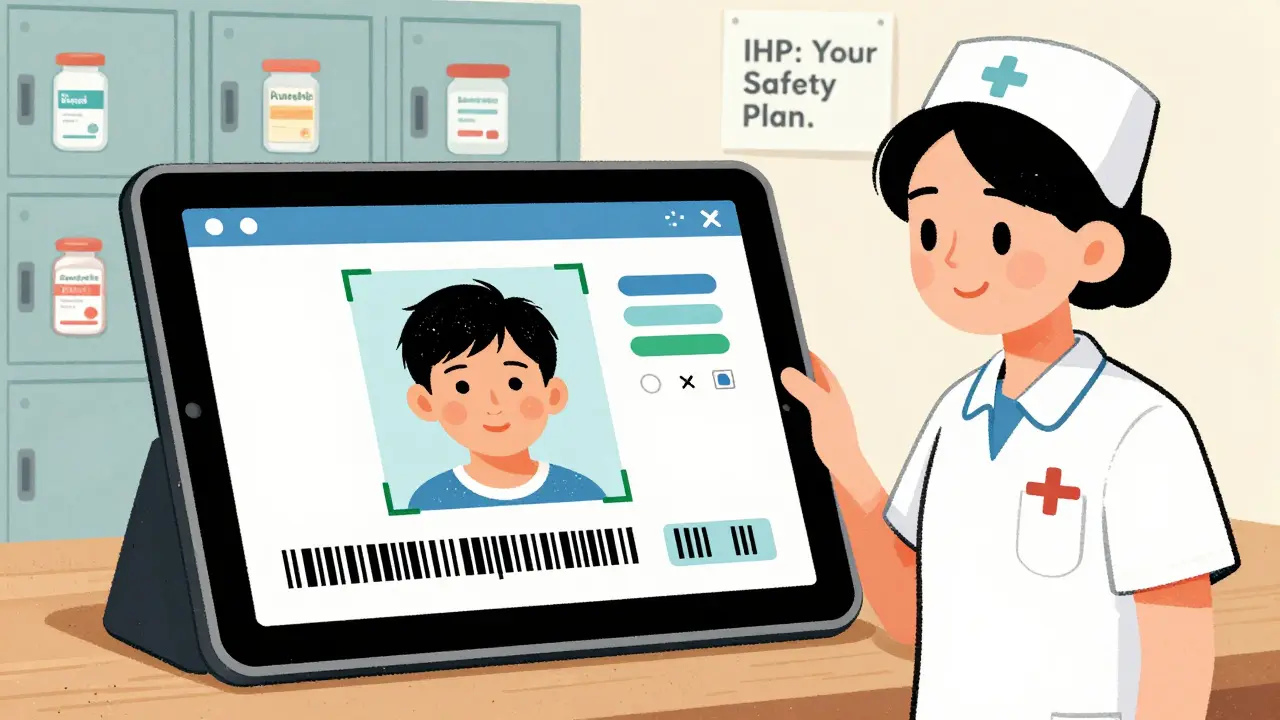
63% of districts are piloting smartphone apps that scan medication barcodes and log administration with a tap. Some even use facial recognition to confirm the right student. But tech doesn’t replace the nurse. It supports them. The AAP warns: “Technology must not reduce human oversight.”
The bigger threat? The nursing shortage. By 2027, we’ll be short 15% of needed school nurses. That means more delegation. More training. More pressure. The solution? Standardization. The NASN and AAP launched the School Medication Administration Standardization Initiative in January 2024. It’s already adopted in 12 states. By 2026, they expect 45 states to follow. That’s the future: one clear, national standard.
Final Thought: It’s Not About Medication. It’s About Care.
Coordinating school medications isn’t a task. It’s a promise. A promise that a child with diabetes won’t pass out in math class. That a child with asthma won’t need an ambulance. That a child with epilepsy won’t be left alone during a seizure. The nurse doesn’t just hand out pills. They hold the line between chaos and safety. And if you want to get it right-you need systems. Training. Documentation. And respect for the job.
Can a teacher give a student medication if the nurse isn’t available?
Yes-but only if they’ve been properly trained and authorized by the school nurse under a delegation protocol. The nurse must assess both the student’s needs and the staff member’s competency before allowing this. Untrained staff cannot give medication, even in emergencies, unless it’s a stock epinephrine or albuterol device with a standing order. Always check your state’s Nurse Practice Act.
What if a parent brings medication in a plastic bag instead of the original bottle?
You must refuse it. Federal law (21 CFR § 1306.22) requires all medications to be in original, properly labeled pharmacy containers. Schools that accept unlabeled meds risk violating drug laws. The best approach is to require parents to bring medications to the pharmacy before school starts. Many districts offer free pharmacy delivery services for school meds to help with this.
Do I need an Individualized Healthcare Plan (IHP) for every student who takes medication?
Only for students with complex or chronic conditions that require ongoing care, such as diabetes, epilepsy, severe allergies, or heart conditions. Students taking simple, routine oral meds (like ADHD pills) may only need a Medication Authorization Form signed by the parent and doctor. But if the student has any history of adverse reactions, requires monitoring, or needs special timing, an IHP is required by law under IDEA and Section 504.
How often should medication storage and inventory be checked?
Controlled substances (like stimulants for ADHD) must be counted and logged daily. All other medications should be audited weekly. A nurse or designated staff member should verify expiration dates, proper storage temperature (if needed), and that all meds match the IHP. Any expired, damaged, or unlabeled meds must be disposed of immediately following state and federal guidelines.
Can a school refuse to give a student their medication?
No-not if the medication is legally prescribed and documented in an IHP or Medication Authorization Form. Refusing to administer a prescribed medication can violate Section 504 and IDEA, which require schools to provide necessary health services so students can access their education. If a parent refuses to provide proper labeling or documentation, the school should work with them to get compliance, not deny care. In extreme cases, legal counsel should be consulted before taking action.
15 Comments
Hariom SharmaFebruary 21, 2026 AT 00:58
This is huge for kids in underfunded districts. In India, we don’t have school nurses at all, but seeing how structured this is in the US makes me realize how much we’re missing. Imagine if every kid had this safety net. I’m sharing this with my ed-tech group back home. We need to start building something like this, even if it’s scaled down.Nina CatherineFebruary 22, 2026 AT 16:14
i just read this and im crying?? like, seriously. my son has asthma and the school nurse is the only reason he’s still in 4th grade. last year they almost didn’t have enough staff and i had to pick him up every afternoon. this whole system? it’s not paperwork. it’s lifesaving. thank u for laying it out so clearly. i’m gonna share this with the pta tomorrow lolTaylor MeadFebruary 24, 2026 AT 13:25
I’ve been a school aide for 12 years and I’ve given meds to kids since 2015. Training was rough, but once you get the rhythm, it’s second nature. The key? Consistency. Never skip the checklist. Never assume. I’ve seen nurses get overwhelmed and cut corners. That’s how accidents happen. This guide? It’s the bible.Ashley PaashuisFebruary 26, 2026 AT 08:40
The emphasis on Individualized Healthcare Plans is particularly compelling. A standardized, personalized approach ensures that each child’s medical needs are not only met but anticipated. Furthermore, the integration of electronic health records significantly reduces human error and enhances accountability. Districts that continue to rely on paper logs are operating at an unacceptable risk level. This framework should be mandatory nationwide.Davis teoFebruary 26, 2026 AT 11:00
I used to be a nurse in a rural district. We had 1 nurse for 2,400 kids. One day, a kid had a seizure and the teacher didn’t know what to do. She panicked. The kid ended up in the hospital. We got sued. The district blamed ME. I quit. This article? It’s everything I wish someone had handed me before I started. Why do we wait for tragedy to fix this?Danielle GerrishFebruary 26, 2026 AT 12:42
I’m a mom of three with a kid on insulin, one on ADHD meds, and another with severe allergies. I’ve been to 17 school meetings. I’ve cried in 12 of them. I’ve had to beg, plead, and threaten to get my kids the care they need. This article? It’s the first time I’ve seen a system that actually works. But here’s the truth: most schools don’t do this. They don’t have the money. They don’t have the will. And the parents? We’re exhausted. This isn’t policy. This is survival.Liam CreanFebruary 28, 2026 AT 11:25
The part about documenting immediately after administration hit hard. I work in admin. We used to let nurses fill logs at the end of the day. Then one kid had a reaction and the record was smudged. No one knew who gave what. We switched to tablets. Now everything’s timestamped. It’s not glamorous, but it’s what keeps kids alive. Small changes. Big impact.Benjamin FoxFebruary 28, 2026 AT 17:26
I’m from a state where we don’t have school nurses at all. We just let teachers handle it. Why? Because the government spends $200 billion on other crap. Schools are broke. Why should we pay for nurses? Kids should learn to self-manage. This is overregulation. I’m not saying don’t help kids. But this system? It’s a nanny state nightmare.John CenaFebruary 28, 2026 AT 23:23
I’ve been a custodian for 18 years. I’ve seen nurses cry over paperwork. I’ve seen parents argue over meds. I’ve seen kids with no meds because the form was ‘in the mail.’ This isn’t just about health. It’s about dignity. Every kid deserves to be seen. Not as a problem. Not as a liability. As a person. This system? It treats them like one.Irish CouncilMarch 2, 2026 AT 18:00
The ‘Five Rights’ sounds like a corporate slogan. But here’s the real issue: who’s auditing this? Who’s checking if the nurse is even qualified? In my county, the superintendent’s cousin is the ‘nurse’ and she’s been retired since 2010. The forms are faked. The training is a PowerPoint. This whole system is a facade. I’ve got screenshots. Want them?Freddy KingMarch 3, 2026 AT 10:40
Let’s be real: this is just bureaucratic theater. You think a 16-hour training course makes someone competent to handle insulin? That’s like saying a 4-hour driver’s ed course qualifies you to race in Formula 1. The real problem? We’re outsourcing healthcare to underpaid, overworked educators. We need a national health service. Not a patchwork of district policies. This isn’t a solution. It’s a Band-Aid on a hemorrhage.Laura BMarch 4, 2026 AT 17:52
My daughter is 10 and has type 1 diabetes. We moved to a new district last year. They had no IHP process. I spent 6 weeks emailing, calling, begging. I finally had to bring in her endocrinologist for a meeting. It took 3 months to get her plan approved. Then they lost it. Twice. This guide? It’s what I wish I’d had. But it’s not enough. We need federal funding. Not just guidelines.Jayanta BoruahMarch 5, 2026 AT 01:43
In accordance with the established norms of educational administration and the codified protocols delineated by the National Association of School Nurses, it is imperative that the operationalization of medication administration be predicated upon a rigorous framework of compliance, accountability, and procedural fidelity. Failure to adhere to the Five Rights constitutes a material breach of statutory obligations under both federal and state jurisprudence. Furthermore, the delegation of duties to unlicensed personnel without demonstrable competency validation is an indefensible deviation from professional standards and exposes the institution to exorbitant legal liability.Robert ShiuMarch 5, 2026 AT 07:59
I’m a nurse. I work in a district with 2 nurses for 4,000 kids. We do triage. We prioritize. We make impossible choices every day. This article? It’s beautiful. But it’s not reality. We don’t have time for 4-hour trainings. We don’t have tech. We don’t have staff. We have heart. And we show up. If you want to fix this, fund us. Don’t give us more paperwork. Give us more people.Greg ScottMarch 6, 2026 AT 00:33
The storage rules? I’ve seen parents bring meds in Ziplocs. I’ve seen expired inhalers. I’ve seen kids with no labels. We have to say no. Every time. It’s not mean. It’s safe. I tell parents: ‘I can’t give this to your child. Not because I don’t care. Because I care too much.’