
When you’re looking for a cheaper version of a brand-name drug, you might assume all generics are the same. But there’s a hidden category of drugs that behave differently - authorized generics. These aren’t your typical generics. They’re made by the same company that produces the brand-name drug, often on the same production line, with the exact same ingredients and quality. The only difference? They don’t carry the brand name on the label. If you’re trying to save money on prescriptions, knowing where to find the FDA’s official list of these drugs can make a real difference - if you know how to use it right.
What Exactly Is an Authorized Generic?
An authorized generic is not approved through the usual generic pathway. Instead, it’s marketed under the original brand’s New Drug Application (NDA). That means it’s not listed in the FDA’s Orange Book, which tracks traditional generics approved via the Abbreviated New Drug Application (ANDA). Authorized generics are legally identical to the brand-name version. The FDA says they’re "the same drug" - same active ingredient, same dosage, same strength, same performance. The only visible changes? Sometimes the color, shape, or marking on the pill is different. You won’t find them labeled as "generic" on the bottle. You’ll see the brand name removed and replaced with the manufacturer’s name.
Why does this matter? Because when a brand-name drug’s patent is about to expire, the original manufacturer can launch its own generic version before any other company can. This strategy, called an "authorized generic," lets them keep market share and undercut competitors who would otherwise enjoy a 180-day exclusivity period. For consumers, it means a lower-priced option that’s chemically identical to the brand. For pharmacists and insurers, it means a new source of cost savings - if they can find it.
Where to Find the Official FDA List
The U.S. Food and Drug Administration is required by law to publish and update a complete list of authorized generics. This comes from Section 505(t) of the Federal Food, Drug, and Cosmetic Act, passed in 2003. The list is updated every three months. As of October 10, 2025, the most recent version is available on the FDA’s official website at fda.gov/drugs/abbreviated-new-drug-application-anda/fda-list-authorized-generic-drugs.
The list is provided as a downloadable PDF file, around 1.09 MB in size. Each entry includes four key pieces of information:
- The brand name (trade name)
- The dosage form (tablet, capsule, gel, etc.)
- The strength (e.g., 10 mg, 1% lotion)
- The name of the brand company that manufactures the authorized generic
- The date the authorized generic entered the market
For example, the list includes:
- ACTIQ lozenges (1200 mcg and 800 mcg), made by Cephalon, LLC, entered market in 2006
- ARTHROTEC tablets (50 mg/200 mcg), made by Pfizer Inc., entered market in 2012
- CLEOCIN T topical gel and lotion (1%), made by Pfizer, entered market in 2003
These examples show how widely used authorized generics are - from pain relief to antibiotics. But here’s the catch: just because a drug appears on the list doesn’t mean it’s currently being sold.
What the FDA List Doesn’t Tell You
The FDA’s list is a legal record, not a real-time inventory. It’s based on annual reports submitted by drug manufacturers. The FDA admits it "does not have information on whether the AG is still marketed and, if not still marketed, the date marketing ceased." That means:
- A drug listed as "entered market in 2020" might have been pulled from shelves in 2022.
- A product might be listed but not available from your pharmacy wholesaler.
- The "date entered" isn’t the exact launch date - it’s the reporting period when the company first told the FDA about it.
Pharmacists and pharmacy benefit managers have reported frustration with this. A 2023 survey by the National Community Pharmacists Association found that 68% of independent pharmacists found the list "somewhat or very difficult" to use for actual purchasing decisions. Why? Because they couldn’t tell which drugs were still being produced or distributed.
One pharmacist in Texas told a colleague: "I had a patient ask for an authorized generic of Xeljanz. The FDA list said it was launched in 2021. I ordered it. The wholesaler said they’d never carried it. Turns out, the manufacturer stopped making it after six months. The FDA list didn’t update."
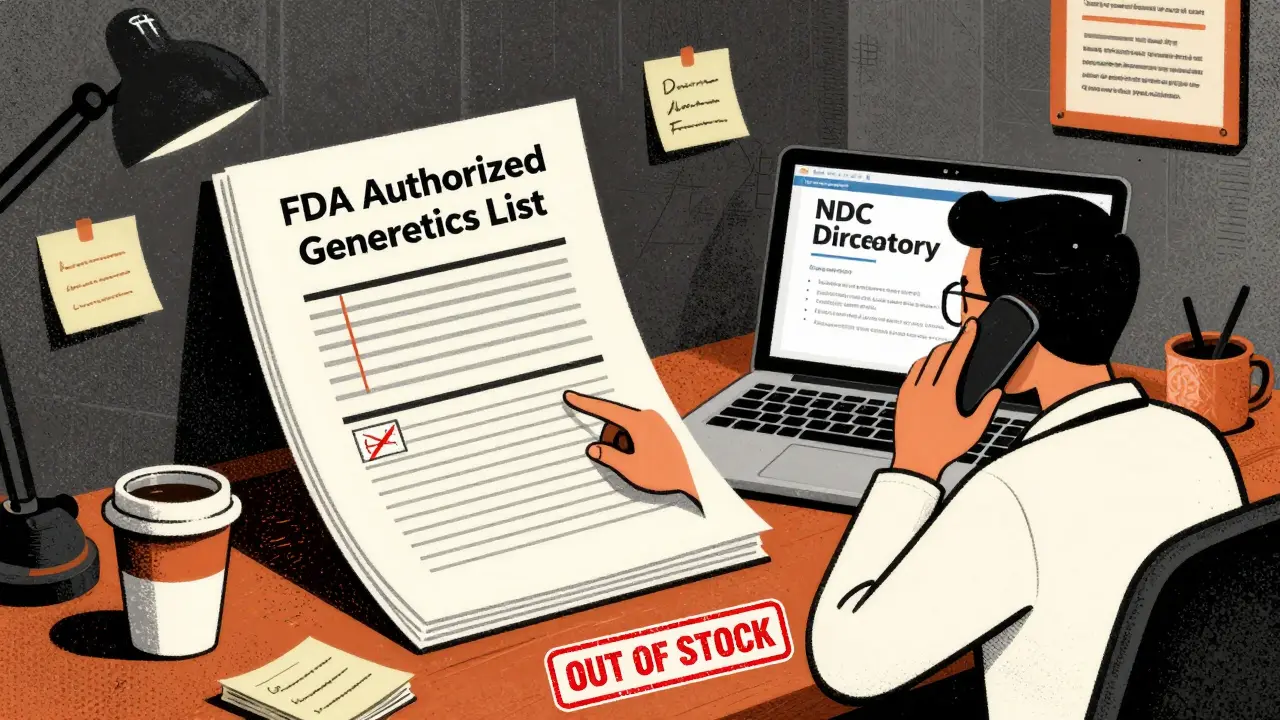
How to Verify if an Authorized Generic Is Actually Available
To get real-world accuracy, you need to cross-check the FDA list with other sources:
- Check the National Drug Code (NDC) Directory - Go to fda.gov/drugs/drug-approvals-and-databases/national-drug-code-directory. Search for the drug name and look for active NDC codes. If there’s no active code, the product isn’t being sold.
- Use commercial databases - Tools like IQVIA National Sales Perspectives or Red Book track actual market presence and pricing. These are subscription services used by hospitals and insurers, but some public libraries offer free access.
- Call your wholesaler - Ask if they carry the authorized generic version of the drug you’re looking for. They’ll know what’s in stock.
- Ask your pharmacist - Many pharmacists now keep a personal list of authorized generics that are actually available in their supply chain.
For example, if you see "CLEOCIN T" on the FDA list, check the NDC Directory. You might find two active codes: one for the brand and one for the authorized version. If only the brand code is active, the authorized version is no longer being made.
Who Uses This List - And Why
The FDA’s authorized generics list isn’t designed for patients. It’s built for:
- Pharmaceutical companies - To track competitors and identify market gaps.
- Insurers and PBMs - To negotiate lower prices by switching to authorized generics when available.
- Regulators and researchers - To study how brand manufacturers use these drugs to delay generic competition.
- Pharmacists - To find lower-cost alternatives, but only after verifying availability.
According to a 2023 study in Health Affairs, 854 authorized generics were launched between 2010 and 2019. Pfizer, Teva, and Mylan (now Viatris) were the top three manufacturers. But the FTC found that in many cases, authorized generics were priced only slightly lower than the brand - sometimes just 5-10% cheaper. That’s not always enough to make a difference for patients paying out-of-pocket.
What’s Changing in 2026
The FDA is working on a major upgrade. By mid-2026, the current PDF list will be replaced with a searchable, dynamic database. This change comes after feedback from 28 industry stakeholders at a 2024 public meeting - 22 of them asked for better search tools and real-time updates. The new system will allow filtering by drug name, manufacturer, date, and availability status. It may even link to the FDA’s Drug Shortage Portal.
But don’t wait for it. The current list is still the only official source. And even with improvements, it won’t solve the core issue: manufacturers aren’t required to report when they stop selling an authorized generic. So the gap between what’s listed and what’s available will remain.
Practical Tips for Patients and Caregivers
If you’re trying to save money on prescriptions:
- Ask your doctor: "Is there an authorized generic version of this drug?" They can check the FDA list or ask their pharmacy.
- Don’t assume "generic" means cheaper. Sometimes the authorized version is the best deal.
- Check your pharmacy’s formulary. Some insurers list authorized generics separately.
- If the drug isn’t available, ask if the brand-name version has a patient assistance program.
- Use GoodRx or RxSaver to compare prices - sometimes the brand is cheaper than the authorized generic.
Remember: authorized generics are not always the cheapest option. But when they are available, they’re the closest thing to the brand - with no risk of bioequivalence issues.
Common Misconceptions
- Myth: Authorized generics are "better" than regular generics. Truth: They’re identical to the brand. Regular generics are also required to meet the same standards.
- Myth: If it’s on the FDA list, it’s in stock. Truth: The list is outdated by design. Always verify with your pharmacy.
- Myth: Only big pharma companies make authorized generics. Truth: Any company with an NDA can do it - including small manufacturers.
- Myth: Authorized generics are only for brand-name drugs with patents. Truth: They’re also used for drugs with market exclusivity, like orphan drugs.
Is the FDA’s authorized generics list free to use?
Yes. The FDA provides the list at no cost on its website. You can download the PDF, search the data, and use it for personal, academic, or professional purposes. There are no login requirements or subscription fees.
Why isn’t the authorized generic I found on the list available at my pharmacy?
The FDA list only shows when a manufacturer first reported the product - not whether it’s still being made or sold. Many authorized generics are discontinued within a year or two after launch. Your pharmacy wholesaler may no longer carry it, or the manufacturer may have stopped production. Always confirm availability with your pharmacist or wholesaler before assuming it’s accessible.
Can I trust that an authorized generic is just as safe as the brand?
Yes. Authorized generics are made by the same company, on the same equipment, using the same formula as the brand-name drug. The FDA considers them therapeutically equivalent because they are, in fact, the same product. The only difference is the label. You won’t notice any difference in how it works or how your body responds.
How often is the FDA’s authorized generics list updated?
The list is updated quarterly, as required by law. The most recent version as of March 2026 is dated October 10, 2025. The next update is expected in January 2026. However, updates may be delayed if manufacturers submit reports late.
What’s the difference between the FDA’s authorized generics list and the Orange Book?
The Orange Book lists traditional generic drugs approved through the ANDA process and rates them for therapeutic equivalence. Authorized generics are not in the Orange Book because they’re marketed under the brand’s NDA, not a generic application. The authorized generics list is a separate tool that tracks these unique products - which are identical to the brand but sold without the brand name.