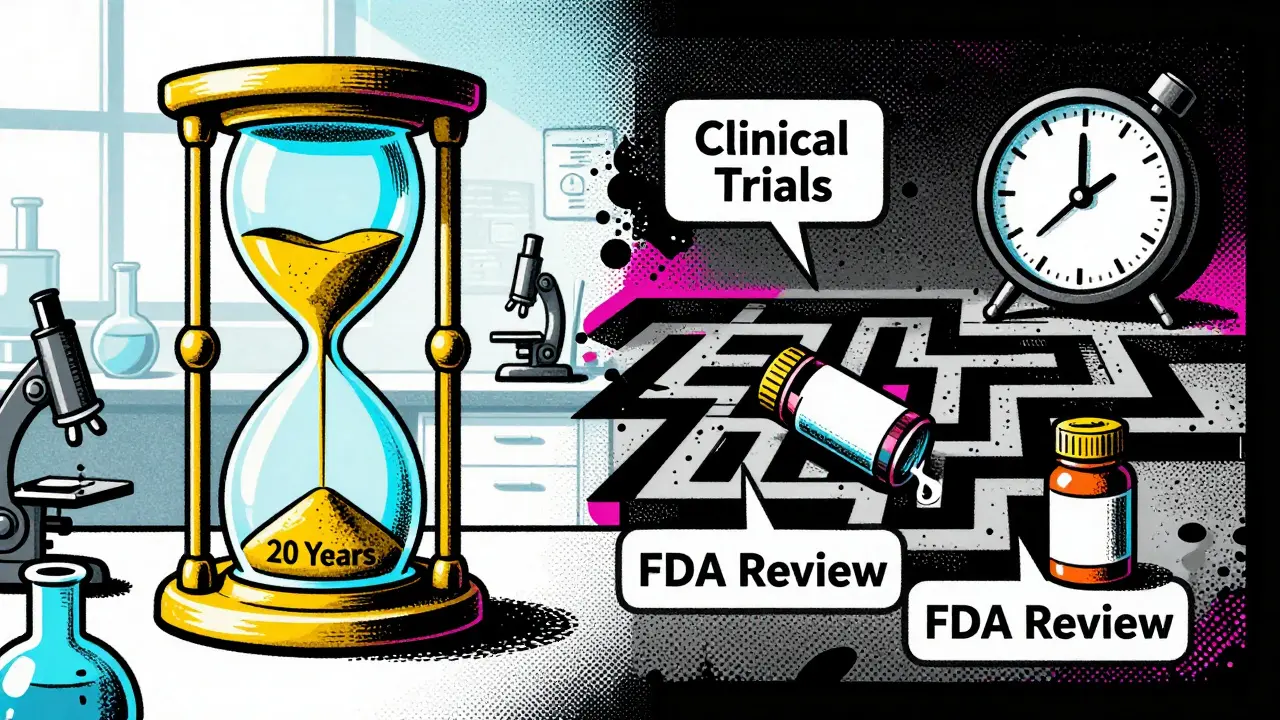
Imagine spending billions of dollars and a decade of your life developing a new drug, only to have competitors flood the market with cheap copies just seven years after you launch it. That is the harsh reality for most pharmaceutical companies. On paper, a patent is a legal right that grants an inventor exclusive control over their invention for a set period lasts for 20 years. But in practice, that clock starts ticking long before the drug ever reaches a patient. By the time regulatory approvals are secured, much of that protection has already evaporated.
This gap between the theoretical 20-year term and the actual time a company can sell its drug without competition is called effective patent life is the actual duration of market exclusivity a pharmaceutical company experiences after accounting for R&D and regulatory review times. Understanding this concept is crucial because it explains why drug prices stay high for so long and why the industry fights so hard to delay generic entry. It also reveals how laws like the Hatch-Waxman Act is the Drug Price Competition and Patent Term Restoration Act of 1984, which balances innovation incentives with generic competition attempt to fix a broken timeline.
The Math Behind the Missing Years
To understand why effective patent life is shorter, we have to look at when the clock starts. Under U.S. law (35 U.S.C. § 154(a)(2)), the nominal patent term is exactly 20 years from the earliest effective filing date. This might sound generous until you realize that the "filing date" happens during the early research phase, not at launch.
Developing a new drug is a marathon, not a sprint. The process typically involves:
- Pre-clinical testing: Lab experiments and animal studies to check for safety and biological activity.
- Clinical trials: Three phases of human testing involving thousands of participants to prove efficacy and monitor side effects.
- Regulatory review: The Food and Drug Administration (FDA) scrutinizing all data before granting marketing approval.
Industry data analyzed by Drug Patent Watch indicates that this entire pipeline consumes five to ten years of the nominal patent term. If you subtract those years from the 20-year limit, you are left with an average effective patent life of roughly 13.35 years. However, some sources suggest even less, citing 7 to 10 years of remaining protection at the time of approval. This discrepancy highlights the volatility of the development process; if a trial fails or the FDA asks for more data, the patent continues to tick down while the company gains nothing.
How the Hatch-Waxman Act Tries to Help
Recognizing this imbalance, Congress passed the Hatch-Waxman Act in 1984. The goal was delicate: encourage innovation by protecting patents, but lower costs by enabling generic competition. The act introduced Patent Term Extension (PTE) is a mechanism that extends the patent expiration date to compensate for time lost during FDA clinical trials and review.
PTE allows companies to recover some of the time spent waiting for FDA approval. Here is how it works in practice:
- Calculation: The extension covers half the time spent in Phase III clinical trials plus the entire time spent in FDA review.
- Cap on Length: The extension cannot exceed five years.
- Total Limit: Crucially, the total effective patent life after FDA approval cannot exceed 14 years.
So, if a drug took 12 years to develop and get approved, leaving 8 years of patent life, PTE could add up to 6 years-but the 14-year post-approval cap would kick in, limiting the extension to 6 years only if it doesn't push the total past 14. In many cases, this means the maximum window for monopoly pricing is capped, regardless of how early the patent was filed.
Beyond Patents: Regulatory Exclusivities
Patents are not the only shield against generics. The FDA grants various types of regulatory exclusivity is legal protection that prevents the FDA from approving generic versions of a drug for a specific period, independent of patent status. These protections operate alongside patents and can sometimes outlast them.
| Type of Exclusivity | Duration | Trigger Condition |
|---|---|---|
| New Chemical Entity (NCE) | 5 years | First approval of a drug containing a new active ingredient never before approved. |
| Orphan Drug | 7 years | Approval for treating rare diseases affecting fewer than 200,000 people in the U.S. |
| New Clinical Investigation | 3 years | New clinical trials submitted for a significant change in an existing drug (e.g., new dosage). |
| Pediatric | 6 months | Completion of pediatric studies requested by the FDA, added to existing patents/exclusivity. |
The key difference here is timing. Patents expire based on the filing date, which is fixed. Exclusivities are tied to the approval date. This means a company can use exclusivity to block generics even if the core patent has expired, provided they file quickly enough.
The Evergreening Strategy
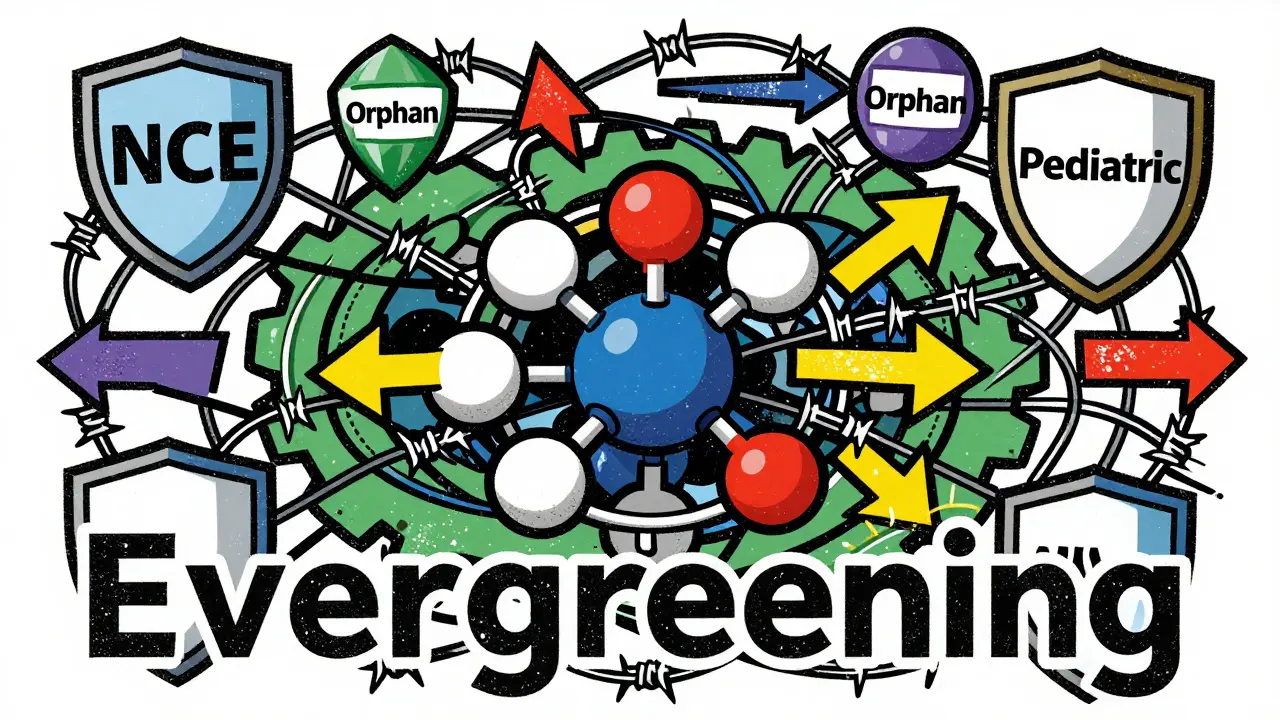
If the clock is always running, what do pharma companies do? They try to slow it down or reset it through a strategy known as evergreening is the practice of obtaining secondary patents on minor modifications of a drug to extend market exclusivity beyond the original patent expiration.
A study by the R Street Institute examined 432 drugs approved between 1985 and 2005. They found that secondary patents-filed after the initial drug approval-were extremely common. These patents might cover:
- A new formulation (e.g., changing from a pill to an extended-release capsule).
- A different delivery method (e.g., a patch instead of a liquid).
- A new medical indication (using the same drug to treat a different disease).
- Specific metabolites or isomers of the molecule.
The study revealed that higher-selling drugs were 37% more likely to obtain these secondary patents. By creating a "patent thicket"-a dense web of overlapping intellectual property rights-companies make it legally risky for generic manufacturers to enter the market. A Yale Law and Policy Review analysis noted that 91% of drugs with patent term extensions continued their monopolies well past the expiration of those extensions using these tactics.
The Patent Cliff: When the Music Stops
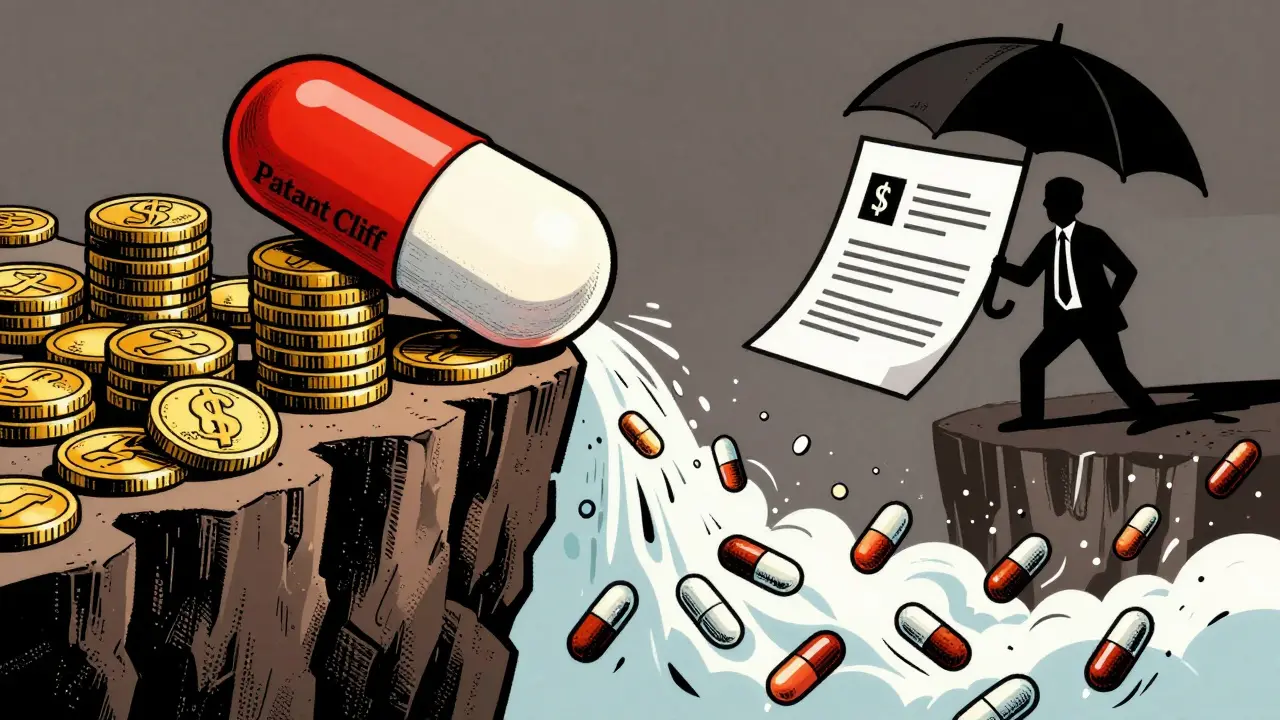
Eventually, the walls come down. The Patent Cliff is the sharp decline in sales revenue experienced by pharmaceutical companies when their blockbuster drugs lose patent protection and face generic competition is one of the most feared events in the industry. When a drug loses exclusivity, generic versions typically enter the market within days.
The economic impact is staggering. Generic drugs cost significantly less to produce because they skip the expensive R&D and clinical trial phases. As a result, the price of the medication often drops by 80-90% within the first year of generic entry. For a company relying on a single blockbuster drug, this can mean losing billions in annual revenue almost overnight.
Industry analysts at EY project that global sales of drugs facing patent expiration will reach $250 billion annually. This massive shift in revenue forces companies to constantly innovate, acquire new drugs, or aggressively litigate to delay the cliff's edge.
Global Variations in Protection
While the U.S. system is complex, other countries handle effective patent life differently. International agreements like TRIPS (Agreement on Trade-Related Aspects of Intellectual Property Rights) standardized the 20-year term globally, but local mechanisms vary.
- Canada: Uses a Certificate of Supplementary Protection (CSP), offering a maximum of 24 months of additional protection after patent expiration for new medicinal ingredients.
- Japan: Offers a Patent Term Extension (PTE) of up to 5 years to compensate for regulatory delays, similar to the U.S. model but with different calculation rules.
These differences create strategic challenges for multinational companies. A drug might be under patent protection in Japan but open to generics in Canada, leading to parallel import issues and varying pricing strategies across borders.
Why This Matters to You
You might wonder why effective patent life matters if you aren't a pharmaceutical executive. The answer lies in healthcare costs. The balance struck by the Hatch-Waxman Act is meant to ensure two things: that companies have enough time to recoup their $2.6 billion investment per drug, and that patients eventually gain access to affordable generics.
When companies successfully extend effective patent life through evergreening or litigation, generic entry is delayed. This keeps drug prices high for longer periods, impacting insurance premiums, government healthcare budgets, and individual out-of-pocket costs. Conversely, if effective patent life is too short, companies may argue there is insufficient incentive to invest in risky, innovative treatments for rare or difficult diseases.
Understanding the mechanics of patent life helps clarify the ongoing debates about drug pricing, the role of the FDA, and the future of medical innovation. It shows that the 20-year number on a patent certificate is just the starting point of a much more complex game.
What is the difference between nominal patent life and effective patent life?
Nominal patent life is the full 20-year term granted by law from the filing date. Effective patent life is the actual time a company can exclusively sell the drug after it receives regulatory approval. Because development takes 5-10 years, effective patent life is typically 10-15 years, not 20.
How does the Hatch-Waxman Act affect drug pricing?
The Hatch-Waxman Act allows for Patent Term Extension to compensate for time lost during FDA review, encouraging innovation. However, it also creates a streamlined pathway for generic manufacturers to challenge patents, which ultimately drives down prices once exclusivity ends.
What is the "Patent Cliff"?
The Patent Cliff refers to the sudden drop in sales revenue for a pharmaceutical company when a major drug loses its patent protection and generic competitors enter the market. Prices often fall by 80-90% within the first year.
Can a patent be extended indefinitely?
No. Federal law caps Patent Term Extension at five years, and the total effective patent life after FDA approval cannot exceed 14 years. Companies cannot extend the core patent itself, though they may file secondary patents for new formulations.
What is evergreening in pharmaceuticals?
Evergreening is a strategy where companies file new patents for minor changes to an existing drug, such as a new dosage form or delivery method, to extend market exclusivity beyond the expiration of the original patent.