
Atopic dermatitis isn’t just dry skin. It’s a constant battle-itching that keeps you up at night, red patches that flare for no obvious reason, and the exhausting cycle of scratching that makes everything worse. If you or someone you care about has this condition, you’ve probably tried everything: creams, steroids, special soaps, even dietary changes. But here’s the truth most people miss: emollient therapy isn’t just another treatment. It’s the foundation. Without it, nothing else works as well.
Why Your Skin Keeps Flaring Up
Atopic dermatitis happens because your skin’s natural barrier is broken. Think of it like a brick wall where the mortar (the proteins and lipids holding skin cells together) is crumbling. That lets moisture escape and irritants, bacteria, and allergens sneak in. One major reason? Mutations in the filaggrin gene. Around 15% to 50% of people with moderate to severe eczema have this. It’s not your fault. It’s biology.Once that barrier is down, your skin loses water fast-up to 30 grams per square meter per hour, compared to just 5-10 in healthy skin. That’s why your skin feels tight, rough, and always thirsty. But what makes it flare? It’s not one thing. It’s a mix.
Cold, dry air is a big one. When humidity drops below 40%, flares jump by 37%. That’s why winter is brutal for so many. Heat is just as bad. Sweat at temperatures above 80°F (27°C) irritates the skin and triggers itching in nearly 7 out of 10 patients. You don’t need to be sweating hard-just a little warmth can do it.
Then there are the sneaky irritants. Sodium lauryl sulfate, found in cheap soaps and shampoos, can wreck your skin barrier at concentrations as low as 0.5%. Fragrances? They trigger flares in 15% of people, even if labeled "natural." Preservatives like methylisothiazolinone cause contact dermatitis in nearly 6% of users. And don’t assume "hypoallergenic" means safe-those terms aren’t regulated.
Stress, dust mites, pet dander, even certain fabrics like wool can all push your skin over the edge. But here’s the key: it’s rarely just one trigger. It’s the combo. A cold day, a new laundry detergent, and a bad night’s sleep? That’s the perfect storm.
What Emollient Therapy Actually Does
Emollients aren’t moisturizers in the way you think. They’re barrier repair tools. They don’t just add water-they seal it in and rebuild the wall.There are three types of ingredients that make emollients work:
- Occlusives like petrolatum (Vaseline) form a physical shield. They reduce water loss by up to 98%. That’s why it’s the top choice for severe flares-especially on cracked hands or legs.
- Humectants like glycerin pull water from deeper layers of skin and the air. The sweet spot? 40-50% concentration. Too little, and it doesn’t help. Too much, and it can dry your skin out.
- Emollients like ceramides, cholesterol, and fatty acids replace what’s missing in your skin’s barrier. Ceramides are especially critical. People with eczema often have 30% less of them. Products with 0.5-3% ceramides help rebuild the wall from the inside out.
When used together, these ingredients can cut transepidermal water loss by 25-50%. That’s not a small win. It’s the difference between constant itching and a few hours of relief.
But here’s the catch: emollients alone clear mild eczema in only 30-40% of cases. They’re not a cure. They’re maintenance. When you combine them with low-dose topical steroids during flares, clearance jumps to 70-80%. That’s why dermatologists say emollients are the base-and everything else is built on top.
The Right Way to Apply Emollients
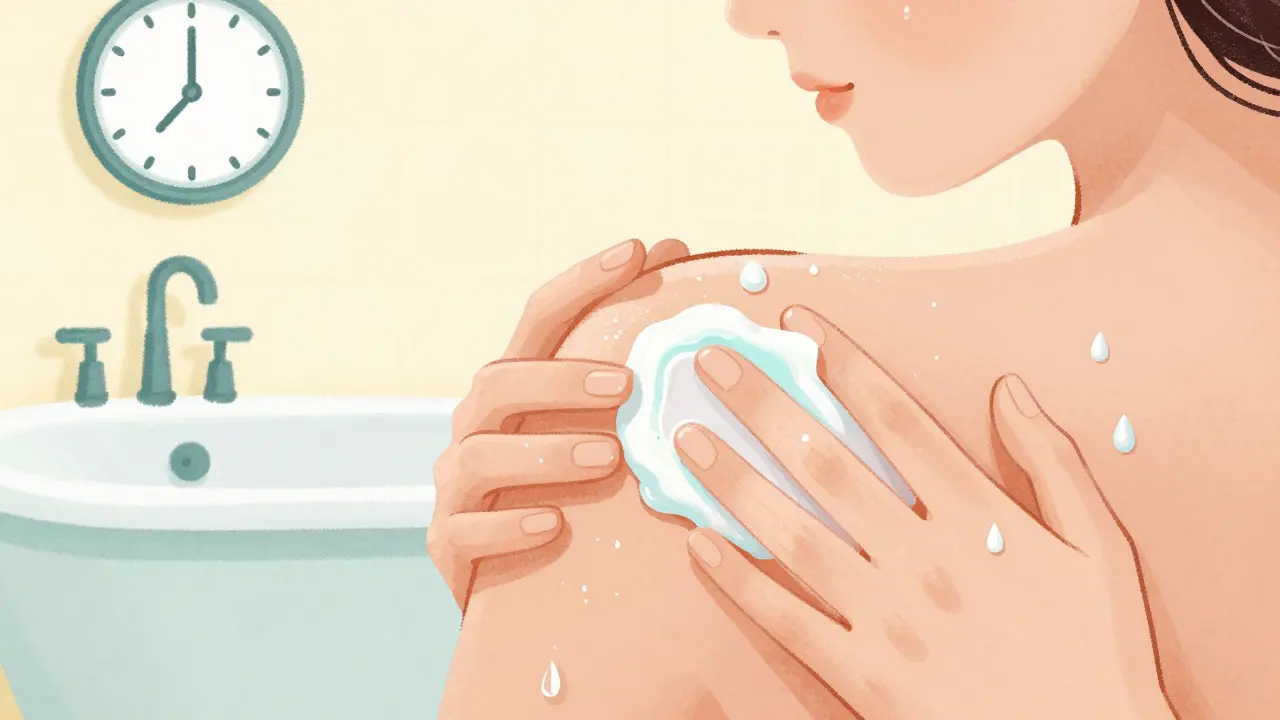
Most people apply emollients wrong. And that’s why they think they don’t work.Dr. Amy Paller from Northwestern University says the most important rule: apply within 3 minutes of getting out of the bath. That’s when your skin is still damp. Locking in moisture then traps up to 50% more water than waiting 10 minutes. This is called the "soak and seal" method.
Here’s how to do it right:
- Take a 15-20 minute lukewarm bath (not hot). Avoid bubble baths or scented oils.
- Pat your skin dry-don’t rub. Leave it slightly damp.
- Apply a thick layer of emollient all over, even on areas that look okay. Don’t skip spots.
- Use downward strokes, following hair growth. Rubbing upward can irritate follicles.
- Use 2-3 finger units (the amount from the tip to the first joint) for each body part-like one arm, one leg, the face.
Apply twice daily. Morning and night. Even if your skin looks fine. That’s how you prevent flares.
How much should you use? The American Academy of Dermatology recommends 250-500 grams per week for adults. That’s about 3-6 tablespoons daily. For kids, it’s double that. Most people use less than half that. No wonder they don’t see results.
What Products Actually Work
There are hundreds of emollients on the shelf. But not all are equal.Based on patient surveys and clinical data, here’s what works best:
- Petrolatum (Vaseline): Best for severe dryness. Cheap ($8-12 per tub), highly effective, and fragrance-free. 63% of Reddit users with eczema swear by it.
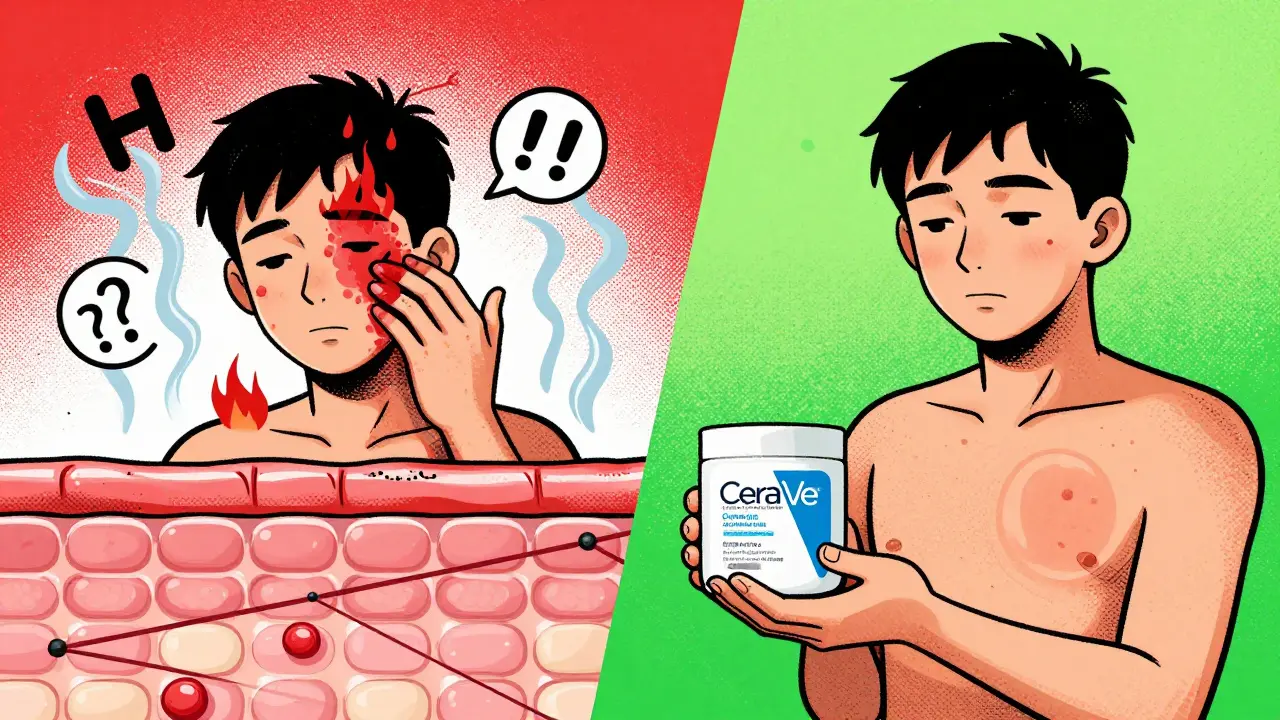
- CeraVe: Contains ceramides, cholesterol, and hyaluronic acid. 68% satisfaction rate in patient surveys. Less greasy than petrolatum, so easier for daily use.
- Eucerin Advanced Repair: Good for mild to moderate cases. Contains urea, which helps exfoliate dead skin. But 42% of users say it feels sticky.
- La Roche-Posay Lipikar: Popular in Europe. Contains niacinamide and shea butter. Good for sensitive skin.
Avoid products with alcohol, fragrances, dyes, or preservatives like parabens and methylisothiazolinone. Check the ingredient list. If you see "parfum" or "fragrance," skip it.
Cost matters. Ceramide-rich products cost $15-20 per tube. Petrolatum is $8. Many patients quit because of price. But here’s the truth: you don’t need the most expensive one. You need the one you’ll use consistently.
Why People Stop Using Emollients
Here’s the ugly truth: 30% of people stop using emollients within six months. Why?Three big reasons:
- It feels greasy. Especially petrolatum. People don’t want to wear it to work or bed.
- It takes too long. Applying 5-6 tablespoons twice a day feels like a chore. Especially with kids.
- They don’t see instant results. Unlike steroids that calm redness in days, emollients take weeks. People give up before they work.
But here’s what the data shows: patients who use over 100 grams per week have 43% fewer flares than those using less than 50 grams. That’s not a myth. That’s science.
One case study followed a 7-year-old with 18 flares a year. After switching to daily CeraVe and the soak-and-seal method, flares dropped to 3. That’s not luck. That’s consistency.
When Emollients Aren’t Enough
Emollients are essential-but they’re not always enough. If your eczema is moderate to severe, you’ll likely need more.Topical steroids are the next step. They reduce inflammation fast. But they’re not for long-term use on the face or folds. That’s where calcineurin inhibitors like tacrolimus come in. They’re steroid-free and safe for sensitive areas.
For stubborn cases, biologics like dupilumab (Dupixent) can reduce flares by 70-80%. But they’re expensive and require injections. Emollients still play a role here-without them, even biologics work less well.
And there’s a new threat: "emollient resistance." Some patients with chronic eczema develop thick Staphylococcus aureus colonies on their skin. This bacteria thrives in dry, broken skin and makes flares harder to control. In these cases, bleach baths or antibiotics may be needed alongside emollients.
What’s Next for Emollient Therapy
The field is evolving. In May 2023, the FDA approved the first emollient with sustained-release ceramides. It keeps working for 12 hours-far longer than traditional formulas. That’s a game-changer for people who can’t reapply during the day.Researchers are also testing "smart" emollient dispensers that track how much you use and send reminders to your phone. Pilot programs are already running at major hospitals.
And then there’s the microbiome. Scientists are developing emollients that don’t just repair skin-they feed the good bacteria on your skin to crowd out the bad ones. These are still in trials, but early results are promising.
One thing won’t change: emollients will remain the first line of defense. No matter how advanced treatments get, the broken skin barrier is still the root cause. Repair that, and everything else has a chance to work.
Final Takeaway: It’s Not About Perfection
You don’t need to use the most expensive cream. You don’t need to apply it perfectly every single day. But you do need to make it a habit.Start small. Pick one emollient that doesn’t feel awful to use. Apply it after your next shower-right after you pat dry. Do it for 14 days. No exceptions. Then check your skin. You might be surprised.
Atopic dermatitis isn’t curable. But it’s manageable. And the most powerful tool you have? It’s not a prescription. It’s a tub of cream-and the discipline to use it.
13 Comments
Colin PierceJanuary 28, 2026 AT 10:35
Been dealing with eczema since I was a kid, and this is the first time someone actually explained why emollients aren’t just "moisturizers." The barrier repair thing clicks now. I used to think Vaseline was gross until I tried it after a shower-holy crap, my skin stopped screaming. No more 3 a.m. scratching sessions.
Also, the 3-minute rule? Game changer. I used to wait till I was half-dry. No wonder nothing worked.
Kevin KennettJanuary 30, 2026 AT 01:38
Let me cut through the noise-this post is 100% correct. People waste thousands on fancy creams while ignoring the simplest, cheapest fix: petrolatum. I used to buy all those "dermatologist-recommended" brands until I realized they’re just Vaseline with a fancy label and 5x the price.
And don’t get me started on "hypoallergenic"-that’s a marketing scam. Check the ingredients. If it says "fragrance," burn it. Even "natural" fragrances wreck your barrier. Simple as that.
Jess BevisJanuary 30, 2026 AT 06:21
Soak and seal. Twice daily. 250g/week. Done.
Howard EsakovJanuary 30, 2026 AT 23:19
Wow. Finally, someone who gets it. 😎 I’ve been using CeraVe for a year now-$18, but worth every penny. Compared to the $60 "luxury" creams I tried? Total waste. And yes, I track my usage like a nerd. 4.2 tablespoons a day. No excuses.
Also, if you’re not using ceramides, you’re just slathering oil on a broken dam. 🤦♂️
Kathy ScamanFebruary 1, 2026 AT 06:54
OMG YES. I thought I was the only one who felt like applying emollient was a full-time job. I have a 4-year-old with eczema and I’m basically a pharmacist, nurse, and emotional support parent. But honestly? Since we started the soak-and-seal thing, her flares dropped like a rock. I still hate the greasy feeling though 😅
Anna Lou ChenFebruary 2, 2026 AT 13:45
Ah, the Western medical paradigm’s latest fetish: lipid-replacement therapy. But let’s interrogate the ontology of skin barrier dysfunction. Is the rupture truly structural-or is it an epiphenomenon of systemic inflammation, microbiome dysbiosis, and neoliberal alienation from ancestral epidermal rituals?
You speak of ceramides as if they’re divine artifacts. But what of the ancestral oils? Fermented rice bran? Bone marrow? The colonized body has forgotten its own wisdom. Emollients are Band-Aids on a wound caused by capitalism.
Also, Vaseline? Petrochemical colonialism in a tub.
Lance LongFebruary 4, 2026 AT 08:24
Hey, I know how hard this is. I’ve been there-applied cream, felt gross, gave up, felt guilty, cried, tried again. You’re not lazy. You’re not failing. You’re just human.
Start with one application. Just after your next shower. Don’t think about the rest. Just that one. If you do it for 7 days, you’ll start noticing your skin feels… calmer. Not perfect. Just calmer. And that’s enough to keep going.
You’ve got this. I believe in you.
fiona vazFebruary 6, 2026 AT 02:50
Thank you for this. I’ve been using Eucerin for months but never knew I was applying it wrong. I was rubbing it in like I was buffing a car. Now I pat dry and smear it on with slow strokes. My arms haven’t felt this soft in years.
Also, the 250g/week stat blew my mind. I was using maybe 60g. No wonder I thought it didn’t work.
Sue LathamFebruary 7, 2026 AT 12:18
Ugh. I tried CeraVe. It felt like I was slathering glue on my face. And don’t even get me started on Vaseline-like, are we back in 1998? I have a 30-year-old career, I don’t want to look like I’m wearing a grease mask to my Zoom meetings.
There are better options. I use that French one-La Roche-Posay. It’s light, smells nice, and doesn’t make me look like a greasy alien. Honestly, if you’re using Vaseline, you’re not trying hard enough.
John RoseFebruary 8, 2026 AT 21:23
Interesting data. I’m curious-what’s the clinical evidence for the 98% reduction in transepidermal water loss with petrolatum? Is that from in vivo studies or in vitro models? And are the ceramide concentrations in commercial products standardized across brands, or is there significant variability in bioavailability?
Also, the 3-minute window-is that empirically validated or anecdotal? Would appreciate references.
Lexi KaruzisFebruary 9, 2026 AT 13:40
WAIT. WAIT. WAIT. Did you know that Vaseline is made from petroleum? And petroleum is linked to cancer? And the FDA doesn’t regulate "emollients" like drugs? So they can put ANYTHING in there? And what if the ceramides are synthetic? And what if they’re made in China? And what if they’re contaminated with heavy metals? And what if your skin absorbs them and they go to your brain? And what if your kid’s eczema is caused by 5G radiation and this is all a distraction from the real enemy?!!??
Mark AlanFebruary 11, 2026 AT 06:57
USA BEST EMOLLENT THERAPY 🇺🇸🔥
Other countries? They use goat milk and dirt. We use science. CeraVe? Made in America. Petrolatum? American innovation. Soak and seal? Invented by a dermatologist in Ohio. Don’t let the Europeans fool you. We got this. 🇺🇸💪 #EczemaWarrior #AmericaFirstSkin
matthew martinFebruary 12, 2026 AT 15:12
I used to think emollients were just for old people with dry legs. Then I got my first flare at 28 and realized my skin was basically a desert with a screaming alarm system.
Switched to Vaseline after a Reddit thread (yes, really) and now I keep a tub by my bed, my desk, my car. I even brought it on vacation. My partner makes fun of me, but now she’s using it too. We call it "the balm of the gods."
And yeah, it’s greasy. So what? I’d rather be greasy and not itching than shiny and screaming at 3 a.m.
Also-don’t skip the feet. I didn’t for a year. Big mistake. Cracked heels are the worst kind of pain.