
You might think that once a pharmaceutical company gets a patent for a new drug, they have a free pass to sell it without competition. But in the real world of medicine, it’s not that simple. In fact, you can have a patent and still face generic competition sooner than expected-or worse, you can have no patent at all and still block competitors from entering the market. This confusion costs companies millions and leaves patients waiting longer for affordable options.
The core issue lies in the difference between patent exclusivity and market exclusivity. These two legal shields operate on completely different tracks, governed by different agencies, and enforced through different mechanisms. Understanding this split is crucial for anyone involved in drug development, regulatory affairs, or even just trying to understand why your medication costs what it does.
Two Different Keys to the Same Door
To grasp the distinction, imagine a house with two locks on the front door. One lock is controlled by the homeowner (the patent), and the other is controlled by the building manager (the regulator). To get inside, you need to bypass both locks. If either one remains locked, you cannot enter.
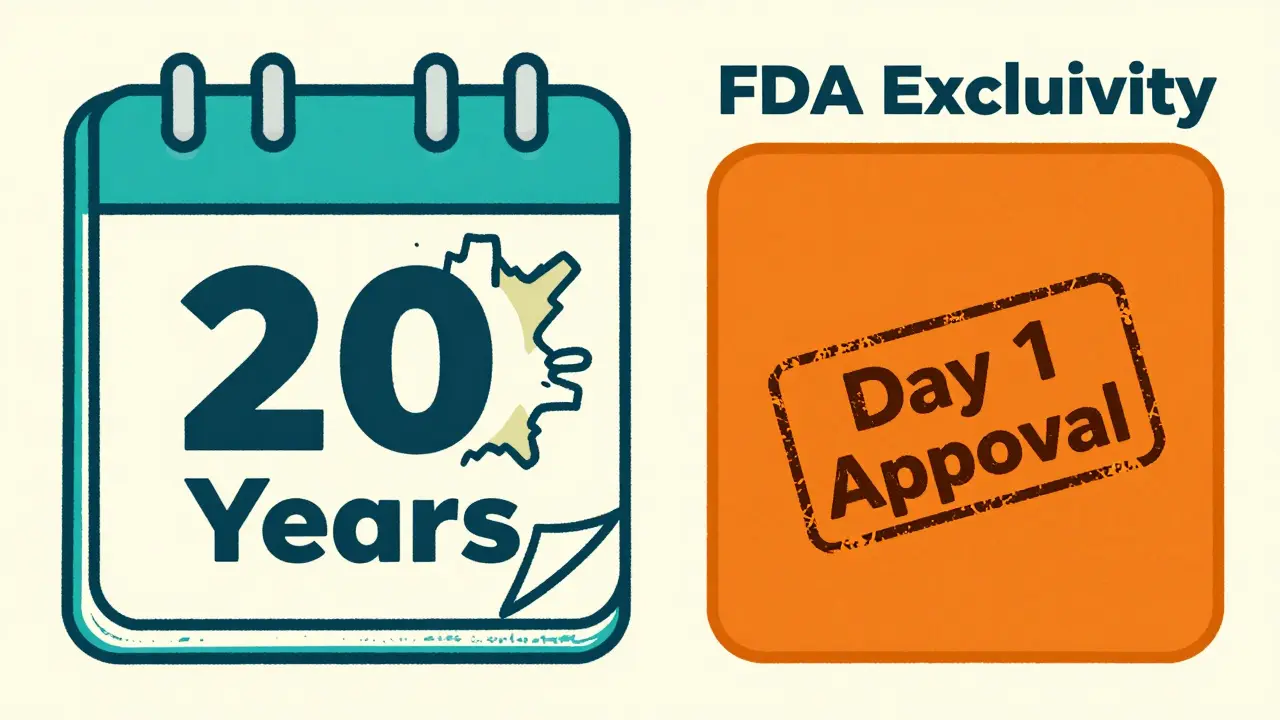
Patent exclusivity is a property right granted by the United States Patent and Trademark Office (USPTO) that allows the inventor to exclude others from making, using, or selling the invention. It is based on the idea that if you invent something new, you deserve a temporary monopoly to recoup your investment. Under current law, specifically the America Invents Act, a standard utility patent lasts for 20 years from the date you file the application.
Market exclusivity, on the other hand, is a regulatory privilege granted by the Food and Drug Administration (FDA) that prevents the agency from approving competing products for a specific period. This isn't about who invented the molecule; it's about who provided the clinical data proving the drug is safe and effective. The FDA actively enforces this. They literally will not accept an application for a generic version until the exclusivity period expires.
The critical difference? Patents are passive. If someone infringes on your patent, you have to sue them. Market exclusivity is active. The FDA blocks the competitor automatically. You don't have to lift a finger to enforce market exclusivity; the government does it for you.
How Long Does Each Protection Last?
Time is money in pharma, but the clocks tick differently for these two protections. A common misconception is that a 20-year patent means 20 years of sales protection. That is rarely true because drug development takes forever.
| Protection Type | Governing Body | Standard Duration | Key Limitations/Extensions |
|---|---|---|---|
| Patent Exclusivity | USPTO | 20 years from filing | Actual market life often only 10-12 years due to development time. Can be extended via Patent Term Extension (PTE) up to 5 years, max 14 years post-approval. |
| New Chemical Entity (NCE) Exclusivity | FDA | 5 years | Prevents FDA from accepting Abbreviated New Drug Applications (ANDAs). Shortens to 4 years if a Paragraph IV challenge is filed. |
| Orphan Drug Exclusivity | FDA | 7 years | Applies to drugs treating rare diseases (<200,000 patients in US). Independent of patent status. |
| Biologic Product Exclusivity | FDA | 12 years | Governed by the Biologics Price Competition and Innovation Act (BPCIA). Prevents biosimilar approval. |
| Pediatric Exclusivity | FDA | 6 months | Added to existing patent or exclusivity periods if pediatric studies are completed per FDA request. |
Let’s break down why the patent clock is tricky. Most small-molecule drugs take 10 to 15 years to go from lab bench to FDA approval. If you file a patent at year zero, by the time the drug launches at year 12, you only have 8 years of patent life left. That’s why companies fight hard for Patent Term Extension (PTE), which can add back some of that lost time, capped at a maximum of 5 additional years.
Market exclusivity periods are more rigid but often more valuable because they start upon approval. For example, if you develop a brand-new molecule (a New Chemical Entity), you get 5 years of NCE exclusivity. During those 5 years, the FDA cannot even *accept* an application for a generic copy. Even if the generic company has done all their work and is ready to launch, they must wait. If they try to challenge your patent early (a Paragraph IV certification), the clock drops to 4 years, but the barrier remains high.
What Exactly Is Protected?
This is where things get technical. Patents protect specific inventions. Market exclusivity protects the approved drug product.
A patent might cover the chemical composition of the drug itself (composition of matter). It might also cover how the drug is made (process patent), how it is formulated into a tablet (formulation patent), or even a new way to use the old drug (method of use patent). These are called secondary patents. Generic manufacturers often target these weaker secondary patents rather than the primary composition patent.
Market exclusivity, however, is broader in its immediate effect. It doesn't care about the nuances of the formulation. If you have 5 years of NCE exclusivity, the FDA won't approve *any* generic version of that specific drug indication during that window, regardless of whether the generic maker has a slightly different manufacturing process. The protection is tied to the clinical data you submitted to prove safety and efficacy.
Consider the case of colchicine. This is an ancient drug used to treat gout. There were no valid patents protecting it because it was known for centuries. However, Mutual Pharmaceutical Company reformulated it and submitted new clinical data. Because they provided new data, they received 3 years of regulatory exclusivity under the FDCA. Even though there was no patent, generics couldn't enter the market for those three years. This allowed the price to skyrocket from pennies to dollars per pill. This illustrates that regulatory exclusivity can function as a de facto patent for non-patentable products.
Who Enforces What?
The enforcement mechanism is the biggest practical difference for companies.
If you hold a patent, you are responsible for policing it. If a competitor launches a generic before your patent expires, you must file a lawsuit in federal court. This is expensive, slow, and uncertain. You might win, or you might lose if the judge decides your patent is invalid. According to industry data, the average cost for a generic manufacturer to challenge a patent via a Paragraph IV certification is around $8.3 million. For the brand owner, defending the patent costs millions more.
With market exclusivity, the FDA is your enforcer. When a generic company files an Abbreviated New Drug Application (ANDA), they must certify against any listed patents and exclusivities. If they claim that the patent is invalid or won't be infringed, they trigger a 30-month stay while litigation plays out. But if they simply try to launch after the patent expires but *before* the market exclusivity expires, the FDA will reject the application outright. No court battle needed. The FDA’s database, the Orange Book, lists both patents and exclusivity periods, creating a clear roadmap for when competition is legally blocked.
Strategic Implications for Pharma Companies
For innovators, the goal is to layer these protections. You want strong composition-of-matter patents *plus* every available type of market exclusivity. This creates a "moat" that is very hard for generics to cross.
However, many small biotech companies rely heavily on market exclusivity because getting strong patents is difficult, especially for biologics or complex formulations. The Biotechnology Innovation Organization (BIO) reports that 73% of small biotechs rely primarily on regulatory exclusivity for their lead products. This makes sense because biologics are too complex to reverse-engineer easily, so the 12-year exclusivity under the BPCIA provides robust protection without needing perfect patents.
For generic manufacturers, the strategy is the opposite. They look for gaps. They analyze the Orange Book to find drugs where the patent has expired but exclusivity remains, or vice versa. They also look for opportunities to challenge weak secondary patents. Winning a Paragraph IV challenge grants the first generic applicant 180 days of *their own* market exclusivity-a massive financial incentive worth hundreds of millions of dollars.
A major pitfall for innovators is failing to claim all available exclusivities. Data from Scendea Consulting shows that 22% of innovator companies failed to properly claim all available regulatory exclusivities between 2018 and 2022, leaving an average of 1.3 years of potential protection unclaimed. This is a costly error. Regulatory specialists spend 120-150 hours per application ensuring these claims are correct, but mistakes happen.
Common Misconceptions
One persistent myth is that "no patent means open season." As the colchicine example shows, this is false. Regulatory exclusivity can block generics even in the absence of patents. Conversely, having a patent does not guarantee market dominance if the patent is weak or if the FDA rejects the exclusivity claim due to insufficient data submission.
Another misconception is that these periods run sequentially. They usually run concurrently. If you have a patent expiring in 2030 and 5 years of NCE exclusivity expiring in 2029, the generic entry is blocked until 2030 (when the last protection falls away). The strongest protection wins.
Looking Ahead: Changes in the Landscape
The rules aren't static. The FDA launched an Exclusivity Dashboard in September 2023 to increase transparency, allowing generic companies to track expiration dates in real-time. This intensifies competition as generics prepare to launch the moment a window opens.
Legislative changes are also on the horizon. The PREVAIL Act of 2023 proposes reducing biologics exclusivity from 12 to 10 years, aiming to lower prices for insulin and other high-cost treatments. Meanwhile, global debates over TRIPS waivers, sparked by the pandemic, continue to influence how countries balance intellectual property rights with public health access.
By 2027, analysts predict that regulatory exclusivity will account for 52% of total market protection time for new drugs, up from 41% in 2020. This shift highlights the growing importance of understanding FDA regulations alongside traditional IP law.
Can a drug have market exclusivity without a patent?
Yes. Market exclusivity is granted by the FDA based on the submission of new clinical data, regardless of patent status. For example, orphan drugs receive 7 years of exclusivity even if the underlying compound is not patented. Similarly, reformulated versions of old drugs can gain exclusivity if new safety or efficacy data is provided.
What happens when patent exclusivity expires but market exclusivity remains?
The FDA will still refuse to approve generic applications. Market exclusivity acts as a regulatory bar. Even if the patent is expired or invalidated, the FDA cannot approve a competing product until the exclusivity period ends. This is why regulatory exclusivity is often considered more powerful for blocking immediate generic entry.
How long does New Chemical Entity (NCE) exclusivity last?
NCE exclusivity lasts for 5 years from the date of FDA approval. However, if a generic manufacturer files a Paragraph IV certification challenging the brand's patents, the period is reduced to 4 years. This incentivizes early challenges by generic companies.
Who enforces patent exclusivity versus market exclusivity?
Patent exclusivity is enforced by the patent holder through civil lawsuits in federal court. Market exclusivity is enforced by the FDA administratively. The FDA reviews ANDA submissions and rejects them if they violate exclusivity periods, without requiring litigation.
What is the difference between data exclusivity and market exclusivity?
While often used interchangeably, data exclusivity refers to the prohibition on relying on the innovator's clinical data for approval, while market exclusivity refers to the prohibition on approving the competing product itself. In the U.S., these concepts are bundled together in periods like NCE exclusivity, but they are distinct legal concepts rooted in the Hatch-Waxman Act.