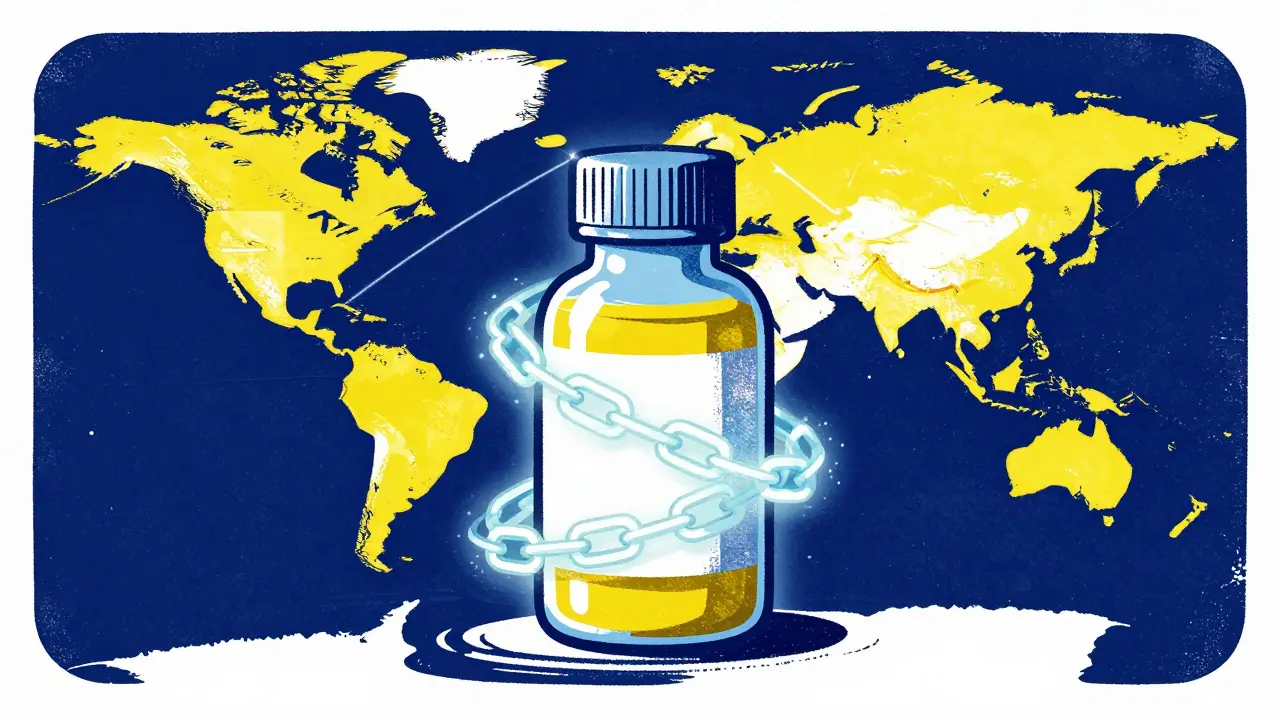
Fake medicines aren't just a logistical headache; they are a global crisis. With counterfeit drugs costing the world roughly $200 billion annually, the stakes for patients using generic medications are incredibly high. How do you actually know that the pill in your hand is the medicine it claims to be? Traditional security like holograms and fancy inks are easy for sophisticated criminals to copy. That's where blockchain for drug verification is a decentralized digital ledger technology that creates an immutable record of a drug's journey from the factory to the patient. By replacing trust in a piece of packaging with trust in cryptography, we're seeing a shift toward a future where generic authenticity is guaranteed.
The Death of the Counterfeit Pill
For decades, we relied on physical markers to spot fakes. But INTERPOL data shows that holograms and color-shifting inks-still used by nearly half of pharmaceutical companies-have a replication rate of about 38%. In other words, the "security" is often an illusion. Blockchain is different because it doesn't just protect the box; it tracks the data. Each individual package of medicine is assigned a unique serial number following GS1 standards. This creates a digital pedigree-a birth certificate for your medicine.
Every time a shipment moves from a manufacturer to a distributor, and then to a pharmacy, that transaction is recorded. Because the ledger is immutable, no one can go back and "erase" a batch of fake drugs or inject them into the system without a valid origin. In the FDA's 2022 pilot project, this method achieved a 99.8% verification accuracy, virtually eliminating the window for counterfeiters to operate. For a patient buying a generic version of a life-saving drug, this is the difference between recovery and tragedy.
How the Tech Actually Works in the Pharmacy
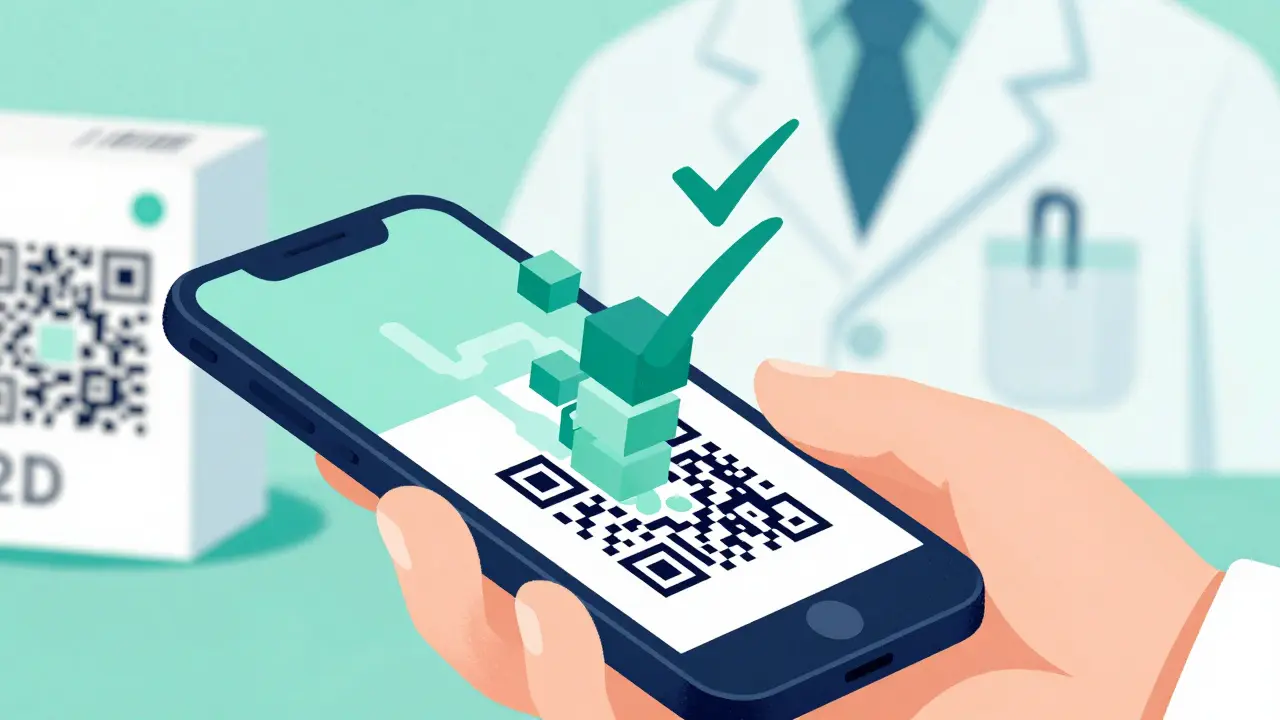
You don't need to be a computer scientist to use this. For the pharmacist, the process is as simple as scanning a 2D barcode or QR code. The mobile app doesn't just read the code; it pings a permissioned distributed ledger-usually built on Hyperledger Fabric or Ethereum Enterprise -to see if that specific serial number has a legitimate history. This entire check happens in under 2.3 seconds.
It's not just about spotting fakes, either. The efficiency gains are massive. According to HIMSS, this tech is helping US dispensers free up about $20 billion in safety stock inventory because they finally trust their supply chain. Pharmacists who've switched to systems like the MediLedger Project report that verification times for batches have plummeted from 15 minutes down to just 45 seconds. That's more time spent with patients and less time staring at shipping manifests.
| Feature | Traditional (Holograms/DBs) | Blockchain-Based |
|---|---|---|
| Counterfeit Replication Rate | ~38% | ~0.2% |
| Data Consistency | Vulnerable to single point of failure | 100% across all partners |
| Verification Speed | Manual/Slow | < 2.3 seconds |
| Initial Investment | Lower (~$1.7M for mid-size) | Higher (~$2.1M for mid-size) |
The Generic Drug Dilemma
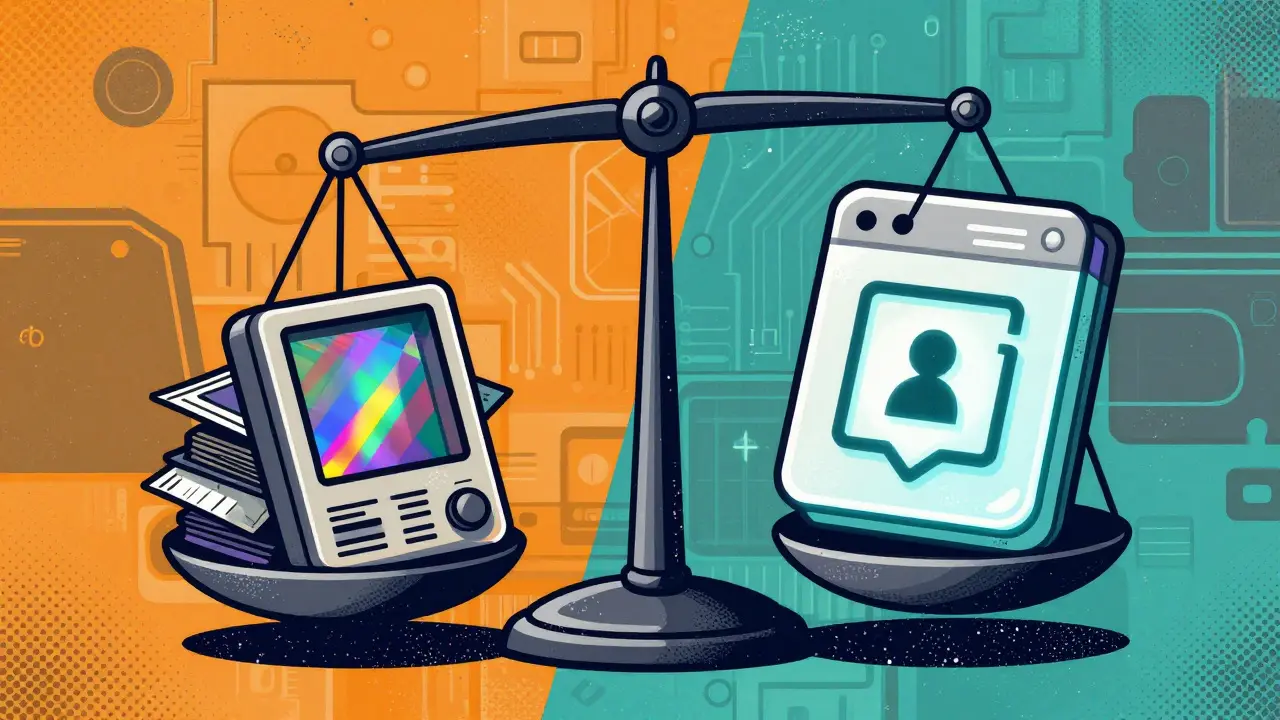
While big pharma is on board-with 89% of the top 50 companies running blockchain initiatives-generic manufacturers are struggling. For a high-cost branded drug, the cost of installing DSCSA-compliant serialization equipment (roughly $150,000 per line) is a rounding error. But for low-cost generics, these costs can eat up 12-15% of the product's total value.
This creates a weird gap in the market. If the cheapest generics can't afford the tech, they remain the prime targets for counterfeiters. This is why regulatory pressure is so key. The Drug Supply Chain Security Act (DSCSA) has been pushing for electronic, interoperable tracing. By 2030, experts predict that 95% of prescription drugs in developed markets will use this standard. It's moving from a "nice-to-have" to a legal requirement for doing business.
Real-World Wins and Rough Patches
We've seen this work in the wild. Apollo Hospitals in India implemented a blockchain-verified chain across 5,000 pharmacies and slashed counterfeit antimalarials by a staggering 94%. That's a concrete example of how tech saves lives in regions where counterfeit rates often exceed 30%.
But it hasn't all been smooth sailing. Blockchain is only as good as the internet connection. Pharmacists in rural areas have reported spotty connectivity that delays verification, turning a 2-second check into a frustrating wait. There's also the "physical gap." As Dr. Sarah Wynn-Williams from the LSE pointed out, blockchain tracks the documentation, not the liquid inside the bottle. If someone swaps the real medicine for salt water but keeps the original bottle and QR code, the blockchain still says "Authentic." To fix this, the industry is starting to pilot IoT sensors for temperature and humidity, and some are even looking at spectroscopy to verify the chemical composition of the drug.
Moving Toward a Trustless Future
The goal here is a "trustless" system. In the old world, you trusted the wholesaler because they had a reputable name. In the blockchain world, you don't need to trust the wholesaler-you trust the math. We are seeing the integration of AI to make this even stronger. New versions of verification software now use deep learning models to spot anomalies in shipping patterns, catching fakes that might have slipped through the cracks with a 98.7% accuracy rate.
For most of us, this will happen behind the scenes. You'll drop off your prescription, the pharmacist will scan a box, and the system will green-light the authenticity in a heartbeat. The transition is happening now, moving from the "hype" phase into actual productivity. While the initial cost is a hurdle for smaller players, the long-term ROI-measured in both dollars and lives saved-is too big to ignore.
Does blockchain actually prove the medicine is real?
It proves the provenance of the package. It confirms that the specific box you are holding came from a legitimate manufacturer and passed through authorized distributors. However, it doesn't analyze the chemical makeup of the drug itself; it verifies the digital history associated with the packaging.
Why is it so expensive for generic drug makers to adopt?
The cost is mainly in the hardware. Implementing DSCSA-compliant serialization equipment costs around $150,000 per production line. For low-margin generic drugs, this investment can represent up to 15% of the product's value, which is much harder to absorb than it is for expensive branded medications.
How long does it take for a pharmacy to set this up?
Typically, the technical integration with legacy ERP systems takes about 6 to 9 months. On the human side, staff training usually lasts about 6 to 8 weeks to ensure pharmacists can troubleshoot the mobile verification apps and handle connectivity issues.
Is blockchain too energy-intensive for healthcare?
Not in this case. Most pharmaceutical chains use "permissioned" blockchains (like Hyperledger) rather than public ones (like Bitcoin). These private networks consume about 97% less energy than public blockchains, making them sustainable for enterprise use.
What happens if the internet goes down in a pharmacy?
This is a known pain point, especially in rural areas. While some systems have offline caching, a total outage can delay verification. Regulatory bodies like the FDA acknowledge "break-the-glass" emergency scenarios where verification might be bypassed to ensure patients get urgent medication.
8 Comments
Robin WaltonApril 12, 2026 AT 09:11
It's honestly heart-wrenching to think about how many people end up taking fake meds without knowing. Really glad to see tech actually being used to save lives like this.
Rakesh TiwariApril 12, 2026 AT 14:21
Oh great, so we just trust a digital ledger now. I'm sure the pharmaceutical giants are just doing this for the 'good of humanity' and not to lock out smaller competitors who can't afford the gear. Truly inspiring stuff.
Victor ParkerApril 13, 2026 AT 13:08
Blockchain is just a way for them to track us better 🙄 once they have the data they can control who gets what and when. Wake up people!!
Doug DeMarcoApril 15, 2026 AT 05:48
Actually, the point about the 'physical gap' is where it gets interesting! Imagine combining this with some cool AI scanning to make sure the liquid is actually what it says it is. That'd be the real game changer! 🚀✨
Will GrayApril 16, 2026 AT 10:17
Typical. We're importing these 'global standards' while our own domestic supply chains are being eroded. If this isn't developed and owned exclusively by US interests, we're basically handing the keys to our healthcare security to whoever controls the nodes. It's a security nightmare waiting to happen.
emmanuel okaforApril 16, 2026 AT 21:26
nature is balance and maybe this tech helps but we must not forget that a pill is just a thing unless the heart is willing to heal it is just a tool
Emily WheelerApril 16, 2026 AT 22:25
I find it quite fascinating how we are evolving toward a system where the conceptualization of trust is shifted from a human entity to a mathematical certainty, and while the transition for generic manufacturers seems steep, perhaps there is a collaborative way to subsidize these costs so that the most vulnerable populations in developing nations aren't left behind in a digital divide that ironically exists to protect them from fraud, because if we truly want a global health victory, we have to ensure that the cost of authenticity doesn't become a barrier to accessibility for those who need low-cost generics the most, which would be a tragic irony in a system designed for safety.
Franklin AnthonyApril 18, 2026 AT 07:39
funny how the 'experts' say it's 99.8% accurate but they admit the liquid can be swapped for salt water so the accuracy is actually 0% if the bottle is a lie just another layer of corporate theater to keep us paying for high costs while they pretend to fix the problem they created by pricing everyone out of real meds in the first place