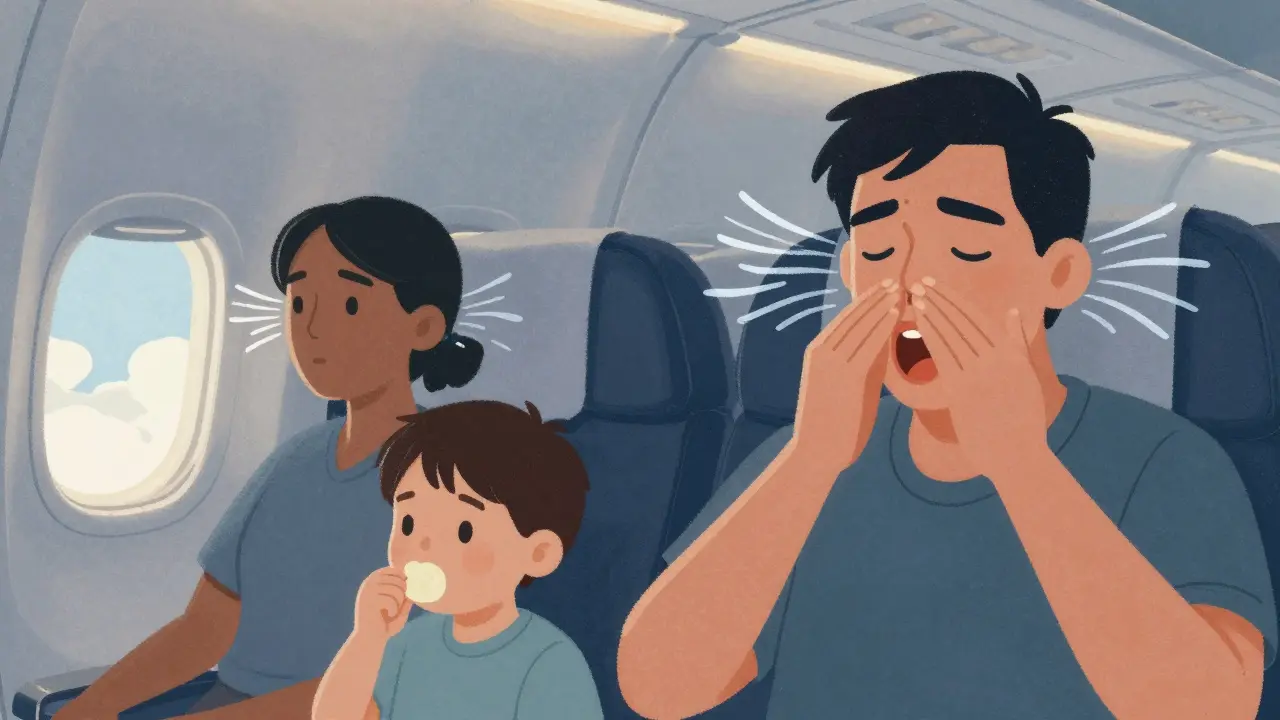
Most people don’t think about their ears until they hurt-especially when flying. If you’ve ever felt like your ears are stuffed with cotton, or experienced sharp pain during descent, you’re not alone. This isn’t just discomfort-it’s airplane ear, a real condition caused by pressure imbalance in the middle ear. And if you’ve got allergies, a cold, or chronic Eustachian tube issues, flying can turn into a nightmare. But it doesn’t have to be. With the right techniques and preparation, you can fly without pain-even if your ears are sensitive.
Why Your Ears Hurt When You Fly
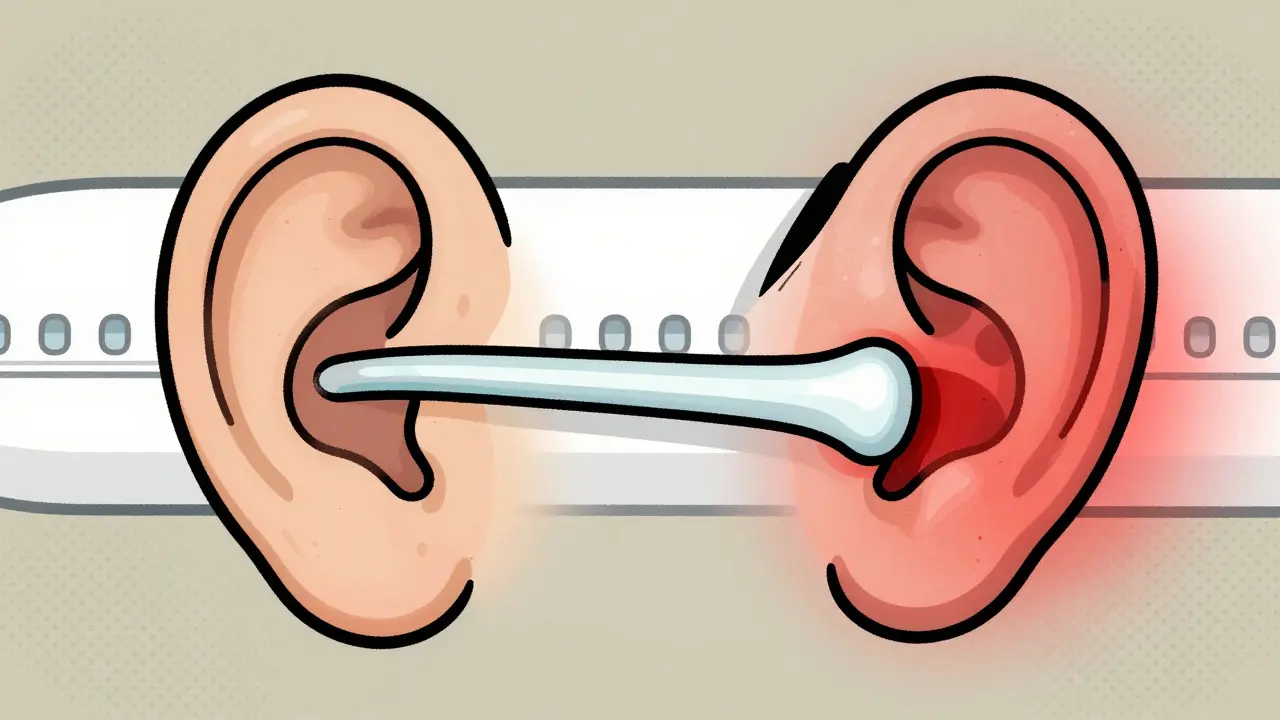
Your middle ear is a small air-filled space behind the eardrum. It’s connected to the back of your throat by a tiny tube called the Eustachian tube. This tube opens when you swallow, yawn, or chew, letting air flow in or out to balance pressure. On the ground, that’s easy. In a plane, things change fast. As the plane climbs, cabin pressure drops. Your middle ear pressure stays higher, so your eardrum bulges outward. During descent, the opposite happens: cabin pressure rises, pulling your eardrum inward. If the Eustachian tube can’t open fast enough, pressure builds up-sometimes to 40 mmHg. That’s enough to cause pain, muffled hearing, or even temporary hearing loss. Children are more vulnerable. Their Eustachian tubes are shorter (17-18mm vs. 35-38mm in adults) and more horizontal, making them harder to open. That’s why 22% of kids experience airplane ear, and up to 34% during allergy season. Adults aren’t immune either-10% report significant discomfort, and that number jumps if you’re congested.What Works: Proven Equalization Techniques
Not all methods are created equal. Some are safe for everyone. Others carry risks. Here’s what the data says.- Swallowing and yawning - The safest bet. Works for 65% of people. Try chewing gum, sucking on hard candy, or drinking water. Swallowing activates the muscles that open the Eustachian tube. Do this every 300-500 feet during descent.
- Toynbee maneuver - Pinch your nose shut and swallow. It’s safer than blowing, with a 68% success rate. Good for kids and adults who can’t force air. Works better if you’re already swallowing (like when drinking).
- Lowry technique - Combine swallowing and gentle blowing. Pinch your nose, swallow, and blow lightly at the same time. Success rate: 89%. But it takes practice. Most people need 3 flights to get it right.
- Voluntary Tubal Opening - This is advanced. You tense the soft palate and push your jaw forward to open the tube. It works for 92% of trained users-but takes 8-12 weeks of daily practice. Not for beginners.
Here’s what to avoid: the classic Valsalva maneuver (pinch nose, blow hard). It’s effective for 82% of people, but forces air into the middle ear. If you blow too hard, you risk damaging the inner ear. In fact, 27% of inner ear barotrauma cases treated by ENT specialists are linked to aggressive Valsalva. Gentle is key-think blowing through a straw, not a balloon.
Earplugs, Sprays, and Medications
There’s more than just swallowing. Products can help, but they’re not magic.- EarPlanes - These filtered earplugs slow pressure changes by 37%. They give your Eustachian tube more time to catch up. Studies show 76% effectiveness. But if you have chronic Eustachian tube dysfunction, success drops to 42%. Worth trying-$4.99 a pair.
- Nasal decongestant sprays (oxymetazoline) - Reduce swelling in the nasal passages by 63% in 10 minutes. Use 30-60 minutes before descent. Works for 85% of users. But don’t use for more than 3 days-rebound congestion is real. And avoid if you have high blood pressure.
- Oral decongestants (pseudoephedrine) - Lasts 8-12 hours. Good for long flights. But 12% of adults over 40 report increased heart rate or palpitations. Check with your doctor first.
- Nasal steroid sprays (fluticasone) - Newer research shows they reduce inflammation in the Eustachian tube by 61%. Use daily for 3-5 days before flying. Not for immediate relief, but great for frequent flyers with allergies.
For kids under 6, avoid decongestants entirely. The FDA has documented rare cases of rapid heart rate in young children. Instead, feed them during descent. Bottle-feeding triggers stronger swallowing than sipping from a cup-and improves equalization by 43%.
When to Start Equalizing (Timing Matters)
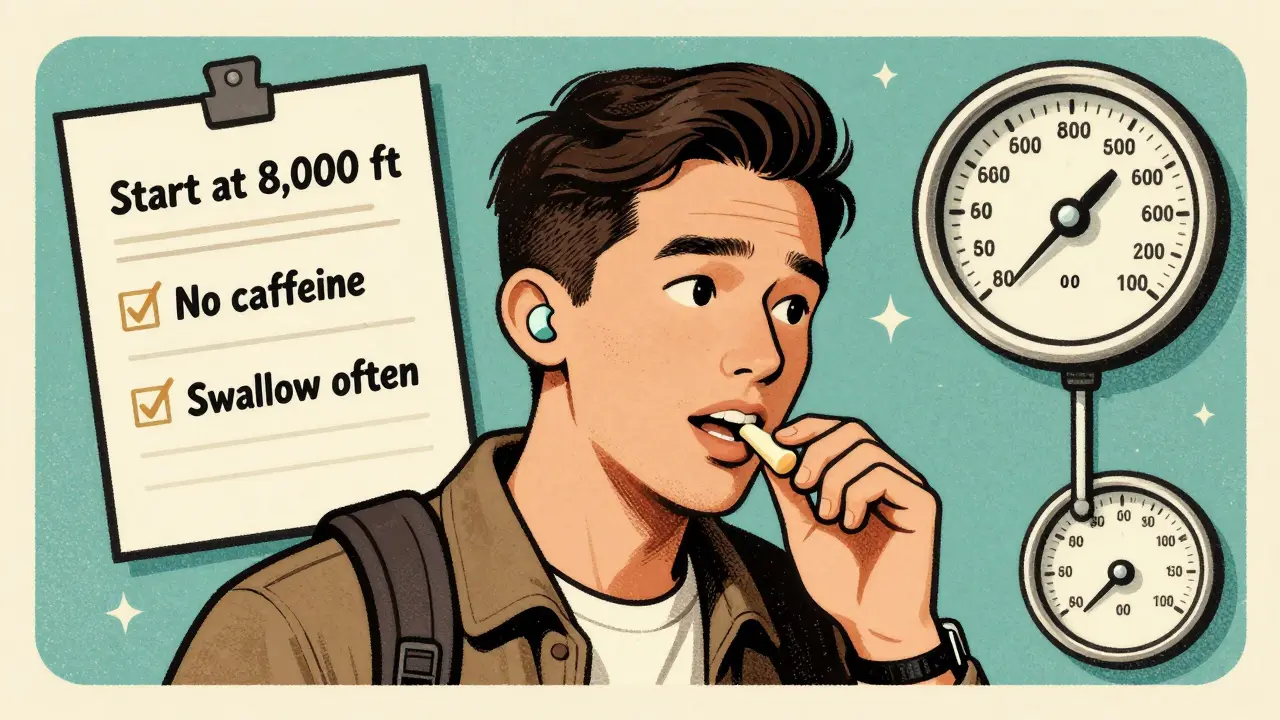
Waiting until your ears hurt is too late. By then, pressure has already built up. Start equalizing at 8,000 feet during descent. That’s when cabin pressure hits about 760 mmHg. Don’t wait for the plane to drop below 5,000 feet. The biggest pressure changes happen in the last 2,000 feet. Experts recommend doing swallowing or jaw movements every 300-500 feet. That’s about every 1-2 minutes during descent. For kids, keep them awake during descent. Sleep is the #1 reason kids get ear pain. If they’re asleep, they’re not swallowing. Keep them fed, distracted, or give them a pacifier. The jaw wiggle technique-moving the jaw side to side while swallowing-boosts success by 22% in children, according to SingHealth.What Doesn’t Work (And Why)
Some common advice is misleading-or dangerous.- Blowing your nose hard - This pushes mucus into the Eustachian tube, making blockage worse. Blow gently, one nostril at a time.
- Using cotton balls or regular earplugs - They don’t help. Only filtered earplugs like EarPlanes slow pressure change. Regular ones just block sound.
- Waiting until pain hits - 68% of people who suffer airplane ear say they waited too long. Prevention beats treatment.
- Drinking alcohol or caffeine before flying - Both dehydrate you. Dry nasal passages = harder to equalize.
One Reddit user summed it up: “I used EarPlanes + jaw wiggles + chewing gum. No pain on my last flight. I used to cry during descent.” That’s not anecdotal-it’s backed by data. Combining methods raises success rates to 91%.
When to See a Doctor
If you’ve had ear pain for more than a few hours after landing, or if you notice hearing loss, ringing, or dizziness, see an ENT specialist. These could be signs of barotrauma or a ruptured eardrum-rare, but serious. Chronic sufferers (those who have trouble equalizing on every flight) should consider advanced options:- Autoinflation devices like Otovent - A nasal balloon you inflate through one nostril. FDA-approved in 2022. Works for 88% of users in trials.
- Eustachian tube balloon dilation - A tiny balloon is inserted into the tube and inflated to widen it. 76% long-term success. Costs $3,800-$5,200 out-of-pocket in the U.S.
- Eustachian tube stents - Still in trials, but early results show 92% success. Could be available within 2-3 years.
Even airlines are adapting. Newer planes like the Boeing 787 keep cabin pressure at 6,000 feet instead of the old 8,000 feet. That’s a 25% reduction in pressure change. Delta Airlines now uses a gentler 3-degree descent angle instead of 3.5 degrees, slowing pressure shifts by 14%.
Quick Checklist for a Pain-Free Flight
- Start using nasal steroid spray 3-5 days before flying if you have allergies.
- Use a decongestant spray 30-60 minutes before descent (if you’re healthy and over 40).
- Bring gum, hard candy, or a bottle for kids.
- Wear EarPlanes during descent.
- Start swallowing or jaw movements at 8,000 feet-don’t wait.
- Keep kids awake during descent. Feed them. Wiggle their jaw.
- Avoid alcohol and caffeine before and during the flight.
- If you feel pressure building, do the Toynbee maneuver. Save Valsalva for last.
It’s not about avoiding flights. It’s about managing pressure like you manage your seatbelt or your phone-proactively, consistently, and with the right tools. Your ears will thank you.
Can I fly if I have an ear infection?
It’s not recommended. An active ear infection means your Eustachian tube is swollen and blocked. Flying can cause severe pain, fluid buildup, or even a ruptured eardrum. Wait until the infection clears and you’re no longer in pain. If you’re unsure, check with your doctor.
Do EarPlanes really work?
Yes, for most people. Studies show 76% effectiveness in reducing ear pressure discomfort. They work by slowing the rate of pressure change, giving your ears more time to adjust. But they’re less effective if you have chronic Eustachian tube dysfunction. They’re not a cure, but a helpful tool.
Why does my child cry during landing?
Children’s Eustachian tubes are smaller and more horizontal, making it harder to equalize pressure. If they’re asleep during descent, they’re not swallowing-which is how pressure gets balanced. Feeding them, giving a pacifier, or having them suck on a bottle during descent can reduce pain by 43%.
Is the Valsalva maneuver dangerous?
It can be. While it works for 82% of people, forcing air too hard can damage the inner ear. About 0.3% of attempts cause injury, and 27% of inner ear barotrauma cases in clinics are linked to aggressive Valsalva. Always use gentle pressure-like blowing through a straw. Try Toynbee or swallowing first.
Can I use decongestants if I have high blood pressure?
Avoid oral decongestants like pseudoephedrine if you have high blood pressure, heart disease, or thyroid issues. They can raise your heart rate and blood pressure. Nasal sprays like oxymetazoline are safer but should still be used sparingly and only before descent-not for more than 3 days.
8 Comments
Dorine AnthonyDecember 19, 2025 AT 01:33
Been flying with ear issues for years. EarPlanes + chewing gum changed everything. No more crying during descent. Seriously, try it. Life-changing.
William StorrsDecember 19, 2025 AT 11:59
Love this breakdown. So many people just suffer through it like it’s normal. You’re right-start equalizing at 8,000 feet. Waiting until it hurts is like waiting until your seatbelt snaps to check if it works. Proactive = pain-free.
James StearnsDecember 19, 2025 AT 23:47
While the practical advice herein is not without merit, one must consider the broader anthropological context of modern aviation physiology. The human middle ear, an evolutionary relic from terrestrial mammals, is fundamentally ill-equipped for rapid depressurization cycles inherent in jet travel. The normalization of such discomfort via consumer-grade earplugs and chewing gum represents not a solution, but a capitulation to systemic engineering inadequacies. One might argue for a return to slower, piston-driven aircraft-where cabin pressure gradients were less violent, and dignity was preserved.
William LiuDecember 20, 2025 AT 21:29
My 4-year-old used to scream on every flight. Now I give him a lollipop during descent and he’s fine. No drama. No tears. Just sugar and science. This post saved our family vacations.
Aadil MunshiDecember 21, 2025 AT 10:26
Wow, you really went full textbook on this. But let’s be real-90% of people just pop their ears by blowing too hard and call it a day. The fact that you listed 8 different techniques means you’ve never actually flown with a crying toddler. Also, why are you telling me about Otovent like it’s a secret? I’ve seen it in the CVS aisle next to the hemorrhoid cream. And yes, I’ve tried it. It’s just a balloon. You’re overcomplicating a 30-second fix.
Adrienne DaggDecember 22, 2025 AT 04:17
OMG YES. I used to hate flying until I found EarPlanes. Now I bring two pairs and one for my partner. Also, avoid coffee. I learned the hard way after a flight where I felt like my head was gonna explode 🤯
Monte PareekDecember 22, 2025 AT 09:50
Let me tell you something real. I’m a pilot and I’ve seen this over and over. People wait until they’re in pain then panic. That’s when they do the Valsalva like they’re inflating a tire. Bad idea. The Toynbee is quiet. It’s subtle. It’s elegant. And it works. I teach my passengers to do it as soon as we start descending. No yelling. No crying. Just swallowing like you’re sipping tea. And kids? Give them a bottle. Not a pacifier. A real bottle. The suction is stronger. It’s physics. And if you’re allergic? Start your steroid spray a week out. Not the day before. You’re not magic. Your body needs time. This isn’t a hack. It’s preparation. Treat your ears like your tires. Check them before you drive.
Elaine DouglassDecember 23, 2025 AT 13:42
I’ve had chronic ear issues since I was a kid and this is the first time I’ve read something that actually made sense. I’ve tried everything. The Lowry technique took me three flights to get right but now I do it automatically. No more pain. Thank you for writing this. I’m sharing it with my whole family.